All Saints’ Church, Cotgrave: A Twelfth-Century Church of England Parish Church


Site at a Glance
- Rating
- 4.1
- Popularity
- Very Low
- Country
- United Kingdom
- Primary era
- Medieval
- External website
- Open
- Eras represented
- Medieval, Modern
- Civilizations
- English
- Site type
- Religious
- Remains
- Church
On this page5 sections
History
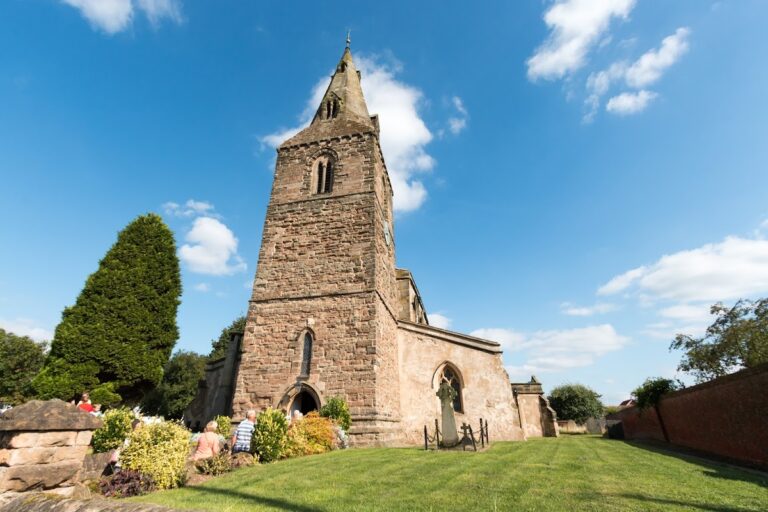
All Saints’ Church, Cotgrave, in the United Kingdom, is a Church of England parish church dating from the twelfth century. The Church of England is England’s established Anglican church. The church belongs to the Diocese of Southwell and Nottingham, within the Archdeaconry of Nottingham and the Deanery of East Bingham. It is a Grade I listed building, the highest level of statutory protection for buildings in England considered to have exceptional architectural or historic interest.
In 1637, during a plague outbreak, the church served as a village food store. Men who had confined themselves in the church received money through a hollowed-out stone filled with vinegar, a measure intended to disinfect it as it passed between them and the village. The stone remains inside the church.
The building was restored in 1877–1878 by Evans and Jolley. A later arson attack in 1996 caused considerable damage, leading to another restoration of the church.
Remains
The surviving church includes a tower with an eight-bell ring, a clock with a large external dial, and the hollowed stone associated with the plague measures of 1637. These features preserve evidence of both the building’s continued religious use and its changing practical role within the village.
Tower fittings and historic stone
Clock and bells
The church has eight bells, most made by John Taylor and Company, an English bell foundry and clockmaking firm. The clock’s chime and strike originally used bells from a peal of five in the tower. A new clock installed in 1865 by Reuben Bosworth operated on the eight-day principle, meaning that it was designed to run for about eight days between windings. Its mechanism was enclosed in a cast-iron frame measuring 5 feet long, 3 feet wide, and 4.5 feet high. The wheels were made of yellow brass with hardened pinions, and the largest measured 14 inches in diameter.
The 1865 clock had a 10.5-foot pendulum, two weights of 5 hundredweight each, a quarter-jack, and one dial measuring 5 feet across. A quarter-jack is a mechanical figure that strikes a bell at the quarter hours. The clock cost £135, raised by public subscription. John Smith and Sons of Derby restored it in 1977, adding electrically driven chime and strike mechanisms and automatic winding for the going train, the part that drives the timekeeping hands. Further restoration followed in 2006, and the dial was repainted and gilded in 2007.
Vinegar stone
The hollowed-out stone used in the 1637 plague arrangements survives inside the church. Its form reflects the method by which money was passed through vinegar before reaching people who had shut themselves away in the building, linking a physical object to a particular episode in the parish’s history.