Laal Pasha Mosque: A Karamanid Sunni Mosque in Mut


Site at a Glance
- Rating
- 4.4
- Popularity
- Very Low
- Country
- Turkey
- Primary era
- Medieval
- External website
- Open
- Eras represented
- Medieval, Early Modern, Modern
- Civilizations
- Karamanid, Ottoman
- Site type
- Religious
- Remains
- Mosque
On this page7 sections
History
Laal Pasha Mosque is a medieval Sunni mosque in Mut, Türkiye, built under the Karamanid dynasty around 1444. The Karamanids were a Turkmen Muslim ruling dynasty that controlled parts of Anatolia before Ottoman incorporation. The mosque was commissioned by Ibrahim Bey of Karaman and constructed by Laal Pasha, a senior official in the Karamanid state.
Laal Pasha and the Karamanid foundation
Laal Pasha was originally named Musa. He entered Karamanid service as a servant of Alaeddin Bey, who arranged his education and later freed him. Laal Pasha went on to govern cities including Niğde and Mut, and he also served as commander of the fortress at Niğde. During his residence in Mut, he commissioned a madrasa, an Islamic institution for religious and scholarly education, and a bathhouse. Revenues from charitable endowments were established to maintain these buildings.
Ottoman conquest and repairs
After 1471, the Ottoman commander Gedik Ahmed Pasha conquered Karamanid territory. The conflict brought destruction to many Karamanid buildings, while Laal Pasha Mosque survived. Inscriptions record two major repairs. Hacı Mustafa, the divan secretary to İçel governor Çelik Mehmet Pasha, repaired the mosque in 1752. The inscription for this work was once placed on the minbar, the pulpit used for the Friday sermon, but it no longer survives. Mehmet ibn Emrullah carried out a second repair in 1820.
Twentieth-century rebuilding
The mosque originally had no minaret. A call-to-prayer tower was later built over an arch on the western side during construction of the portico, the covered prayer area at the entrance. Both the tower and portico were destroyed in 1915. Work on a replacement minaret and portico began in 1923, and the minaret was completed in 1936. Laal Pasha Mosque remains an active place of Sunni worship.
Remains
Central mosque and prayer spaces
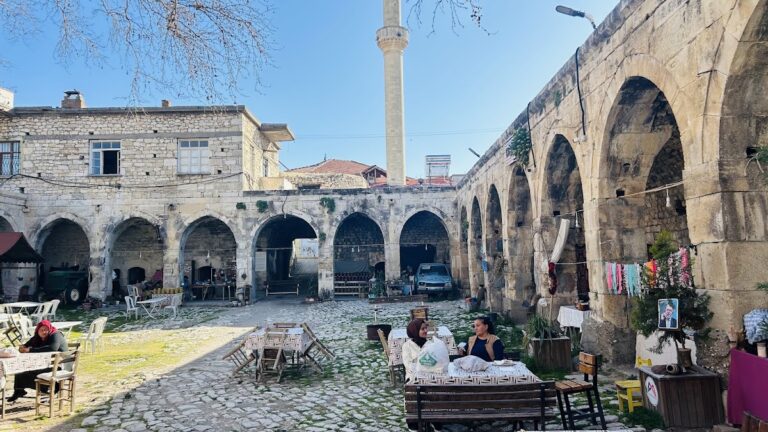
The mosque stands in central Mut between a castle and a caravanserai described as approximately contemporary with it. A caravanserai was a lodging and service complex for travelers and caravans. The building has a square principal plan and a rectangular base constructed from regularly cut stone. A central dome, formed from flat-faced stones, rests on an octagonal drum.
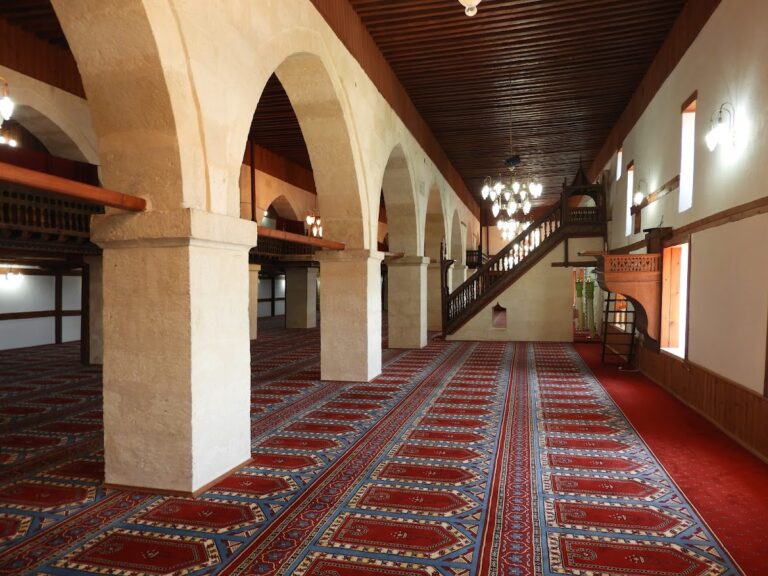
Four internal piers carry the central dome. Alongside the four principal arches, four additional arches create wall niches. The northern final prayer space or portico is supported by four columns and round arches, and five small domes cover it. The main entrance opens in the northern facade, while a small doorway near the eastern corner of the east facade leads by a wooden staircase to the women’s gallery.
Interior furnishings and courtyard
The original marble minbar contains muqarnas, a tiered three-dimensional form of Islamic ornament. The mihrab, the prayer niche indicating the direction of Mecca, was painted at a later date.
Two small conical mausoleums stand in the courtyard. One belongs to the original complex, while the other was added during the Ottoman period. One mausoleum contains three graves and the other contains four. The seventeenth-century Ottoman traveler and writer Evliya Çelebi stated that Laal Pasha’s grave lay in the first courtyard mausoleum. The exact location of the grave and Laal Pasha’s date of death remain uncertain.
The courtyard formerly contained a stone-built madrasa with an earthen-covered roof, and a bathhouse once stood around the mosque. These associated buildings have disappeared.