Kellibaron Monastery: A Byzantine Lavra in Türkiye


Site at a Glance
- Rating
- 4.6
- Popularity
- Low
- Country
- Turkey
- Primary era
- Medieval
- Eras represented
- Medieval
- Civilizations
- Byzantine
- Site type
- Religious
- Remains
- Fortified Monastery
On this page11 sections
History
Kellibaron Monastery is a Byzantine men’s monastery in Türkiye, located in the Yediler area of the Milas district in Muğla Province. It was a lavra, a monastery where monks lived in separate cells while sharing a church and communal institutions. The monastery stood in ancient Caria, on Mount Latros, and its name was associated with the city of Karvali, now Güzelyurt.
The Latros monastic center
Kellibaron was the oldest monastic establishment within the wider center of Latros. This monastic region extended around the shores and islands of Lake Latmos, now Lake Bafa, as well as through the mountain country east and north of Heraclea on Latmos, now Kapikiri. Monastic life in Latros lasted from the seventh to the fifteenth century.
Between the tenth and thirteenth centuries, Kellibaron was a center of monasticism in Cappadocia, the historical region of central Anatolia that was an important area of Byzantine Christian monasticism. Its abbot held the office of protos, the senior head of a regional group of monasteries, in Latros until the end of the eleventh century. Arsenios of Latros was among the abbots of Kellibaron.
Changes in authority and community
The Lamponiou Lavra probably developed from a division within the Kellibaron community during the tenth century. In 1049, a dispute concerning the division of territory between the two lavras was considered with the participation of a representative of Patriarch Michael I Cerularius of Constantinople. Lamponiou does not appear in later records.
Between 1075 and 1081, Patriarch Cosmas I of Constantinople, also known as Cosmas the Jerusalemite, decided that the right to hold the office of protos should pass to Christodoulos Latrinos. Christodoulos was abbot of the Stylos Monastery from 1075 to 1087. Stylos had been founded by Paul of Latros.
Around 1282, Emperor Michael VIII Palaiologos ordered the monastery’s community, then reduced to nine monks, to move to the Monastery of Saint Demetrius in Constantinople. The two monasteries were not formally merged, because the Kellibaron monks continued to live in Constantinople under special rights. Soon afterward, the Latros monastery became a metochion, a dependent monastic house administered by a larger monastery, belonging to Saint Demetrius. Kellibaron thereby permanently lost its primacy within Latros. Several thirteenth-century manuscripts from the monastery are known.
Later history
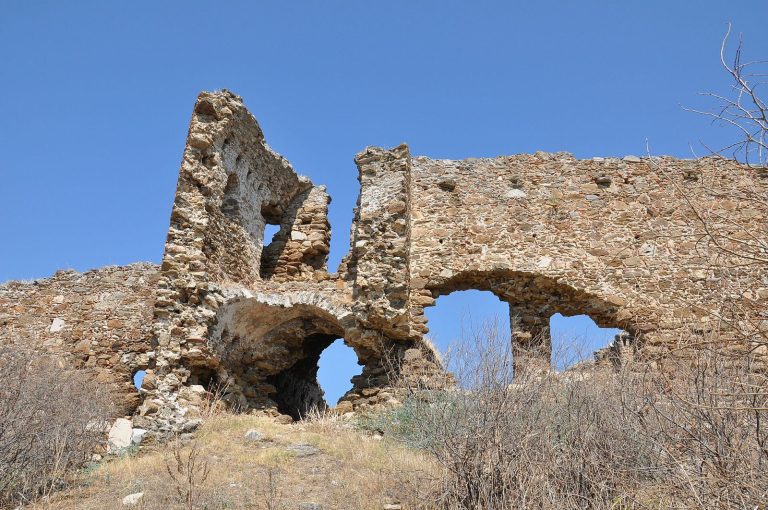
In the late thirteenth and early fourteenth centuries, Latros came under the control of the Sultanate of Rum and other Seljuk Turkish states. The Sultanate of Rum was a medieval Seljuk Turkish state in Anatolia. Monastic life in Latros continued for a considerable period under Muslim rule. Kellibaron is now in ruins, southeast of ancient Miletus and east of the modern village of Kapikiri and Lake Bafa.
Remains
The monastery was arranged in two principal parts. A small fortified area contained a chapel and defensive rooms, while a larger zone held numerous separate monastic cells set out irregularly. A church stood south of the fortress, giving the complex both a protected core and a dispersed living area characteristic of a lavra.
Fortress and church
Fortified enclosure
The small fortress formed one part of the monastery complex. It contained a chapel together with rooms used for defense. The surviving remains are in ruins, but the division between the fortified area and the wider field of cells remains central to the site’s physical organization.
Church south of the fortress
South of the fortress stood an elongated church with a single apse, the rounded or polygonal end of a church sanctuary. Its position formed a distinct architectural element beside the fortified section of the monastery.
Cells and painted room
Monastic cells
Twenty-four small rooms with varied plans were investigated across the monastery. Some were cut directly into the rock, while others were constructed from stone. Their individual liturgical and domestic functions cannot be determined with certainty, but their irregular arrangement reflects the dispersed residential organization of the lavra.
Thirteenth-century frescoes
One of the rooms preserves thirteenth-century frescoes depicting episodes from the life of Christ. These paintings provide a surviving example of the monastery’s religious decoration and remain part of the ruins’ archaeological evidence.