Kinn Church: A Medieval Romanesque Church in Norway
Site at a Glance
- Rating
- 4.8
- Popularity
- Very Low
- Country
- Norway
- Primary era
- Medieval
- External website
- Open
- Eras represented
- Medieval, Early Modern
- Civilizations
- Norwegian
- Site type
- Religious
- Remains
- Church
On this page9 sections
History
Kinn Church is a medieval Norwegian stone church on the island of Kinn in Norway, built during the second half of the 12th century in the Romanesque style. Its earliest surviving written mention dates from 1322, showing that the church was already established by that time. Archaeological dating places the construction of the chancel around the middle of the 12th century, with the nave added several decades later.
Medieval origins and traditions
Local tradition attributes the church’s foundation to Borni, said to have been the sister of Saint Sunniva, a Christian saint associated with western Norway and patron saint of the Diocese of Bjørgvin. The same tradition holds that Borni lived in a cave in the mountain immediately south of the church. These associations connect Kinn Church with local religious memory as well as with the medieval Christian landscape of western Norway.
The church previously belonged to the Catholic Church and is now Evangelical Lutheran. It belongs to the Church of Norway and is affiliated with Kinn Parish, the Sunnfjord Deanery, and the Diocese of Bjørgvin.
Parish church and constitutional history
Kinn Church served as the main church of Kinn Parish until 1882, when Florø Church was built in the newly established town of Florø. Kinn Church was then taken out of regular use and used mainly as a museum, although special occasions continued to take place there. It is now used mainly during the summer.
In 1814, the church served as an election church and polling station for the elections to Norway’s Constituent Assembly, the body that drafted the Norwegian Constitution. The parish formed a constituency that elected local electors, who later helped choose representatives to the assembly at Eidsvoll.
Repairs and preservation
Kinn Municipality purchased the church in 1866. Major repairs in 1868 and 1869 enlarged the windows and reduced the roof angles. These changes were reversed in 1911 and 1912, when the roof was rebuilt according to the historical design. The porch was demolished and rebuilt, and parts of the interior were reconstructed during the same work. The latest restoration was completed in the late 1960s.
Kinn Church is an automatically protected Norwegian cultural-heritage site. It is regarded as the oldest and only church of its particular kind in the Sunnfjord region and as one of Western Norway’s notable medieval monuments.
Remains
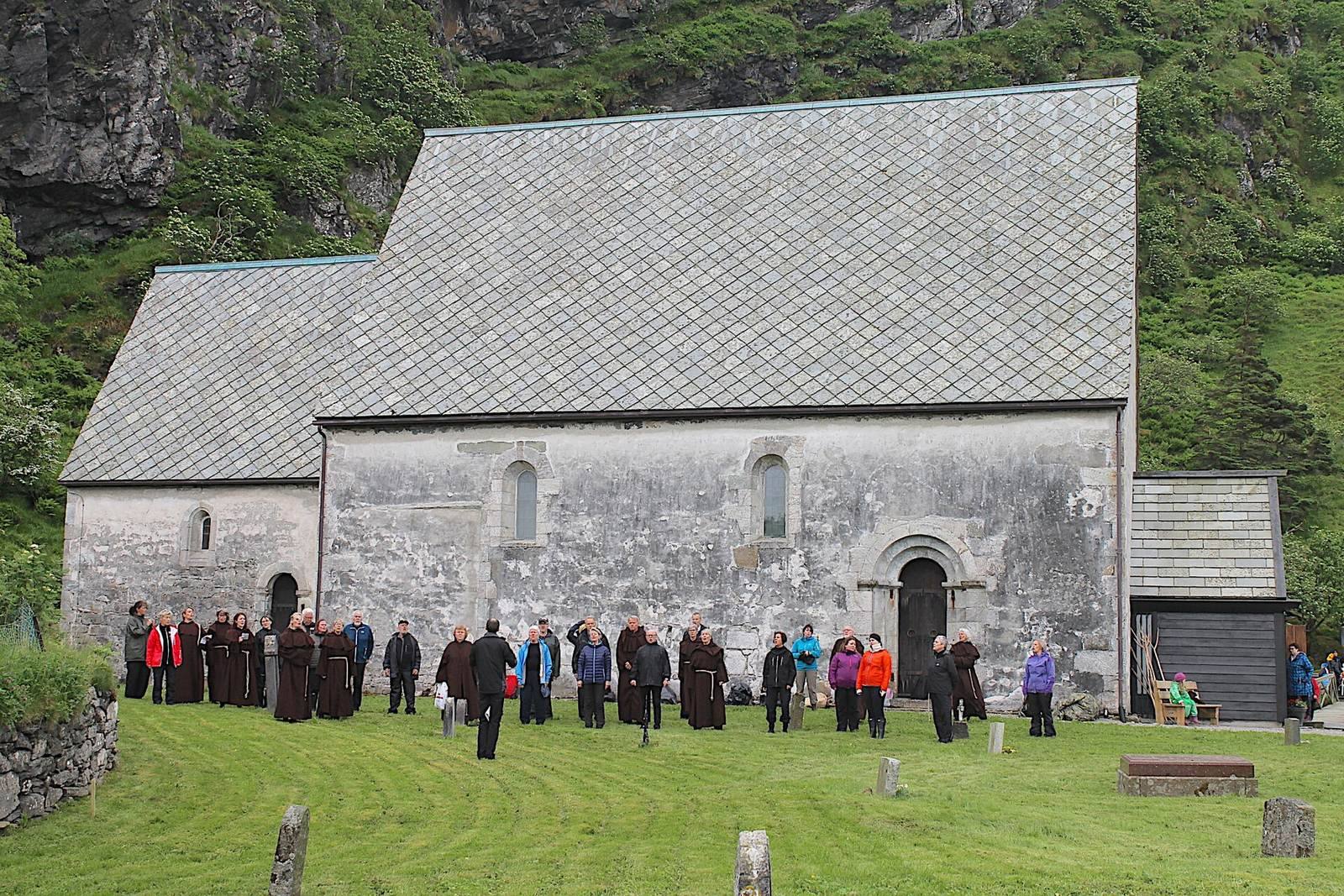
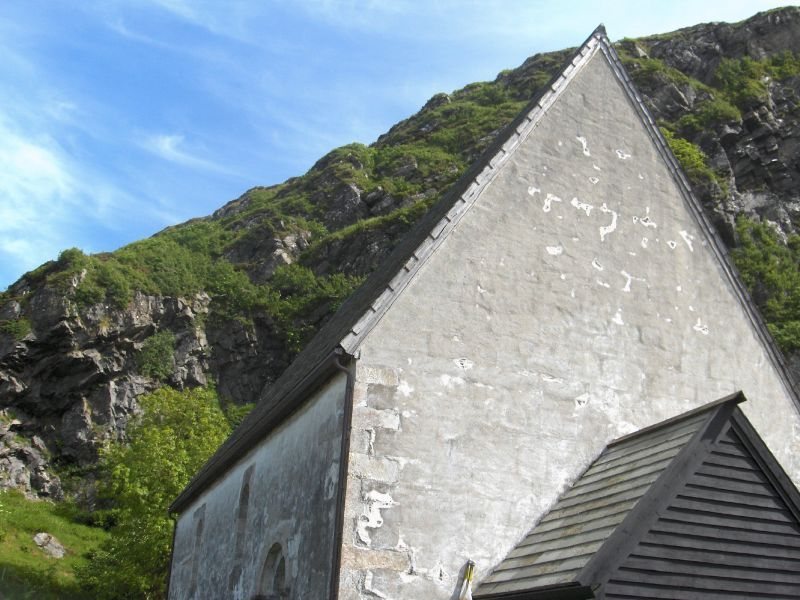
Kinn Church is a white stone long church with a rectangular nave and a narrower, nearly square chancel. Its Romanesque design uses massive masonry, rounded arches, and relatively thick walls. The stonework was built from sandstone obtained from the island of Skorpa. Roman-arched windows and doorways remain among the church’s characteristic features, while the rebuilt porch and reconstructed interior reflect the restoration work of 1911 and 1912.
Medieval carved work
Lectorium
The lectorium, a raised or separating feature between the nave and chancel, is described as the oldest part of the church. Research most probably dates it to the middle of the 13th century. Its wooden reliefs were carved by artists associated with the royal court in Bergen during the reign of Håkon Håkonson, a 13th-century Norwegian king whose rule was an important period of royal and cultural development. The reliefs are regarded as an outstanding example of Norwegian medieval art.
Chancel furnishings
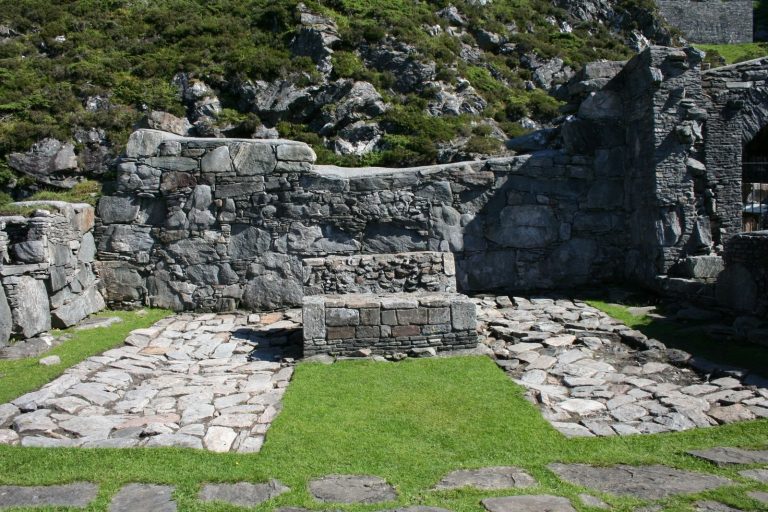
The chancel contains a soapstone altar. A small opening in the altar slab, covered by a marble lid, was used to conceal holy objects and relics, physical objects preserved because of their association with a saint or another sacred person.
Triptych and altarpiece
A triptych, an artwork made from three connected panels, stands on the south wall of the chancel. Its three saint figures were made in the Netherlands and may have been given to the church in the early 16th century. At Kinn, the figures are identified as Ingebjørg, Borni, and Sunniva and are associated with local legends.
The altarpiece dates from 1644 and is probably the work of Peter Negelsen, an artisan who produced altarpieces and other religious objects for churches in Norway.