Ardchattan Priory: A Valliscaulian Monastic Community in Scotland


Site at a Glance
- Rating
- 4.5
- Popularity
- Low
- Country
- United Kingdom
- Primary era
- Medieval
- External website
- Open
- Eras represented
- Medieval, Early Modern
- Civilizations
- Kingdom of Scotland
- Site type
- Religious
- Remains
- Monastery
On this page9 sections
History
Ardchattan Priory is a medieval monastic site in Scotland, United Kingdom, founded around 1230 by Duncan MacDougall, Lord of Argyll. It belonged to the Valliscaulian order, a small medieval monastic tradition that combined elements associated with Carthusian and Cistercian practice. The priory church was dedicated to the Virgin Mary and John the Baptist. Its history is closely connected with Clan MacDougall, the Scottish Gaelic kin group that held influence in the region.
Foundation and MacDougall patronage
Duncan MacDougall, who is also identified as the builder of Dunstaffnage Castle, established the priory as a Valliscaulian community. The accepted origin tradition of Clan Chattan states that the MacDougalls appointed Gillichattan Mor as bailie, or protector, of the priory’s lands. This tradition reflects the close relationship between the religious house and the local kin groups that supported and defended it.
In 1308, during his campaign in the area, Robert the Bruce held a council of local chiefs at Ardchattan. Robert the Bruce was king of Scots from 1306 to 1329, and the gathering at the priory is believed to have been the last Gaelic-speaking parliament in Scotland. From the early fourteenth century, the prior, the head of the priory, also held the chantership at Lismore Cathedral. This cathedral office was associated with music and liturgical chant.
Expansion and changing affiliations
The priory was enlarged in the mid-fifteenth century, when its refectory, or communal dining hall, and choir, the part of the church reserved for clergy and choral worship, were expanded. At least three successive members of the MacDougall family served as priors during the later fifteenth century, maintaining the family’s institutional connection with Ardchattan.
Eugenius, also known as Eogan, MacDougall commissioned the MacDougall Cross in 1500. He succeeded his relative Dugall MacDougall as prior in 1502, but Beauly Priory deposed him in 1506. In April 1510, a papal order incorporated Ardchattan as a cell of Beauly Priory. A cell was a dependent religious house subject to a larger monastery. Ardchattan may have become Cistercian at this time, although that change remains uncertain.
Campbell control and decline
During the sixteenth century, the priory passed into the hands of Clan Campbell. The brethren left in 1545, and in 1602 administration passed to Archibald Campbell, the last commendator. A commendator managed the revenues and affairs of a religious institution, often without acting as its regular monastic superior. Under Campbell control, parts of the conventual buildings were gradually converted into a private residence, while the choir and transepts continued to be used for parish worship.
By order of James VI, king of Scotland from 1567 to 1625, Ardchattan was annexed to the Bishopric of the Isles during the 1610s. A bishopric was a diocese administered by a bishop. In 1653 and 1654, John Campbell, who supported Charles II during the mid-seventeenth-century conflict over the Stuart monarchy, stationed a garrison in the residence. An attack followed from the English administrator of Dunstaffnage Castle, and three people were killed.
The monastic church fell out of regular use after a new parish church was built in 1731 and 1732. Ardchattan continued as a burial place, but parts of the church were later quarried for stone, leaving the remains heavily ruined. The priory, burial ground, and carved stones are protected together as a scheduled monument, a legally protected archaeological or historic site. The site is also associated with a Category B listed building designation, while the gardens are listed for their historical, horticultural, and scenic value. Historic Scotland is identified as the managing body.
A local tradition further associates the priory’s yew trees with Robert the Bruce. They were allegedly inspected by the king and cut to supply at least some of the longbows used at the Battle of Bannockburn.
Remains
The cruciform church
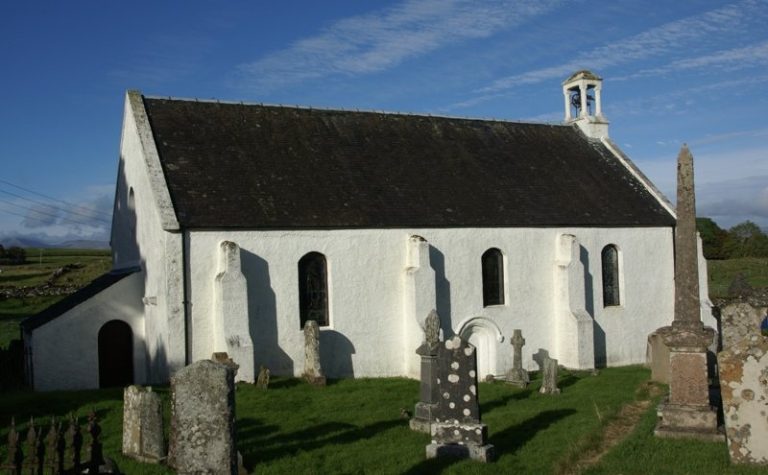
The priory church followed a cruciform plan, with a nave, transepts, and choir arranged in the shape of a cross. The small nave and transepts belong to the thirteenth century, while the substantially larger choir dates from the fifteenth-century enlargement. Much of the nave has disappeared, although it included a narrow north aisle. The northwestern part of the priory, including the nave area, has either vanished or been absorbed into the later dwelling.
A surviving stone screen divides the choir from the rest of the church. Farther east, a tomb chest and a piscina remain. A piscina is a basin used in medieval Christian worship, usually set into a church wall. Two seventeenth-century burial enclosures, or family mausolea, abut the church remains, with one positioned on each side of the choir.
Cloister and refectory
A cloister stood south of the church and measured approximately 15 by 16 metres. Much of this monastic courtyard is now built over by the later house. The fifteenth-century refectory is the only surviving claustral building, meaning a building belonging to the monastic cloister complex. It was subdivided in 1713 and later served as the dining room of the residence. Its vaulted pulpit survives and was restored in 1960.
Grave slabs and carved monuments
Ardchattan contains carved stones and West Highland-style grave slabs. Nine medieval slabs, most dating from the fifteenth or early sixteenth century, are displayed beneath a shelter and numbered. Their decoration includes floral and leafy patterns, swords, crosses, human figures, and inscriptions. Later grave slabs dating from after the Reformation remain approximately in their original positions and commonly bear skulls, crossed bones, and other symbols of mortality.
Grave slab 1 dates from the tenth century and was probably first set upright so that both decorated faces could be seen. One side carries a heavily ornamented cross, while the other shows a simpler cross. The stone was later removed from its base and reused as a flat grave slab. Most of the later examples follow the Iona style, while slabs 3 and 5 were made by a group of sculptors from Loch Awe.
The MacDougall Cross is a Celtic high cross made in 1500 for Prior Eugenius, or Eogan, MacDougall. John O’Brolchán carved it as a member of a family of sculptors from Iona. It is one of the few West Highland crosses whose maker and name are known. One face represents the Crucifixion, while the other shows the Virgin Mary with the Child.
Dugall MacDougall’s graveslab lies in the choir. It depicts Dugall and his brother Duncan wearing the dress of priors, with a skeleton between them as a reminder of human mortality. Their father Somerled, their mother, and their brother Alan are also represented. The inscription identifies Duncan and Dugall as successive priors, records their family relationships, names Dugall as the creator of the monument, and gives his death as 1502.
Gardens and landscape
The priory occupies a site with views over Loch Etive, Ben Cruachan, and the hills of Mull. The gardens developed alongside the house in the early seventeenth century, although most of their present form belongs to the nineteenth and twentieth centuries. Their features include a woodland garden established in the 1960s, an older formal garden near the priory, shrub walks, and a wildflower meadow planted beneath rowan trees.
Lawns bordered by herbaceous beds and roses, a rockery, and a walled kitchen garden form further parts of the grounds. The surrounding parkland is described as Picturesque, with groups of trees and woodland. Neutral soil and a temperate climate support a wide range of plants and more than thirty varieties of trees, including large specimens of Cornus kousa, Eucryphia glutinosa, and Hoheria lyalii, together with scented roses and philadelphus.