Saints Stanislaus and Adalbert Church in Rzeszów: A Gothic-Baroque Parish Church
Site at a Glance
- Rating
- 4.7
- Popularity
- Low
- Country
- Poland
- Primary era
- Early Modern
- External website
- Open
- Eras represented
- Medieval, Early Modern
- Civilizations
- Kingdom of Poland, Polish–Lithuanian Commonwealth
- Site type
- Religious
- Remains
- Church
On this page7 sections
History
Saints Stanislaus and Adalbert Church in Rzeszów, Poland, is a Roman Catholic parish church whose origins reach back to 1363 and whose surviving fabric combines a Gothic presbytery with a Gothic-Baroque nave and Baroque additions. It belongs to the Parish of Saints Stanislaus and Adalbert and stands in the historic centre of the city.
Medieval origins
In 1363, a small wooden church dedicated to Saints Felix and Adauctus probably stood on the site. King Casimir III, the fourteenth-century king of Poland also known as Casimir the Great, mentioned it in a letter to Pope Urban V, who served as pope from 1362 to 1370. After a fire and the wars of the fifteenth century, the church was rebuilt. The oldest surviving part of the present building is the stone-and-brick Gothic presbytery, dated to 1427.
At the beginning of the sixteenth century, the church was secured by a surrounding wall. A later fire devastated Rzeszów in the seventeenth century, prompting another rebuilding and enlargement in 1621 under the patronage of Mikołaj Spytko Ligęza, a Polish nobleman and magnate.
Baroque reconstruction and later changes
In 1754, the church underwent a further reconstruction based on a substantially altered architectural concept. The work gave the building its Baroque character and was accompanied by the construction of the adjacent bell tower. The richly decorated interior also dates mainly from the eighteenth century.
The church was restored in 1962–1965 and again in 1971–1972. It was entered in Poland’s heritage register as monument A-548 on 13 May 1994. Its musical and bell equipment also reflects later changes. An earlier Rieger organ from 1893 was destroyed during the Second World War and replaced by an instrument built by Zygmunt Kamiński’s Warsaw company. That company enlarged the replacement in 1966. Its former console was temporarily used in Stoczek Warmiński and is now used in the parish church at Ciechanów.
In 1917, material shortages and financial difficulties led the Austrian government and military command to requisition three bells. The bell tower remained without bells until replacements were purchased in 1926, although the fate of those bells is unknown. At the beginning of the twenty-first century, linear drives replaced the original chain drives. The bells are still operated manually and are rung before the evening Mass, while a played melody replaces the bells for the Angelus at noon.
Remains
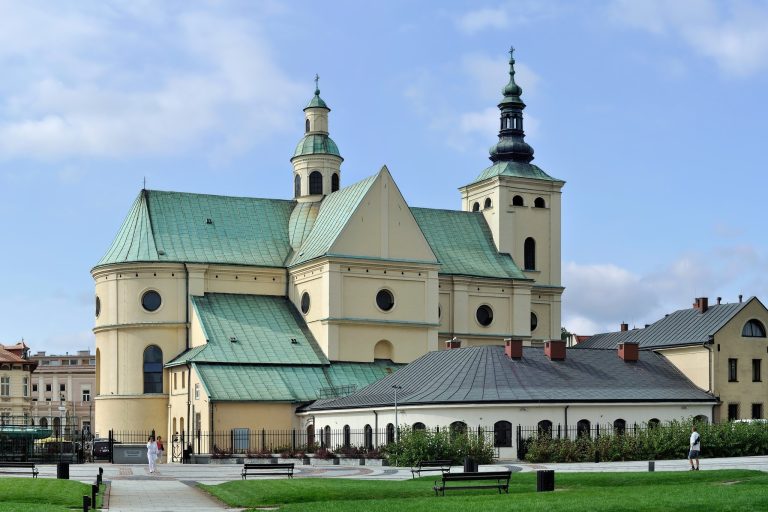
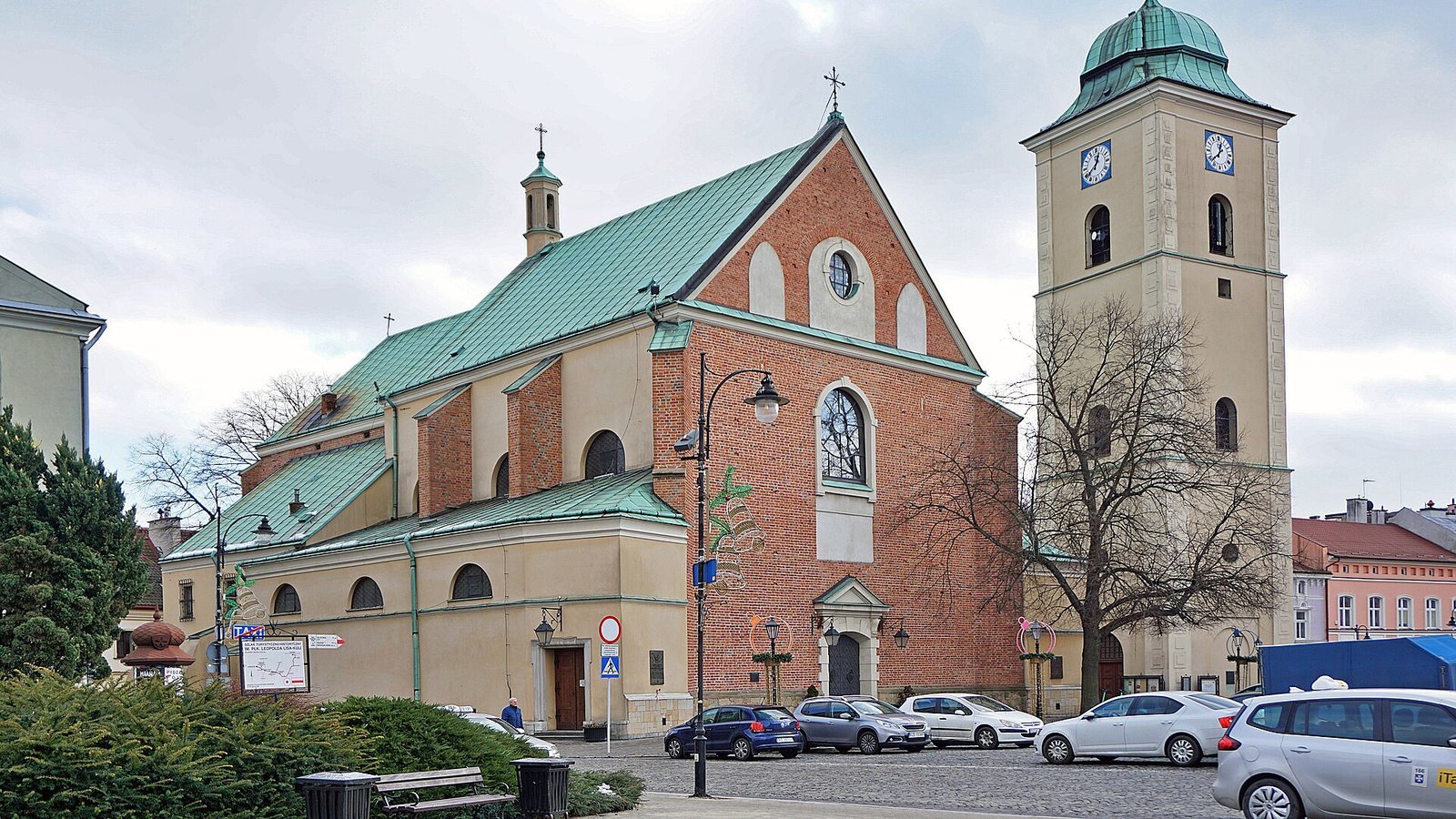
The church occupies a site in Rzeszów’s Old Town centre on Farny Square, at the junction of 3 Maja Street and Kościuszki Street. It is a massive three-aisled structure organized around a medieval presbytery, a later main nave, and substantial Baroque additions containing chapels. A small bell turret rises from the church itself, while a separate bell tower stands alongside it.
Church building
The presbytery is the part surrounding the main altar and traditionally reserved for the clergy. Its surviving walls are Gothic and date from 1427, with both stone and brick used in their construction. The main nave combines Gothic and Baroque character, while the chapels belong to the later Baroque additions. Together these elements preserve the successive rebuilding of the church after the medieval damage, the seventeenth-century fire, and the eighteenth-century reconstruction.
Bell tower and bells
The adjacent Baroque bell tower is 30.5 metres high and has a square plan. A domed roof covers it, and a spire bearing an angel crowns the structure. One of the bells hanging in the tower dates from 1816. It bears the inscription “A. D. 1816,” plant ornaments, and two angels holding a crown beneath an image of the Eye of Providence. Two other bells, named Maximilian and John the Baptist, were cast in 1973.
Interior furnishings and organ
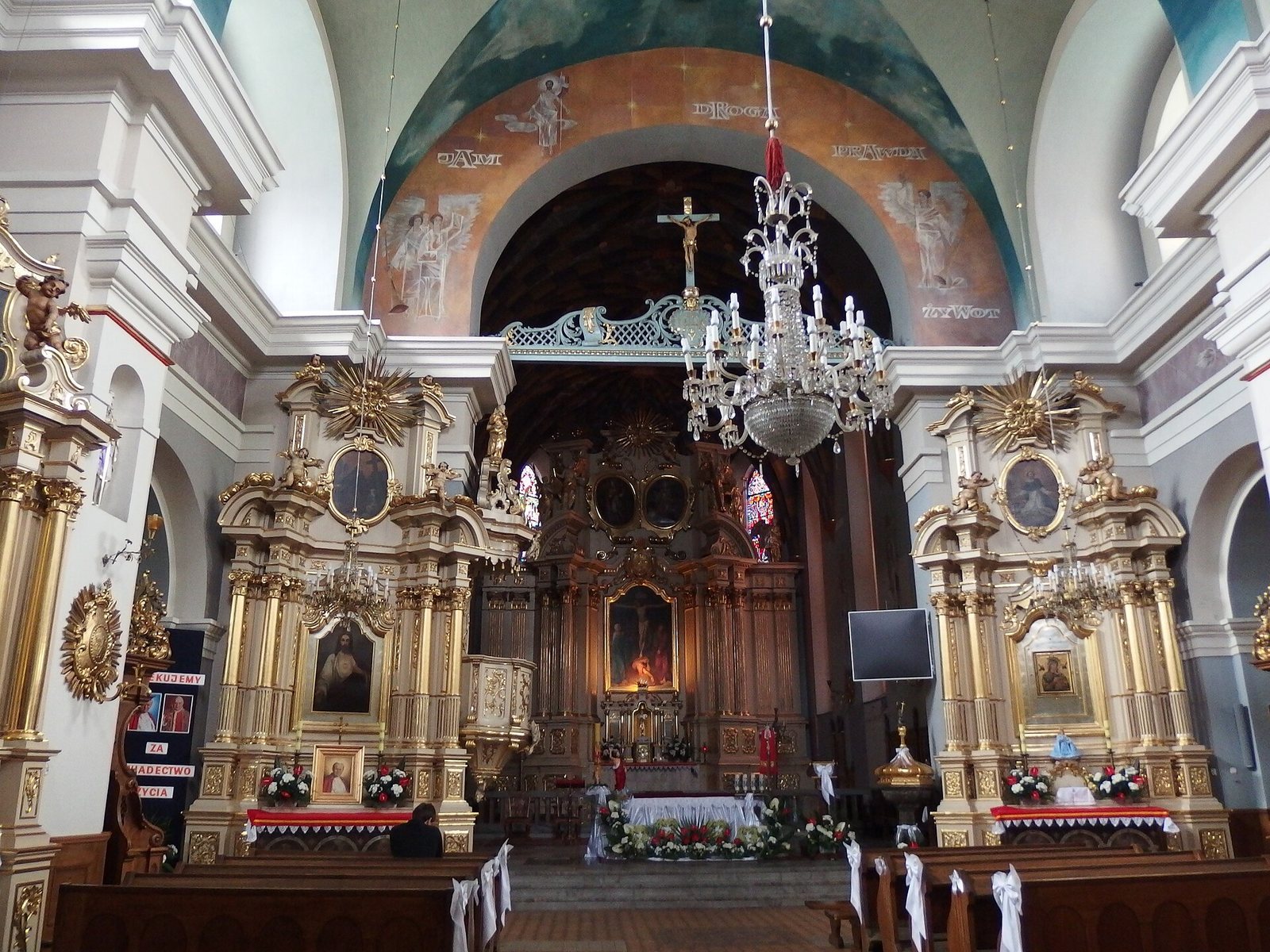
The eighteenth-century interior contains a single-storey main altar made in 1730. Set on a raised platform spanning the entire presbytery wall, it uses columns to frame a central oil painting of the crucified Christ and two side paintings of the church’s patron saints. The side altars are Baroque works from the eighteenth century and contain oil paintings. Other furnishings include an eighteenth-century Rococo pulpit and a presbytery beam with a cross carved in the Regency style, a decorative style that preceded and influenced Rococo.
The organ built by the Kamiński company has 35 stops, three manuals, and a pedal division. Its installation followed the destruction of the 1893 Rieger instrument during the Second World War, while its enlargement in 1966 forms part of the church’s later musical history.