Saint Géry Church of Braine-le-Comte: A Romanesque-Gothic Parish Church in Belgium
Site at a Glance
- Rating
- 4.3
- Popularity
- Very Low
- Country
- Belgium
- Primary era
- Early Modern
- External website
- Open
- Eras represented
- Medieval, Early Modern, Modern
- Civilizations
- Holy Roman Empire
- Site type
- Religious
- Remains
- Church
On this page20 sections
History
Saint Géry Church of Braine-le-Comte is the town’s principal religious building in Belgium. Dedicated to Saint Géry, the Merovingian-era bishop of Cambrai who served from 555 to 624, it belongs to the Diocese of Tournai and is a Romanesque-Gothic church originating in the thirteenth century. Its elevated site and long history have connected the church with the development and defense of Braine-le-Comte.
Origins and Medieval Authority
A local legend attributes the foundation of both the town and an early oratory on the hill to Saint Géry. Nothing of that primitive building survives. The church itself is documented from the twelfth or thirteenth century, and the site later came under the authority of the chapter of Sainte-Waudru in Mons, a collegiate religious institution based at Sainte-Waudru.
During the medieval period, Count Baldwin IV built a keep and a fortified enclosure opposite the church. The enclosure incorporated both the church and the town, placing the religious building within the defended settlement. The bases of the enclosure walls and the remains of a turret still survive around the church.
The Sixteenth-Century Enlargement
As the population grew, the medieval church was enlarged. The principal campaign took place from 1512 to 1524 under the parish priest Georges Descrolieres, with financial support from parishioners and the town magistrates. The works transformed the earlier building and included the western entrance tower, the present choir, and the side chapels.
The project continued into the following century, when the tower received a large spire. Lightning destroyed the spire on 7 June 1677, Pentecost day. The loss resulted in repeated repairs during the eighteenth century. In the sixteenth century, a community of Oratorians of Saint Philip Neri, a Catholic congregation devoted to communal life, preaching, and pastoral work, preached in the choir.
Revolutionary and Modern History
The church passed through the revolutionary period with relatively little damage. Catholic worship resumed in 1802, at the time of the Concordat. The original carillon had been confiscated by French Revolutionary troops in 1794, while the surviving bells and later replacements reflect the church’s changing history.
Restoration during the second half of the nineteenth century preserved and enriched the building. The work included new stained-glass windows in the choir, the installation of a cross above the rood screen, and the placement of an organ in the entrance tower. Saint Géry Church is a protected classified heritage property.
Remains
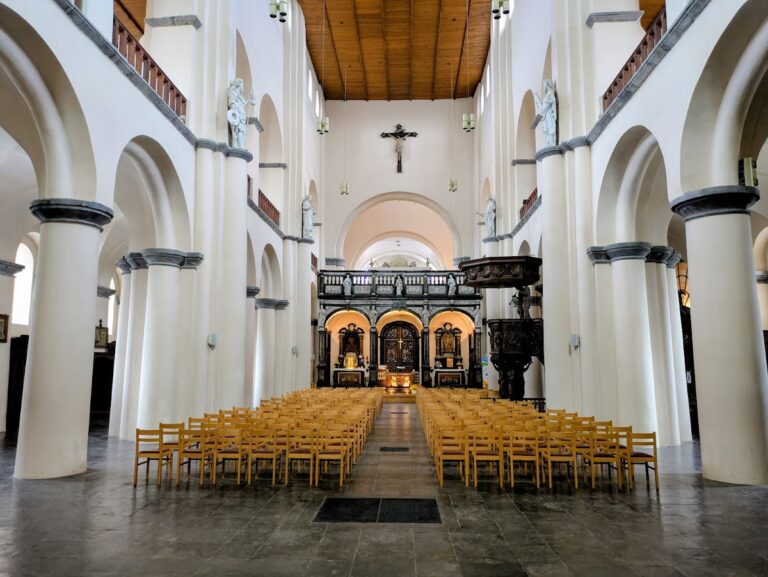
The present church is a hall church, with three aisles of equal height arranged in four bays. Rectangular chapels of unequal dimensions extend along the sides. Sixteen columns of Soignies petit-granit, a Belgian limestone traditionally quarried around Soignies, support three vaults that replaced the original ceiling at the beginning of the eighteenth century.
Church Structure
Entrance Tower
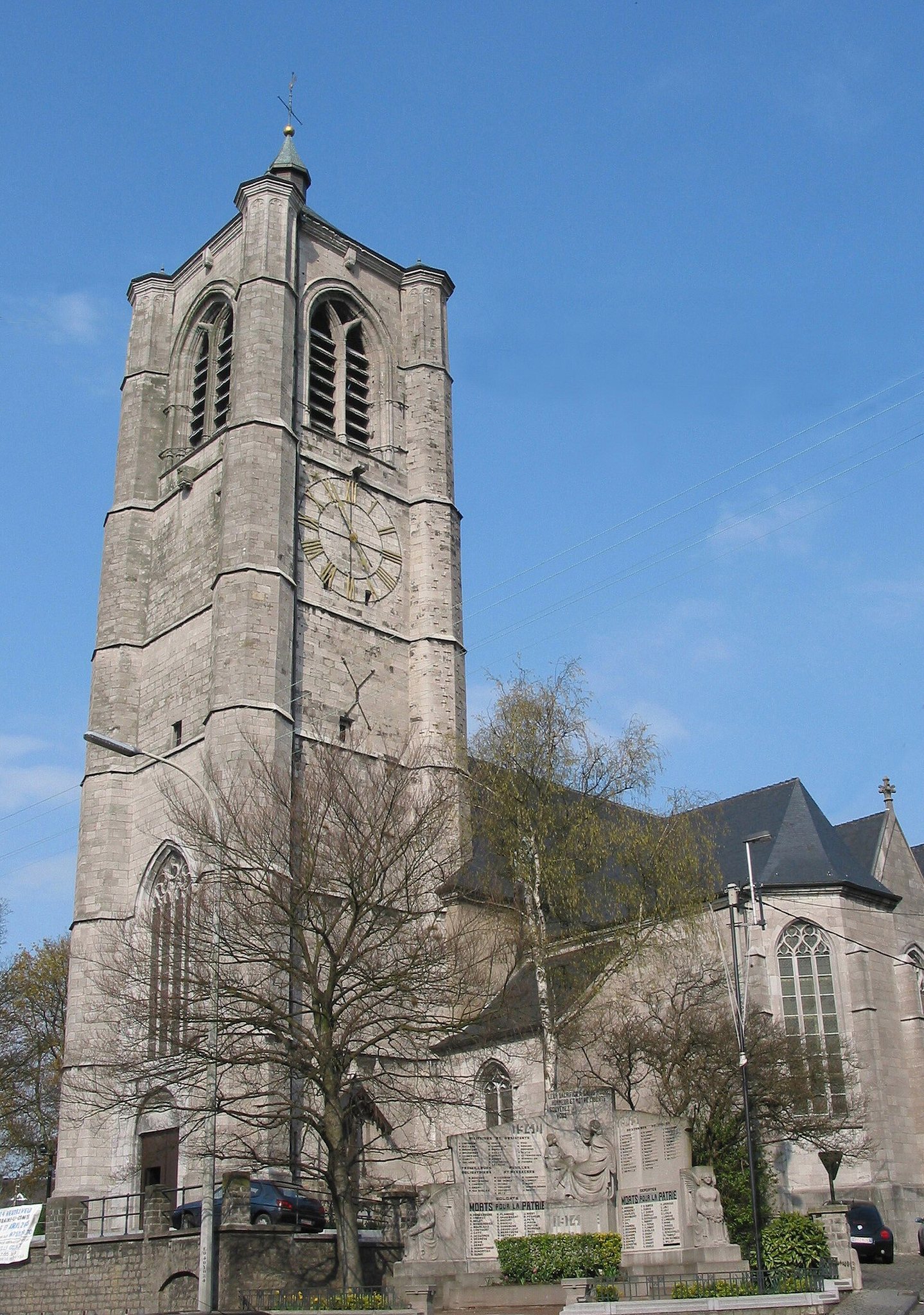
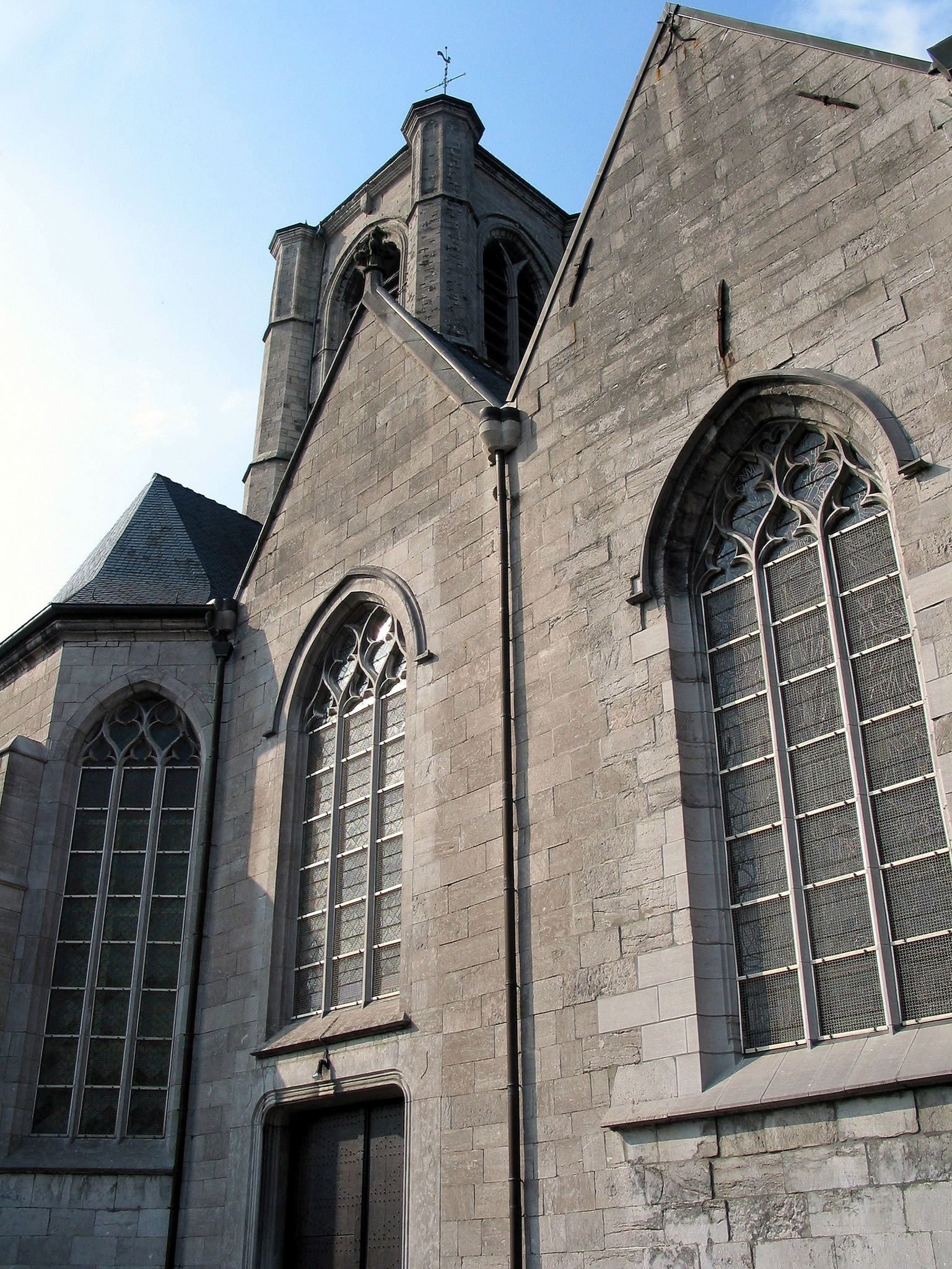
A massive square entrance tower rises approximately 40 metres at the western end of the church. Four octagonal turrets flank its corners. The tower was added during the sixteenth-century building campaign and replaced an earlier Romanesque bell tower that stood against the south side of the choir. The base of that earlier tower survives and has been converted into a chapel.
Choir and Sacristies
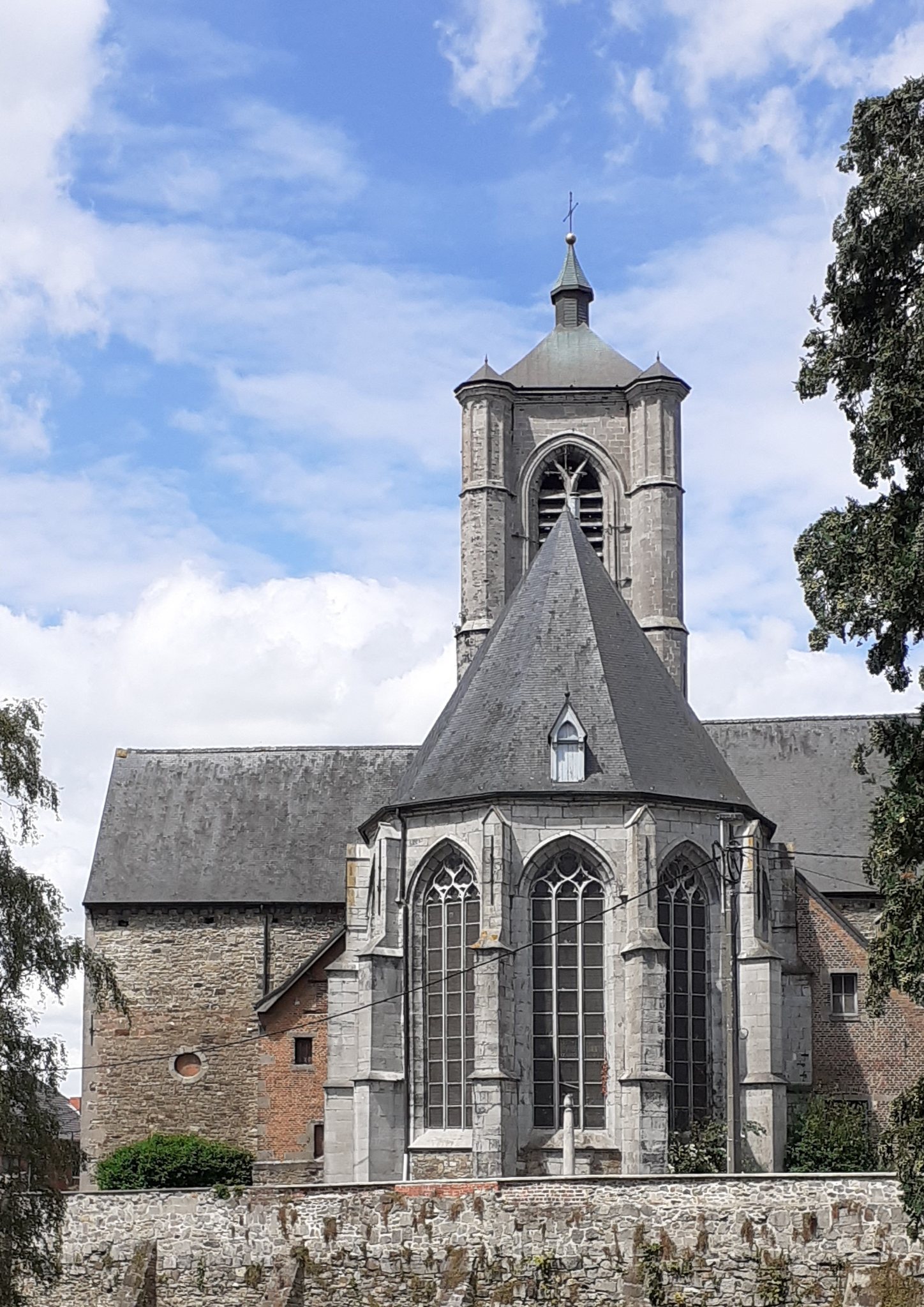
The choir rises higher than the nave and is lit by six windows. Their mullions divide the glazing into three sections, while exterior buttresses reinforce the structure. Sacristies occupy the angles between the transept and the choir, completing the arrangement of the eastern end.
Entrance Portal
The entrance portal has a lintel decorated with a bas-relief of Christ carrying his cross and overpowering a monster. Christ extends his right hand toward two figures. The scene has been interpreted either as Christ extending his hand to Adam and Eve or as Christ’s descent into Limbo and the redemption of the first righteous souls.
Tower Bells and Carillon
Historic Bells
The tower contains Maxellende, the only large bell dating from before the revolutionary period. A second bell, Prospérine, was installed in 1819 in honor of Prosper-Louis, Duke of Arenberg.
Carillon
A replacement carillon was inaugurated on 30 July 1911 through a donation from Félicien Étienne, who was then mayor. German occupation forces melted it down in 1942. The present carillon, installed in 1967, consists of 47 bells.
Sculpture and Chapels
Our Lady of Braine-le-Comte
A Gothic statue of Our Lady of Braine-le-Comte dates from 1470 and is attributed to the sculptor Jean Borman II. The Virgin carries the Christ Child on her right arm, while he turns the pages of the book held in her left hand. Her clothing is richly detailed and decorated with colors and patterns.
Saint Christopher
At the rear of the church stands a colossal fifteenth-century statue of Saint Christopher, carved from solid oak and measuring 3.80 metres in height. It represents the saint carrying the Christ Child on his shoulders and rests on a monumental Gothic pedestal made of Soignies petit-granit.
Saint Christopher Chapel
A lateral chapel at the western end of the side aisle is dedicated to Saint Christopher. Its Baroque altar contains a painting representing the saint.
Rood Screen and Altar
Rood Screen
The rood screen, a gallery or partition separating the choir from the nave, dates from 1593. It consists of three round-arched arcades surmounted by an open gallery. The central bay gives access to the sanctuary through a double-leaf door. Seven statues of the theological and cardinal virtues decorate the outer façade, with most of them inspired by Jacques Du Broeucq’s work for the Sainte-Waudru collegiate church in Mons.
Made of multicolored marble, the screen has diamond-shaped cartouches beneath the balustrade. Their inscriptions identify the families who contributed to its construction. A cross was installed above the screen during the nineteenth-century restoration.
High Altar
The altar dates from 1577 and consists of a reredos, an ornamental structure behind an altar, set on the altar table, together with a pyramidal tabernacle, the repository for the Eucharistic elements, above it. The reredos has two superimposed levels divided into six compartments containing scenes from the New Testament.
The tabernacle is decorated with statuettes of figures from the Gospels and crowned by a pelican. In Christian symbolism, the pelican represents Christ giving his life for his followers.
Baptismal Font
The baptismal font stands in a small chapel enclosed by a grille. It is made of cut stone, with an octagonal support and basin. Its moldings and vegetal ornament date from the late fifteenth century.