Trianon Mosque: An Ottoman Mosque and Cultural Venue in Nafplio
Site at a Glance
- Rating
- 4
- Popularity
- Very Low
- Country
- Greece
- Primary era
- Early Modern
- External website
- Open
- Eras represented
- Early Modern, Modern
- Civilizations
- Ottoman
- Site type
- Religious
- Remains
- Mosque
On this page9 sections
History
Trianon Mosque is a late sixteenth-century Ottoman building in Nafplio, Greece, built during the first period of Ottoman rule in the Peloponnese, perhaps shortly before 1666–1667. Founded by Aga Pasha, it is the oldest surviving example of Ottoman architecture in Nafplio and now serves as a cinema and cultural venue rather than a mosque.
Ottoman and Venetian rule
During Ottoman administration, the mosque stood in the Grand Vizier’s Quarter, also known as the Quarter of Sultan Ahmed, at the center of Nafplio’s market. Its position placed it among the religious and civic buildings of the town’s commercial heart.
Venetian forces took control of the Peloponnese in 1687, and the building was converted into a church dedicated to Saint Anthony of Padua, the thirteenth-century Franciscan friar and Catholic saint associated with the Italian city of Padua. After the Ottoman reconquest in 1715, it was converted back into a mosque.
From charitable institution to school
During the early years of the Greek War of Independence, around 1823, the former mosque was adapted for non-religious use as the home of the Charitable Society of Nafplio. The society assisted poor and sick people, cared for children orphaned during the war, and provided those children with an education.
After Greek independence in 1830, the building became a mutual-teaching school for children from poor families. In this system, older pupils taught younger ones. Ioannis Kapodistrias, the first governor of the newly independent Greek state, supported and strengthened the institution at his own expense.
King Otto, the first king of modern Greece, abolished mutual teaching and replaced it with state-sponsored schools. The former mosque nevertheless continued to function as a school from 1831 until 1884, when it closed because of health concerns.
Municipal and cultural uses
For several years after the school closed, the building housed both the Nafplio Magistrate’s Court and the town’s metropolitan church. In 1893, it was renovated and converted into a conservatory and theater. It became the Trianon municipal cinema in 1937.
Since 1993, the building has served as the seat of the Municipal Theater of Nafplio and as a venue for cultural events and exhibitions. Its successive religious, charitable, educational, judicial, and cultural functions reflect the changing institutional life of the town.
Remains
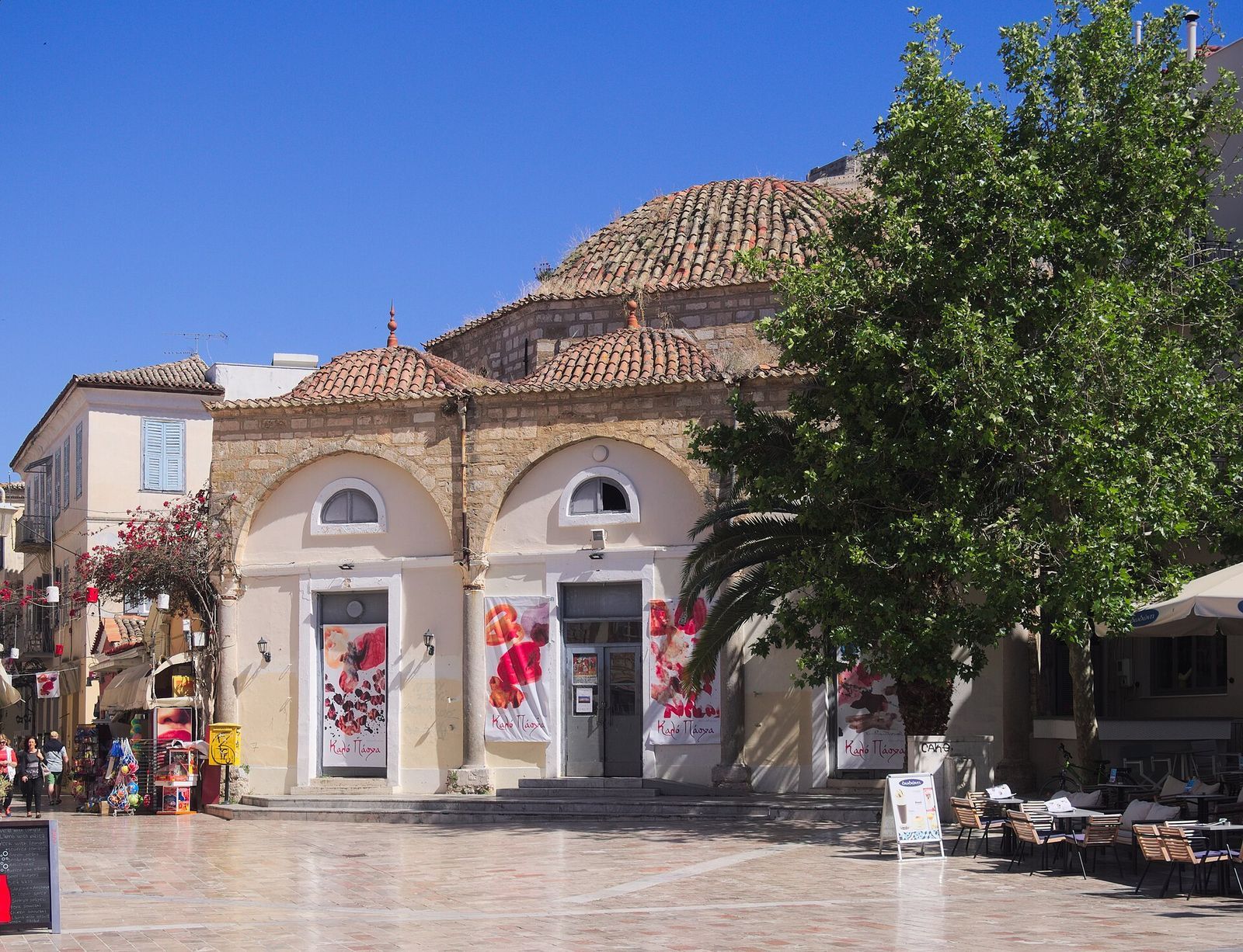
The former mosque is a simple stone-and-brick structure with a rectangular plan and one octagonal dome. Its entrance is formed by an arched, colonnaded porch sheltered by three smaller domes. A small courtyard once stood to the west, but it has not survived. The building stands approximately 100 meters from Agha Pasha Mosque, commonly known as Vuleftikon Mosque, on the opposite side of Syntagma Square.
Plan and entrance
Main building
The main structure has a plain architectural treatment and is built from stone and brick. It was aligned with the qibla, the direction toward the Kaaba in Mecca, at 132°44′. The original lower level is partly buried because the surrounding soil rose over time, changing the relationship between the building and the ground around it.
Entrance porch
The columned entrance porch, or narthex, an entrance vestibule adjoining the main space, was later enclosed by a wall. This alteration means that the building’s original architectural elements are no longer fully visible. The mosque’s minaret has not survived, and the building was constructed without major decorative features or a large minaret.
Alterations and surviving evidence
False ceilings were installed in 1915 to accommodate the building’s later functions. They conceal the domes, internal staircases, and a reinforced-concrete mezzanine. These changes belong to the building’s adaptation as a civic and cultural structure rather than to its original mosque form.
Evliya Çelebi, a seventeenth-century Ottoman traveler and writer, recorded three mosques in Nafplio, including two in the market area. He described the market mosques as stone buildings with brick domes and a stone minaret, providing a contemporary description of the architectural setting in which Trianon Mosque stood.