Church of St. Mary in Bytom: A Medieval Roman Catholic Parish Church
Site at a Glance
- Rating
- 4.6
- Popularity
- Low
- Country
- Poland
- Primary era
- Medieval
- External website
- Open
- Eras represented
- Medieval, Early Modern, Modern
- Civilizations
- German, Holy Roman Empire
- Site type
- Religious
- Remains
- Church
On this page12 sections
History
Church of St. Mary in Bytom is a Roman Catholic parish church in Poland, founded in 1231 in the late Romanesque period by Henry the Bearded, the Piast duke who ruled much of Silesia in the early thirteenth century. Dedicated to the Assumption of the Virgin Mary, it is the oldest church in Bytom and has remained an important religious centre through successive political and confessional changes.
Foundation and Gothic expansion
The church was established at its present location in 1231. Its original late Romanesque form used massive masonry, rounded forms, and restrained decoration. During the fourteenth century, the building was expanded in the Gothic style, which introduced greater verticality and more elaborate structural forms. Parts of the main nave and chancel, the area containing the principal altar and traditionally reserved for clergy, survive from this Gothic phase.
A major town fire in 1515 led to further construction and rebuilding. By 1530, the tower, western section, and side aisles had been completed. The church therefore preserves both the medieval fabric of its earlier phases and elements resulting from the reconstruction that followed the fire.
Confessional change and later rebuilding
From the 1560s until 1632, during the Reformation, the sixteenth-century movement that challenged Roman Catholic authority and led to the establishment of Protestant churches, the church was controlled by Protestants. Another fire, in 1675, almost completely destroyed its furnishings. Later changes included major work between 1851 and 1857, when Neo-Gothic elements were introduced and the tower was raised.
Extensive renovation followed in 1935–1938, with additional work in 1957 and 1967. Around 1957, state authorities planned to close and demolish the church because of damage caused by mining. Father Wacław Schenk, parish priest from 1957 to 1982, prevented the plan, and repairs were carried out between 1957 and 1967.
Parish life and preservation
In 2006, the parish marked the 775th anniversary of the church’s consecration and its establishment as a parish. Bishops Jan Kopiec and Jan Wieczorek concelebrated the commemorative Mass. Since 1990, Mass has been celebrated in German every Saturday for Bytom’s German minority, alongside services in Polish.
The church was entered in the register of immovable monuments of the Silesian Voivodeship, one of Poland’s principal administrative regions, on 21 December 1970 under registration number A/261/09. Work on the exterior and renewal of the stained-glass windows began in 2009. From 15 August 2026, the church has held the status of a Marian sanctuary, a Christian shrine especially associated with veneration of the Virgin Mary.
Father Józef Szafranek served as parish priest from 1840 to 1874. In 1863, he transferred the Bytom Madonna to the newly built St. Joseph Chapel in Schomberg. The image returned to Church of St. Mary in 1973 after conservation carried out between 1970 and 1973. Richard Gillar was choir director and organist from 1892 to 1924, and also wrote and edited an extensive Polish hymnal with an accompanying choral book for organ accompaniment.
Remains
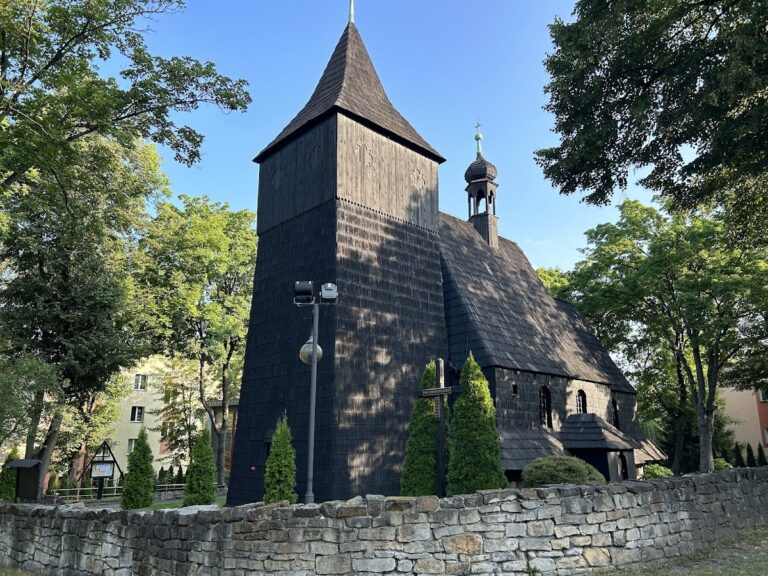
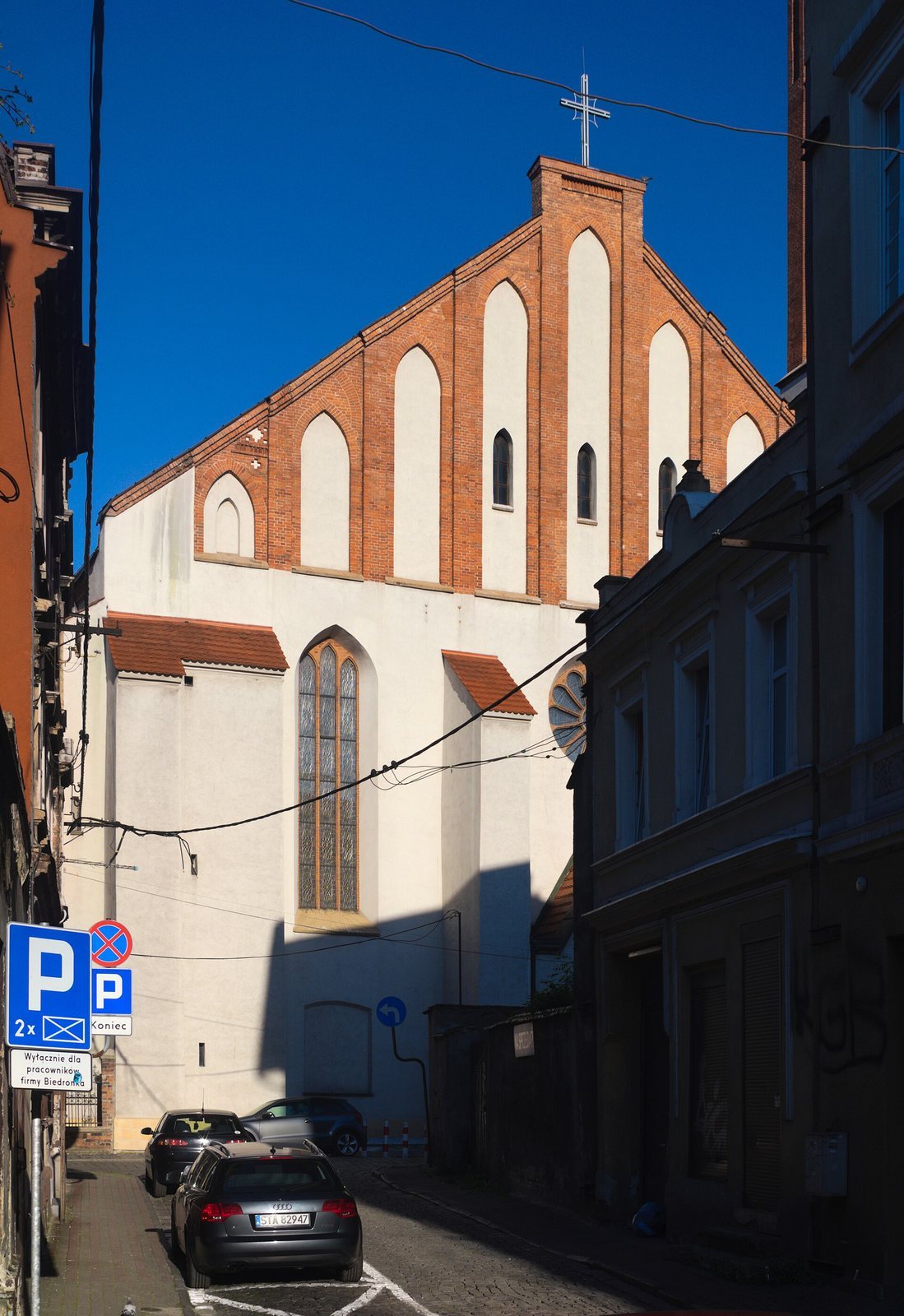
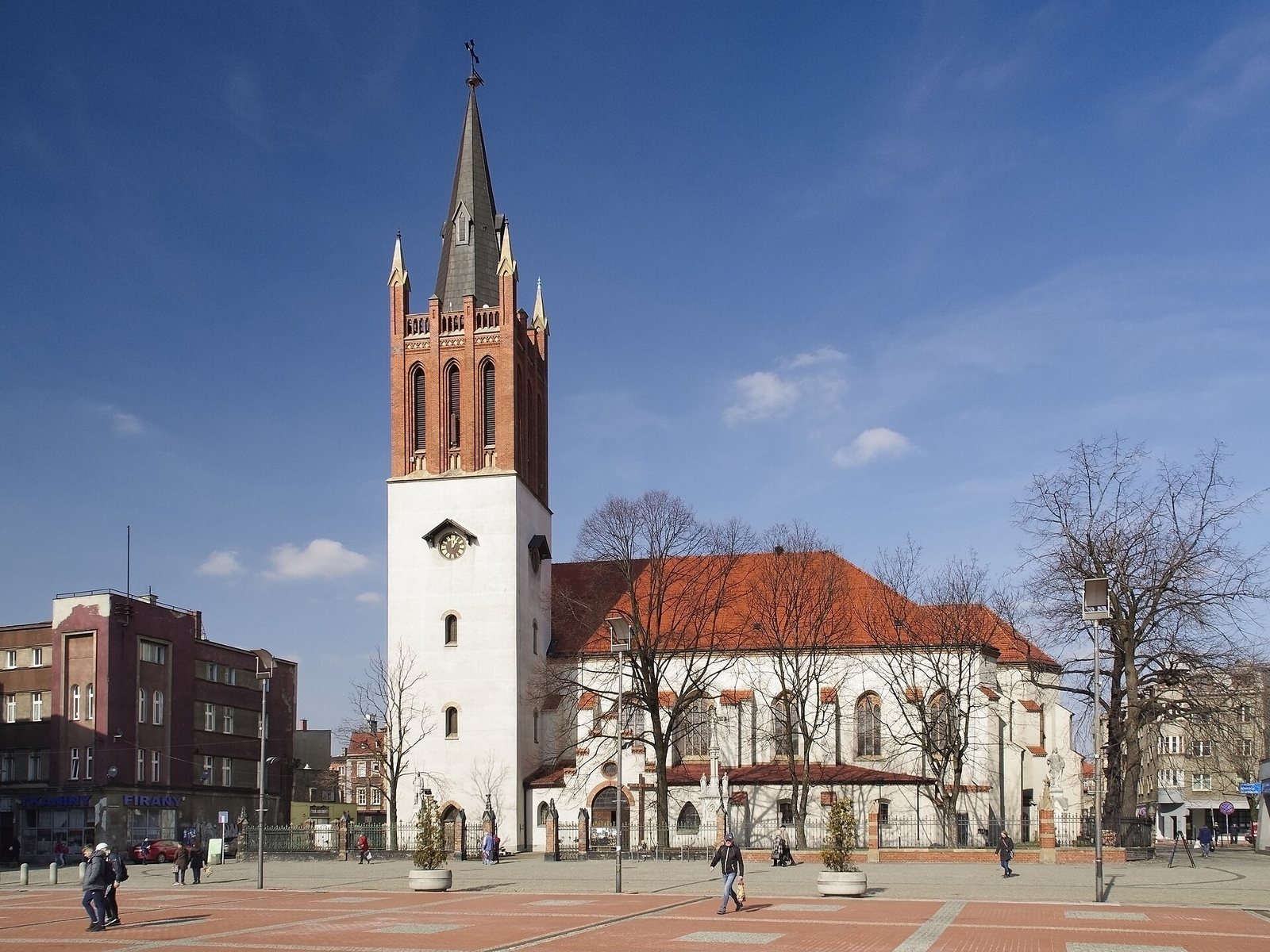
Church of St. Mary is a brick building with a predominantly Gothic appearance. It stands north of Bytom’s Ring and has a single tower on its south side. The surviving Gothic main nave and chancel form the medieval core, while the western section and side aisles belong to the construction completed after the 1515 fire. A keystone above the organ vault carries the dates 1231 and 1257, linking the building’s interior to its early history.
Architectural features
Entrances and furnishings
A Renaissance double portal marks one of the church’s architectural features. Inside are a wooden pulpit and a stone baptismal font. The sacristy door has iron fittings, bears the date 1681, and carries a monogram incorporating the names of Jesus, Mary, and Joseph.
Tower and organ
The tower houses four bells and two clock gongs. The bells are named Salutaris Hostia, Saint Joseph, Angelus Domini, and Rex Gloriae. The organ has 44 stops, three manuals, and a pedal. Its electro-pneumatic action uses electrical controls and compressed air to transmit the movement of the keys and stops. After earlier repairs by organ builder Olgierd Nowakowski, a comprehensive renovation and conversion of the instrument for concert use was completed in 2022.
Altars, paintings, and memorials
High altar paintings
The Baroque high altar contains a seventeenth-century painting of the Assumption of the Virgin Mary by Francesco Curradi. A nineteenth-century version of the same subject by Bonaventura Emler occupied the high altar until the 1930s and is now displayed on a wall in a side aisle.
Bytom Madonna
The Bytom Madonna is a tempera painting on a limewood panel made around 1430. It originally showed Mary and the Christ Child against a plain gold background and was formerly kept in the high altar, where it was regarded as miraculous. After the 1515 fire, the painting was restored and supplemented with figures of Saint Catherine of Alexandria and Saint Agnes of Rome, early Christian female saints honored in Catholic devotion, while a decorative background was added. Since its return in 1973, the image has been displayed in the retable, the decorated structure behind an altar, of a side altar.
Burial and commemorative features
The church contains the burial crypt of the Donnersmarck family and an epitaph for Marianna Gutmann dated 1681. Sculptures of saints and other paintings form additional parts of the interior furnishings.