Oratorio di San Protaso: A Medieval Romanesque Oratory in Milan
Site at a Glance
- Rating
- 4.5
- Popularity
- Very Low
- Country
- Italy
- Primary era
- Medieval
- Eras represented
- Medieval, Early Modern
- Civilizations
- Duchy of Milan, Holy Roman Empire, Spanish
- Site type
- Religious
- Remains
- Chapel
On this page13 sections
History
Oratorio di San Protaso is a small Catholic oratory in Milan, Italy, built around AD 1000 in the Lombard Romanesque tradition. It stood outside the city’s medieval walls near the settlement of Laurentiglio, in the former municipality of Corpi Santi. Its precise date and earliest origins remain uncertain. Probably founded by Benedictine monks of the Basilica of San Vittore al Corpo, it served as a place of worship for local peasants and was dedicated to Saint Protasius, an early bishop and martyr associated with Milan.
Early religious history
The building’s unusual alignment may relate to an earlier road running west from Milan’s medieval walls beside the Olona canal. Another interpretation connects it with the summer solstice and an older pagan practice, raising the possibility that the oratory replaced a pagan shrine. These explanations remain part of the building’s historical interpretation rather than established facts about its foundation.
Milanese tradition connects San Protaso with the siege of Milan by the forces of Frederick I Barbarossa in 1161–62. Barbarossa, the twelfth-century Holy Roman Emperor who campaigned against the communes of northern Italy, is said to have prayed in the oratory after Milanese resistance near Lorenteggio and to have spared the building after the city’s defeat. Another tradition tells of a hermit who stayed there during the fourteenth-century plague and whose prayers were believed to protect the village.
In 1364, the oratory temporarily housed Pietro De Franzonis of Tavernasco, chaplain of the nearby church of San Cristoforo sul Naviglio Grande, while he waited for a residence to be built. It later became a hospice for travelers along the nearby naviglio, or canal, and subsequently served as a lazaretto, an institution for isolating people affected by or suspected of carrying epidemic disease.
Religious communities and changing uses
For several years, the oratory functioned as a chapel for the Angeliche of Saint Paul, a women’s religious order founded in 1530 by Countess Ludovica Torelli. The nuns lived in the adjacent farmhouse, which may then have served as a convent before becoming a rural complex. In the seventeenth century, control of the oratory passed to the Olivetans, a Benedictine congregation founded by Bernardo Tolomei.
During the Napoleonic era, imperial troops used the building as a weapons depot. Its religious function ended, and the neglected interior was later used as a hayloft and tool store. Tradition also associates San Protaso with Count Federico Confalonieri, who allegedly met other Carbonari there. The Carbonari were members of a secret revolutionary movement active in Italy during the early nineteenth century, particularly in opposition to Austrian rule. A supposed tunnel from the apse to the Pusterla of Sant’Ambrogio, or possibly to Sforza Castle, was closed during twentieth-century restoration, although its route was not found.
Renewed worship and urban pressure
After an event regarded locally as miraculous, the oratory returned to use for prayer and worship. Its religious role declined after the neighboring parish church of San Vito al Giambellino was completed in 1937, and the building then fell into severe neglect. In the 1950s, when fields still surrounded it and lizards were frequent visitors, residents gave it the popular name “Little Church of the Lizards.” Its appearance inspired Milanese songwriter Piero Mazzarella and numerous painters.
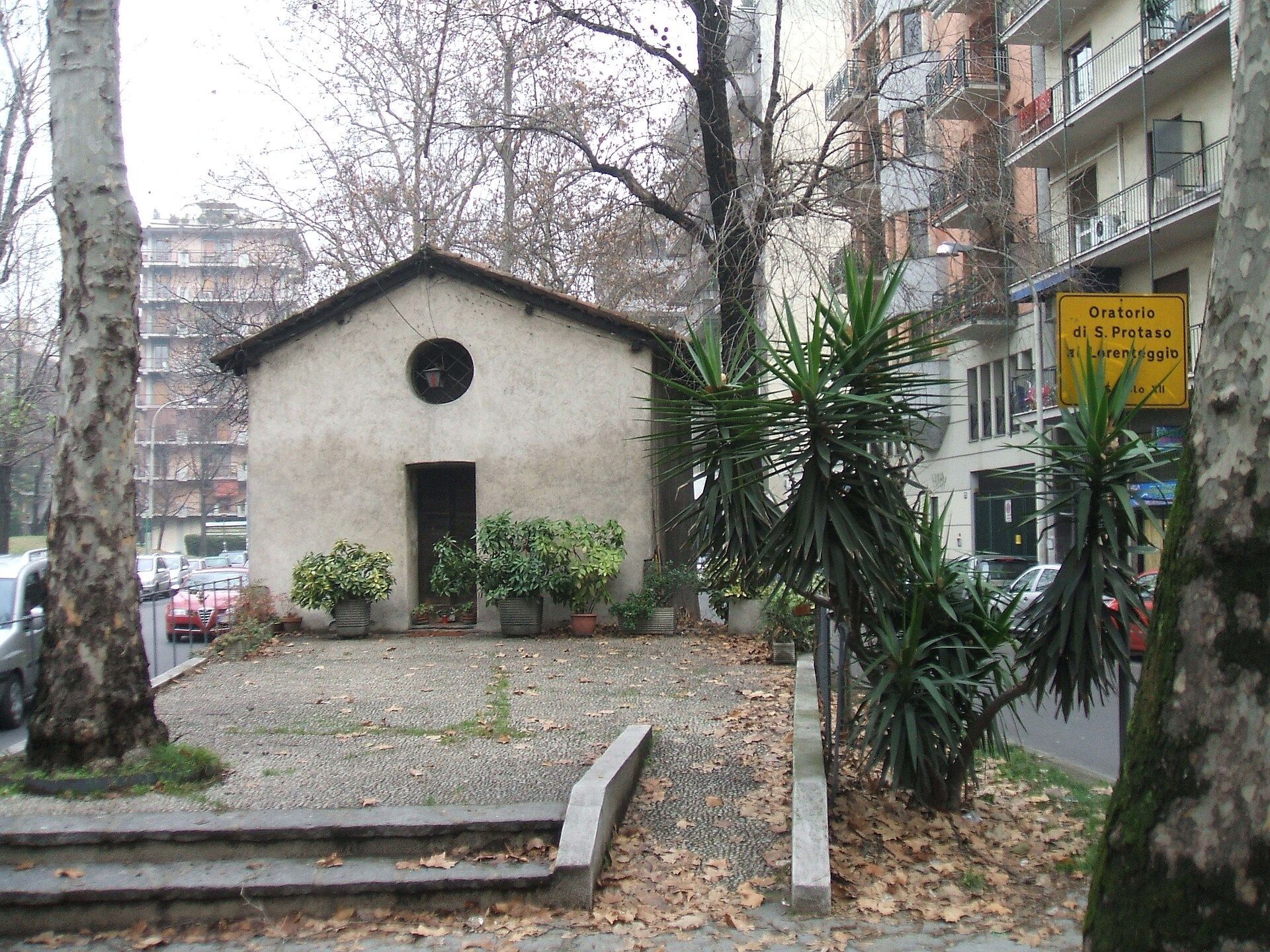
Urban expansion placed the building at repeated risk. Lorenteggio, briefly an independent municipality, became part of Milan in 1923. Later, the Municipality of Milan expropriated the surrounding land and planned to demolish both the oratory and the adjacent Cascina San Protaso to widen Via Lorenteggio. Local protests changed the road scheme, allowing the oratory to remain in the traffic median.
The building was restored in 1986 with support from the Lions Club, the Lorenteggio traders’ association, several banks, and local residents. Architect Luigi M. Guffanti supervised the work. The oratory remains a Catholic building of the Ambrosian rite, the distinctive liturgical tradition associated principally with the Archdiocese of Milan. It has not been formally deconsecrated, although its municipal ownership has placed it in profane use. A pebble-paved forecourt was added after the restoration. In 2008, a boundary stone found near Via Inganni was installed there, marking the former boundary between Corpi Santi and Lorenteggio.
Remains
Building and layout
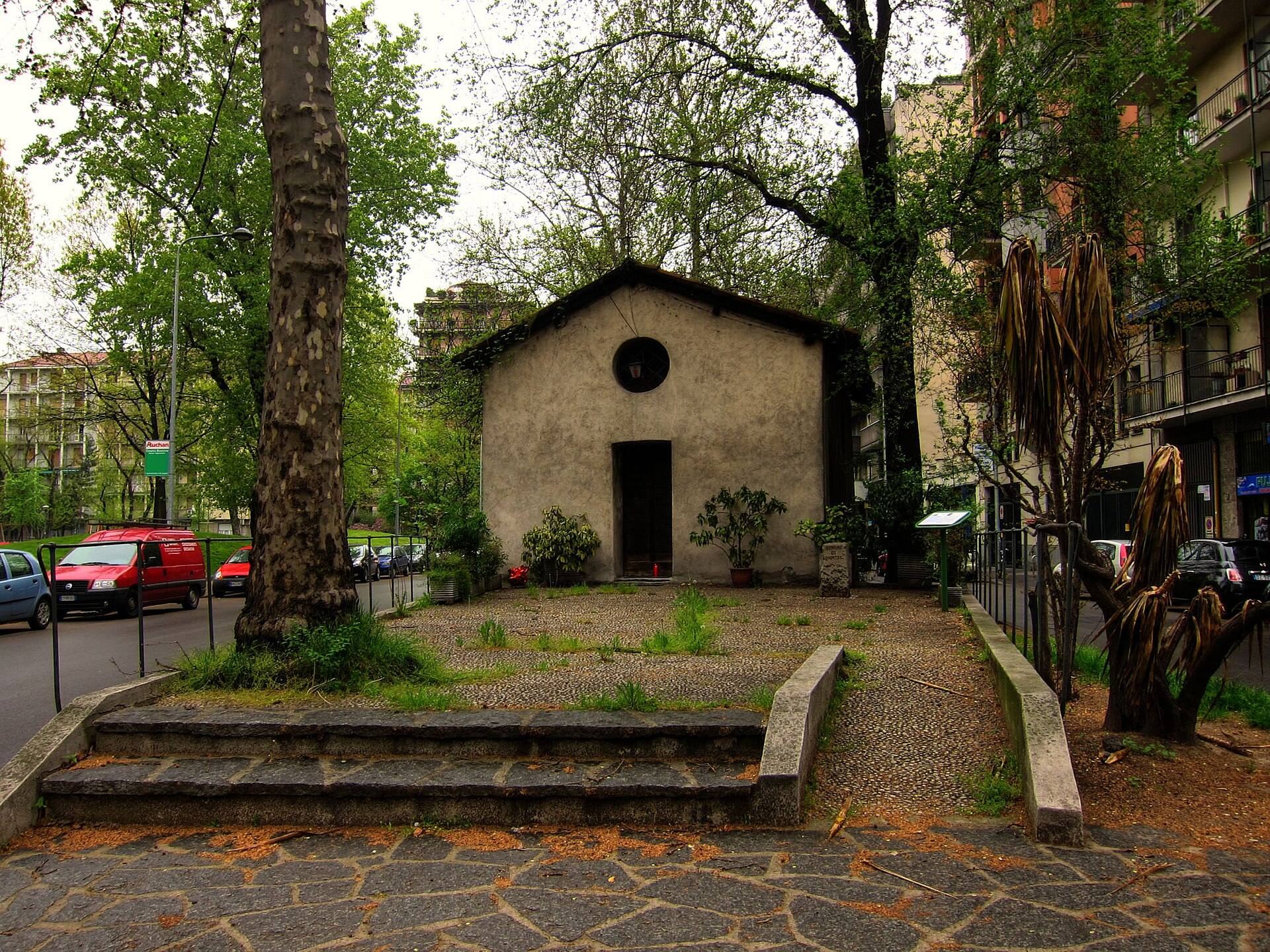
Oratorio di San Protaso is a compact rectangular structure with a gabled roof and a wooden coffered ceiling, meaning a ceiling divided into recessed or framed panels. Its simple masonry form and restrained openings reflect Lombard Romanesque architecture. The building now stands in the median strip between the two directions of traffic on Via Lorenteggio.
The entrance has a small wooden door beneath an architrave, or horizontal supporting lintel, with a circular window above. Three pointed-arch slit windows light the interior. Two are set in the right-hand wall, while one is in the left-hand wall between two frescoes. These narrow openings replaced two larger original side windows.
Medieval and Renaissance frescoes
Apse hunting imagery
The lower part of the apse preserves fragments of the oldest fresco. Probably contemporary with the construction of the oratory, or only slightly later, it dates to the eleventh or twelfth century. Its imagery consists of hunting scenes or figures drawn from a bestiary, a medieval symbolic repertory of animals that could carry moral or religious meanings.
Saint Catherine of Siena
A fresco of Saint Catherine of Siena occupies the left wall. It is signed by Fra’ de Porta Vercellina. The inscription naming its patron, Michele de Zeni Grando, is now almost illegible, and the date is uncertain between July 14, 1428, and July 14, 1498.
Late-fifteenth-century wall painting
The same wall contains fragmentary remains of a late-fifteenth-century fresco attributed to the Zavattari school. The surviving imagery includes a Crucifixion, a distorted figure probably representing Saint John the Evangelist, and part of a church façade. The architectural fragment may have formed the back panel of an enthroned image of the Virgin Mary.
Baroque apse fresco
Madonna del Divino Aiuto
The upper apse contains the late-seventeenth-century Baroque fresco known as Madonna del Divino Aiuto, or Virgin Mary of Divine Help. The Virgin appears among angels and Saints Bernardo Tolomei, Frances of Rome, and Victor the Moor. Tolomei founded the Olivetan congregation, while Frances of Rome founded the community associated with the Benedictine Oblates.
Local tradition holds that the image became clearer after limewash had covered it three times, when the building was being considered for conversion into a dwelling. The event led local peasants to regard the fresco as miraculous, abandon the residential plan, and continue venerating the Virgin. Flowers and votive lights are still placed before the building.
Restoration and forecourt
The 1986 restoration treated both the exterior and interior. Work included repairs to the plaster and roof, the detachment and restoration of the frescoes before their repositioning, repainting of the walls, cleaning of the terracotta floor, and replacement of the wooden coffered ceiling.
The pebble-paved forecourt contains the boundary stone installed in 2008. Found near Via Inganni and dating from the beginning of the nineteenth century, it physically marks the former municipal boundary between Corpi Santi and Lorenteggio.