Osnabrück Town Hall: A Late-Gothic Civic Building and Peace Congress Site


Site at a Glance
- Rating
- 4.5
- Popularity
- Low
- Country
- Germany
- Primary era
- Medieval
- External website
- Open
- Eras represented
- Medieval, Early Modern, Modern
- Civilizations
- Holy Roman Empire
- Site type
- Civic
- Remains
- Town Hall
On this page11 sections
History
Osnabrück Town Hall is a late-Gothic civic building in Osnabrück, Germany, commissioned by the council of the Hanseatic city in the fifteenth century. Construction began in 1487, the topping-out ceremony took place in 1505, and the building was completed in 1512. Interior decoration continued until 1575. The town hall became historically important as one of the two places where negotiations connected with the Peace of Westphalia were conducted.
A new town hall for the market
The present building replaced an earlier town hall on the Markt. That predecessor continued in use into the sixteenth century and remained standing until 1836. It was the first town hall on the market site, while the present structure is the second. A timber-framed house now occupies the location of the older building.
The peace negotiations, 1643 to 1648
From 1643 to 1648, Osnabrück Town Hall hosted delegations negotiating the end of the Thirty Years’ War, a major European conflict shaped by religious, dynastic, and political rivalries. Envoys of the Kingdom of Sweden met representatives of the emperor and the imperial estates in Osnabrück. At the same time, negotiations between the emperor and France took place in Münster. Agreements associated with both town halls produced the Peace of Westphalia in 1648, treaties that ended the war and reshaped political and religious relations within the Holy Roman Empire and Europe.
Alterations and reconstruction
Between 1846 and 1880, the Hall of Peace was converted into a grand hall. At the beginning of the twentieth century, this change was reversed and the room was restored to its earlier form as a council chamber. Its original civic function is now represented by the annual Handgiftentag on 2 January.
British aircraft and other Allied bombing repeatedly struck the town hall on 13 September 1944. The building burned down to its foundation walls, but most historic furnishings and interior decoration survived because they had been placed in secure storage before the attacks. In autumn 1946, the municipal council decided to rebuild it, and reconstruction began on 2 May 1947. Postwar shortages led the city to offer coal from its leased Anneliese mine at Schafberg in exchange for building materials. The restored town hall, together with its historic furnishings, reopened ceremonially on 24 October 1948 during commemorations of the three-hundredth anniversary of the Peace of Westphalia.
Later public history
On 29 March 2003, about 40,000 people formed a human chain roughly 50 kilometres long between the town halls of Osnabrück and Münster to protest the Iraq War. The European Commission awarded Osnabrück Town Hall the European Heritage Label on 15 April 2015 because of its association with the Peace of Westphalia. On the night of 5 July 2019, a 47-year-old man set fire to the building’s more than five-hundred-year-old door. The damage was superficial, and the traces were removed.
Remains
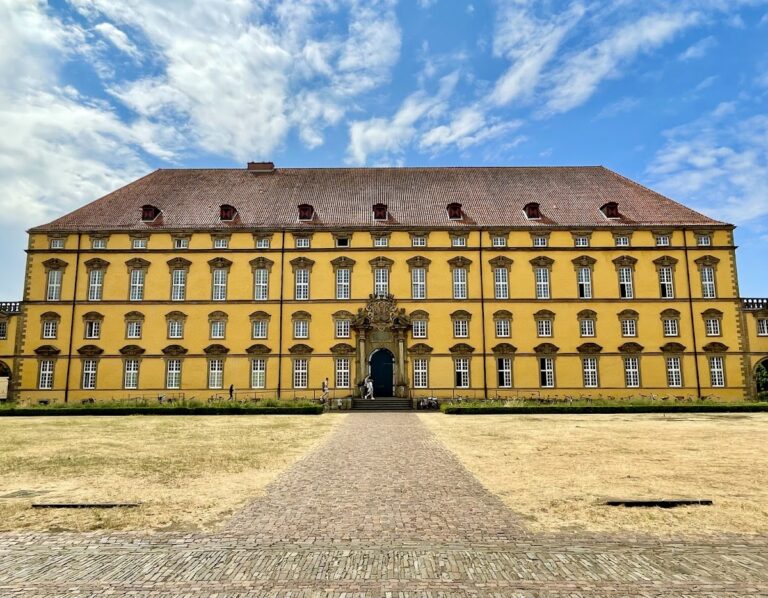
Osnabrück Town Hall stands on the western side of the Old Town market beside the parish church of Saint Mary. Its compact rectangular structure is a late-Gothic building with four levels: a low basement, a ground floor, an upper floor, and an attic. An approximately 18-metre-high hipped roof dominates the building and is nearly as high as the section from the foundation slab to the eaves. Dormer windows light the attic. Six cylindrical turrets with conical roofs rise along the roof’s lower edge. Four mark the corners, while two stand at the centres of the long sides, giving the building the appearance of a structure guarded by fortress-like watchtowers and corner towers.
Market facade and entrance
A broad flight of steps has led to the entrance facing the market since 1846. The two-sided staircase replaced a retractable wooden stairway and ends at a landing with a tracery balustrade and a polygonal bay window aligned with the entrance portal. The door is approximately five hundred years old. Its heavy bronze handle carries the date 1648 and a dove. Above the entrance stands a statue of Charlemagne, the early medieval Frankish ruler crowned emperor in 800, who is identified here as the founder of the city and the Roman Catholic Diocese of Osnabrück.
Eight imperial statues flank Charlemagne on the facade. They represent Sigismund, Frederick II of the House of Hohenstaufen, Rudolf of Habsburg, Wilhelm I, Frederick I Barbarossa, Arnulf of Carinthia, Maximilian I, and Ludwig the Bavarian. The nineteenth-century statues were donated by the Prussian royal family, and former statue bases remain visible on the south side. Earlier representations of the Nine Worthies also appeared on the facade: Hector, Alexander the Great, Julius Caesar, Judas Maccabaeus, Joshua, David, King Arthur, Charlemagne, and Godfrey of Bouillon. They were arranged in three groups of pagan, Jewish, and Christian chivalric heroes.
Historic rooms and collections
Hall of Peace
The Hall of Peace lies a few metres to the left behind the entrance. Its wooden panelling and benches belong to a room used for peace negotiations. Portraits of 42 European envoys connected with the peace congress line the walls, alongside portraits of Queen Christina of Sweden, King Louis XIV of France, and Emperor Ferdinand III. A decorated sixteenth-century crown-shaped chandelier hangs from the wooden ceiling. Its ornament includes shields bearing the arms of Osnabrück.
Town hall treasury
The town hall treasury stands directly opposite the Hall of Peace. It stores and displays civic silver, coins, minting dies, and historical documents. Among its notable objects are an imperial goblet dating from the thirteenth or fourteenth century and Osnabrück’s oldest marksmen’s chain. The documentary material includes a replica of the Peace of Westphalia, the Osnabrück Instrument of Peace, and a copy of the 1171 document in which Emperor Frederick Barbarossa granted Osnabrück the right to exercise its own jurisdiction.
City model
A model on the upper floor reconstructs Osnabrück as it appeared in 1633. It is based on a city map made that year by Wenzel Hollar, a seventeenth-century draftsman and engraver known for topographical views and maps. The sculptor and genre painter Heinrich Bohn constructed the model between 1955 and 1957.