Morića Han: An Ottoman Caravanserai in Sarajevo


Site at a Glance
- Rating
- 4.6
- Popularity
- Low
- Country
- Bosnia and Herzegovina
- Primary era
- Early Modern
- Eras represented
- Early Modern
- Civilizations
- Ottoman
- Site type
- Economic
- Remains
- Caravanserai
On this page10 sections
History
Morića Han is a former Ottoman caravanserai in Sarajevo, Bosnia and Herzegovina, built in 1551 during the city’s sixteenth-century expansion. A caravanserai was an enclosed lodging complex for travelers, merchants, and their animals. The building formed part of the Ottoman development of Sarajevo’s old town and belonged to the vakuf, or religious and charitable endowment, of Gazi Husrev Beg, the Ottoman governor and military-administrative official in Bosnia who died in 1541.
Ottoman Sarajevo
Morića Han was the third major inn built in the present-day old town. It followed the Kolobaran Han, established in 1462 by Isa Beg Isaković, an Ottoman governor associated with Sarajevo’s foundation and early growth, and the Tašlihan, completed in 1543. Together with the Đulov-han, the Kolobaran Han, and the Tašlihan, Morića Han was regarded as one of Sarajevo’s four most important caravanserais.
The han developed alongside a market hall, a mosque, and other buildings connected with the expansion of sixteenth-century Sarajevo. Its ownership by Gazi Husrev Beg’s vakuf linked it to a wider ensemble whose revenues supported designated buildings and institutions. For more than three centuries, until 1930, Morića Han also hosted meetings of Sarajevo’s 80 craft guilds, organized associations of people working in the same trade.
Names and Ottoman tenants
The word han originally described a simple inn in Turkish and later, from the second half of the eighteenth century, was also used for caravanserais. Morića Han was once known as Han Džedid, meaning “second new inn.” Evliya Çelebi, a seventeenth-century Ottoman traveler and writer, recorded it in 1659 as Hadži-Bešir’s Han, indicating that Hadži-Bešir was then the tenant or lessee of the endowment property.
The name Morića Han became established after Mustafa-aga Morić operated the building until 1815 and his son Ibrahim-aga continued until 1827. Another tradition associates the name with the Morić brothers, whose feud and rebellions against Ottoman rule caused disturbances in Sarajevo during the mid-eighteenth century. The han also survives in several sevdalinka, traditional Bosnian urban folk songs known for lyrical and emotionally intense themes. These include Kasno pođoh iz Morića hana, Jutros rano prođoh kraj Morića hana, Braća Morići, and Vila viče sa vrha Trebevića. The last song was used in Emir Kusturica’s film When Father Was Away on Business.
Damage, fire, and reconstruction
Prince Eugene of Savoy’s attack on Sarajevo in 1697 damaged the han. Prince Eugene was a Habsburg military commander and imperial prince active in the European wars of the late seventeenth and early eighteenth centuries. Morića Han burned in 1831 and was restored by 1833. Further damage in 1852 led to another renovation.
A major fire in December 1957 severely damaged the building, including its roof. Temporary protective measures followed, but the roof collapsed several years later. By 1970, only the south wall remained intact, while rubble covered the courtyard. The building was reconstructed between 1971 and 1974, with an important role played by the Architectural Faculty of the University of Sarajevo. Water penetration had damaged the walls and the wooden structure supporting the floors, so the reconstruction reproduced the historic building while incorporating concealed iron supports and reinforced concrete for stability. The original use as an inn was initially expected to continue, and preparations were made for restaurant use.
A further restoration was approved in 2018 but was not initially undertaken because it was considered potentially harmful to the building’s historic character. Stari Grad returned ownership of Morića Han to the Gazi Husrev Beg endowment in 1998. The endowment later rented parts of the building for uses regarded as compatible with its historic setting.
Political and cultural associations
On 29 July 1878, Sarajevo citizens gathered at Morića Han and founded the Narodni Odbor, or People’s Council. The council coordinated opposition to the Austro-Hungarian occupation of Bosnia and Herzegovina, giving the building a role in the city’s political history beyond its commercial and guild functions.
Morića Han’s preservation also represents the continuity of Baščaršija after fires destroyed the district’s other caravanserais. It is regarded as the only surviving larger Ottoman inn in Sarajevo and the last surviving caravanserai in Bosnia and Herzegovina. Bosnia and Herzegovina declared the building a national monument on 10 October 2019.
Remains
Morića Han stands in the Baščaršija bazaar district on Sarači Street, on the north side of the boulevard that formed the principal street of historic Sarajevo. It was built at roughly the same time as the Brusa Bezistan to the south. The Gazi Husrev Beg Mosque lies about 100 meters to the southwest, the Baščaršija Mosque about 100 meters to the southeast, and the Muslihudin-Čekrekčije Mosque about 150 meters to the northeast. A medrese, an Islamic educational institution, the city’s old Orthodox church, and the Novi Hram synagogue are also nearby.
Courtyard and outer structure
The building measures approximately 44.70 meters from north to south and 38.40 meters across. It has a ground floor and an upper floor, while its large dimensions remain relatively inconspicuous among the smaller shops surrounding it. The plan is arranged around a paved, trapezoidal courtyard about 27 meters by 20.5 meters. Its narrower side measures only 13.1 meters. The courtyard covers about 350 square meters, most of which is roofed, leaving about 135 square meters open near the center. Building wings enclose it on all four sides, and a large tree rises from the open central area above the surrounding roofs.
The courtyard and ground floor contained stables and storage rooms. Their walls were about 70 centimeters thick, reducing the danger of fire, while some walls facing the courtyard were approximately 20 centimeters thick. The ceilings reached 1.2 meters in thickness because they were built in layers of lime mortar and clay. The roof was originally covered with wooden shingles and later with stone shingles.
Entrances and upper floor
The principal entrance opens directly into the courtyard and measures 2.2 meters wide. A much smaller secondary entrance stands on the east side, on Prote Bakovića Street. The innkeeper’s room was placed above the main entrance, allowing supervision of the building. Wooden stairs lead to the upper floor, where an unusually open central passage had no ceiling. This arrangement allowed views toward the roof, brought more daylight into the passage, and helped ventilation.
The passage measures between 4.0 and 5.2 meters in width and formerly provided access to 40 rooms. Most rooms measured about 4 meters by 3.5 meters. Guest rooms occupied the upper floor alongside a large meeting room used by city notables and craft guilds for assemblies. The complex could accommodate approximately 300 people and 70 animals. Unlike a simple inn, a caravanserai generally expected guests to provide their own food, and Morića Han had no kitchen.
Services and defensive features
The complex had its own water supply, heated rooms, a room for ritual washing, a steam bath, and a toilet in the eastern section. A defensive enclosure and a steel door provided protection during raids. The courtyard contained a well and a fountain. In the northern part of the complex were cellars, a barn, and a kafana, regarded as Sarajevo’s oldest coffeehouse.
Reconstructed interiors and present use
The reconstructed building reuses original architectural components wherever possible. Hidden iron supports and reinforced concrete were added to improve stability, while hollow bricks replaced clay in the walls. Persian calligraphic inscriptions containing poetry by Omar Khayyam, the Persian poet, mathematician, and astronomer known for his verse, decorate the building.
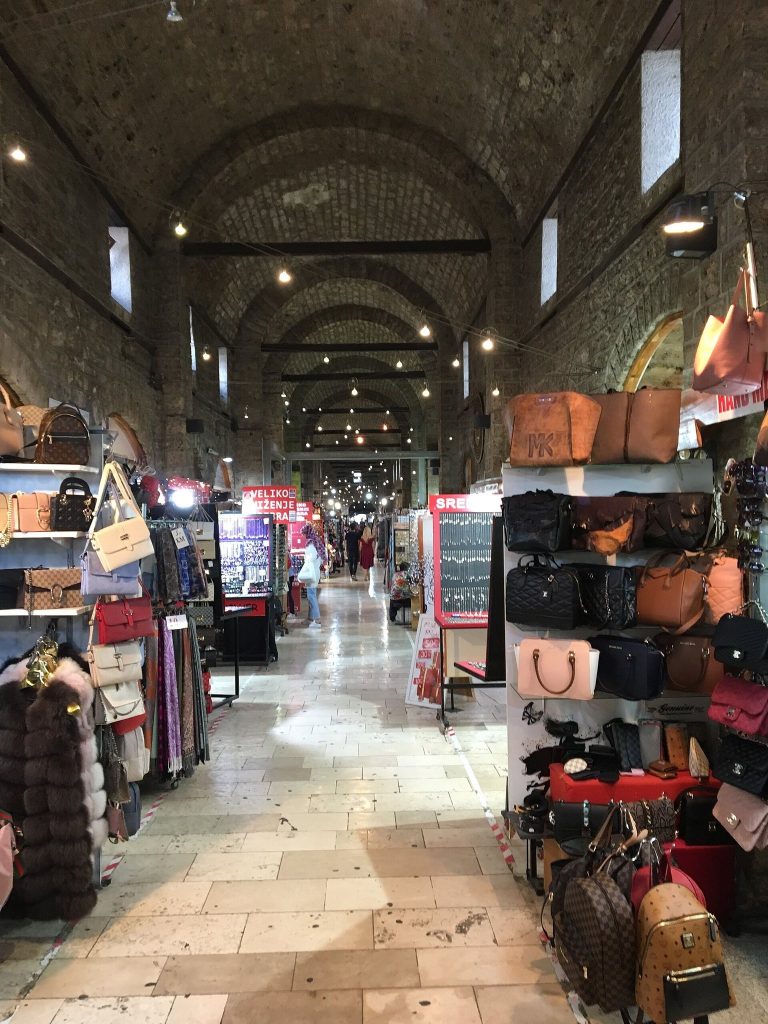
The former accommodation and service areas have been adapted for cafés, a restaurant, offices, religious and cultural organizations, a Persian carpet shop, a copy shop, a travel agency, and other businesses. Exhibitions are also held within the building. Morića Han no longer functions as an inn, but its surviving courtyard plan, upper-floor rooms, service areas, and reconstructed structure continue to express the form of an Ottoman caravanserai within Sarajevo’s historic bazaar district.