Leicester Guildhall: A Medieval Civic and Performance Building


Site at a Glance
- Rating
- 4.7
- Popularity
- Low
- Country
- United Kingdom
- Primary era
- Medieval
- External website
- Open
- Eras represented
- Medieval
- Civilizations
- English
- Site type
- Civic
- Remains
- Town Hall
On this page10 sections
History
Leicester Guildhall is a medieval timber-framed building in the United Kingdom, whose earliest surviving part, the Great Hall, was built around 1390 for the Guild of Corpus Christi. Founded in 1350, this medieval religious and charitable association brought together merchants and gentry to protect trade and carry out religious and ritual activities. The town council purchased the Guildhall late in the fourteenth century, establishing its long civic connection with the building.
The Guild of Corpus Christi
The guild used the Guildhall for banquets and festivals. A guild priest lived there and prayed for deceased members in a chantry chapel, an endowed place of worship for prayers for the dead, at nearby St Martin’s Church. The building therefore served both the social life of the guild and its religious obligations.
In 1589, the Corporation of Leicester, the city’s formal municipal governing body, was created and later adopted the Guildhall as its meeting place and administrative centre. The building hosted council meetings, feasts, court proceedings, and theatrical performances. It remained Leicester’s town hall until the corporation moved to the new Leicester Town Hall in 1876.
Shakespearean tradition and civic memory
Leicester has a tradition linking the Guildhall with William Shakespeare. According to the story, Shakespeare appeared there in the late sixteenth century and encountered the tale of King Leir, which inspired King Lear. No actual evidence supports the tradition. In 2003, the Royal Shakespeare Company performed at the Guildhall for Maya Vision’s BBC series In Search of Shakespeare, written and narrated by historian Michael Wood.
The English Civil War
The Guildhall became a setting for important decisions during the English Civil War, the conflict between supporters of King Charles I and Parliament. When Prince Rupert, a leading Royalist commander, demanded £2,000 from Leicester, the mayor and corporation decided in the building to offer a loan of £500 and appeal to the king.
On 29 May 1645, an army of 6,000 Royalist troops took position outside Leicester’s walls. Further decisions about the city’s fate were made at the Guildhall. The following day, the Royalists repeatedly demanded Leicester’s surrender while the city attempted to delay them. Prince Rupert eventually attacked, breached the walls, and forced the defenders into a last stand outside the Guildhall and St Martin’s Church.
Royalist troops entered the building and looted Leicester’s archives, mace, and seal. Their victory was reversed several weeks later after their defeat at Naseby. Records of expenditure on wine and beer for Oliver Cromwell indicate that he probably visited the Guildhall on several occasions, although they do not establish that he stayed there.
Library, police station, and museum
The Guildhall library was established in 1632, when Leicester’s town library was moved into the east wing. It is described as the third-oldest library in England and includes a fifteenth-century New Testament written in Greek. From 1836, Leicester’s first police force also occupied a station in the building. After the corporation moved to the new town hall, the Guildhall continued to house the police station and was later used as a school.
By the 1920s, the building had become increasingly dilapidated and faced proposals for demolition. Intervention by the Leicestershire Archaeological and Historical Society led Leicester City Council to restore it. The work was completed in 1926, when the Guildhall opened as a museum.
Modern interpretation and use
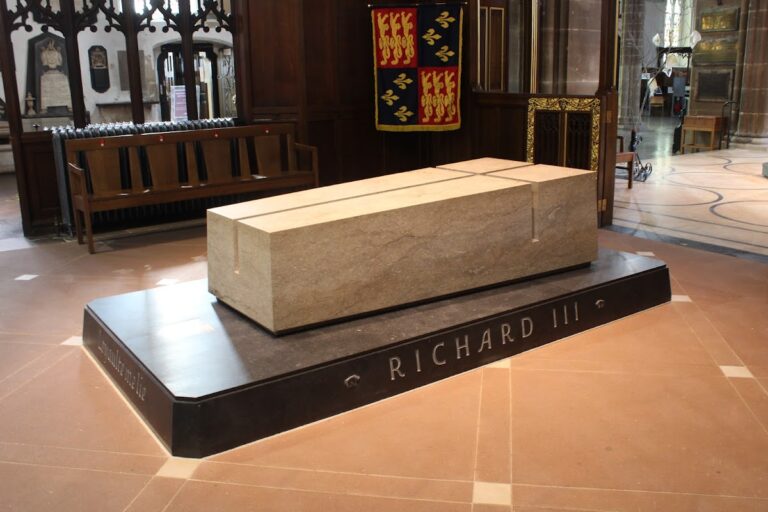
On 4 February 2013, a press conference at the Guildhall confirmed the archaeological discovery of the remains of Richard III at the nearby Greyfriars car park. Richard III was the last Plantagenet king of England, reigning from 1483 until his death at the Battle of Bosworth in 1485. The former Alderman Newton’s Greencoat School building near the burial site opened as a permanent Richard III museum in 2014.
Leicester Guildhall is now part of Leicester Museums and Galleries and functions as both a museum and a performance venue. It became a Grade I listed building on 5 January 1950. Grade I is England’s highest category of listed-building protection, reserved for buildings of exceptional architectural or historic interest. The Guildhall and the surrounding area, including the Cathedral of St Martin, form part of the Cathedral-Guildhall Conservation Area. The building is also reputed to be Leicester’s most haunted, with five reported ghosts, a reputation that has brought it appearances on television programmes including Most Haunted.
Remains
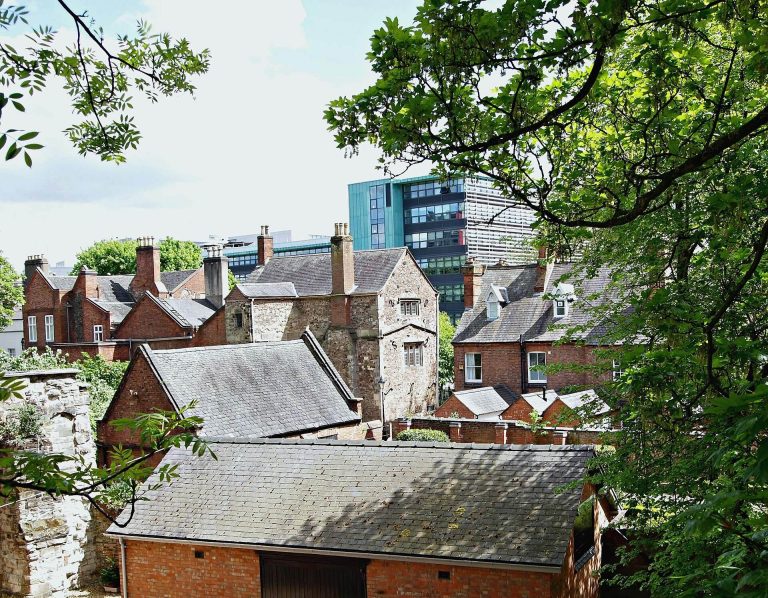
Leicester Guildhall is a medieval timber-framed building whose earliest surviving element is the Great Hall, constructed around 1390. It stands within Leicester’s former walled city on the street now called Guildhall Lane, beside St Martin’s Cathedral. Its setting connects the building with the former city fortifications and with the nearby church where the Guild of Corpus Christi maintained its chantry chapel. Restoration completed in 1926 allowed the historic structure to be adapted for museum and performance use.
The Great Hall and medieval setting
The Great Hall forms the earliest part of the Guildhall and preserves the building’s origin as a meeting place for the Guild of Corpus Christi. Its timber frame consists of a structural wooden framework with the spaces between its members filled by other materials. The hall’s later civic and public functions developed around this medieval core.
The east wing library
The east wing contains the Guildhall library, including a fifteenth-century Greek New Testament. The collection represents the building’s continuing connection with Leicester’s civic and intellectual institutions after the town library was moved there in 1632.
Mayor’s Parlour and adapted interiors
The Mayor’s Parlour contains the coat of arms of King Charles I. Other parts of the building retain the results of its long adaptation to civic, police, educational, museum, and performance uses, with the restored structure continuing to accommodate its present public functions.