Marienkirche: The Parish Church of Botenheim


Site at a Glance
- Rating
- 4.3
- Popularity
- Very Low
- Country
- Germany
- Primary era
- Medieval
- Eras represented
- Medieval, Early Modern, Modern
- Civilizations
- German, Holy Roman Empire
- Site type
- Religious
- Remains
- Church
On this page19 sections
History
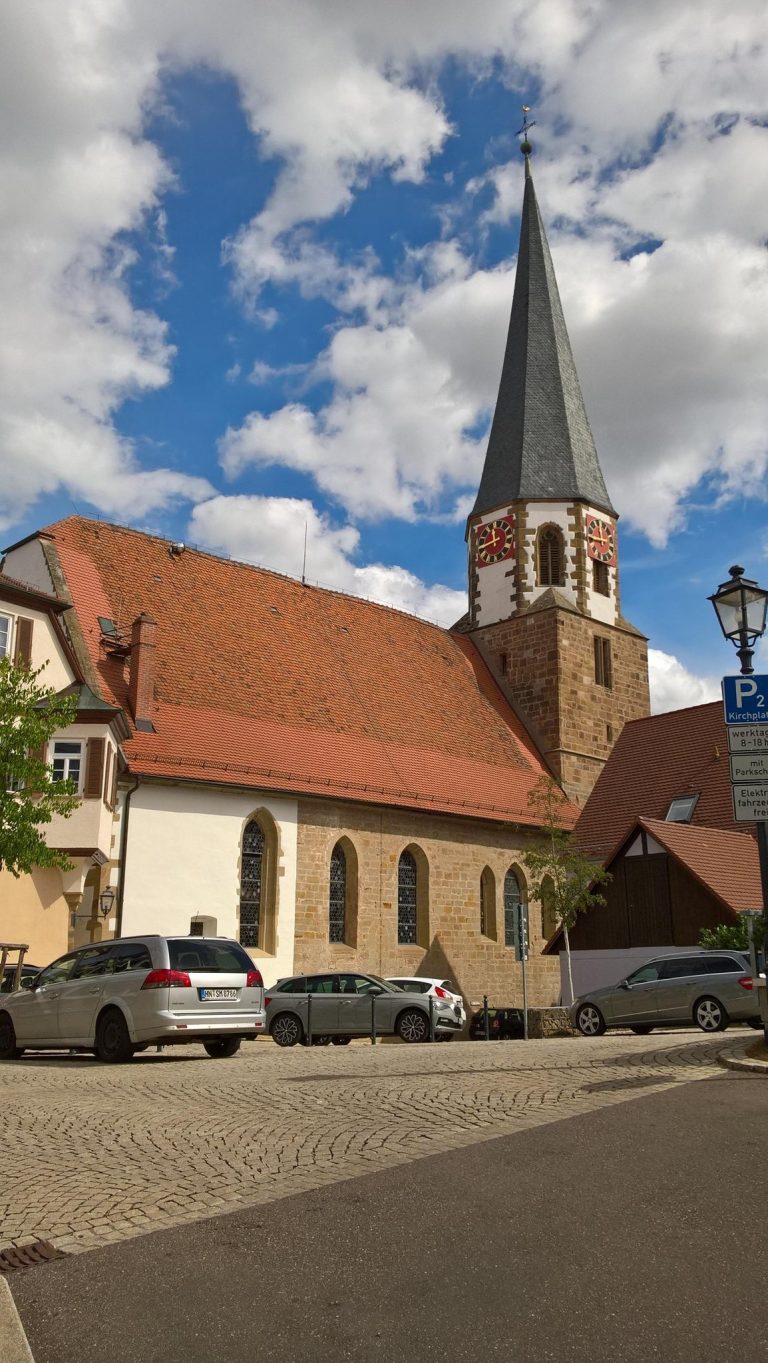
Marienkirche is a medieval parish church in Botenheim, Germany, now a district of Brackenheim, whose oldest surviving element, the base of its choir tower, dates from around 1280. Dedicated to the Virgin Mary, the church developed as Botenheim separated from the parish of St. Martin’s Church in Meimsheim and was already an independent parish when it was first mentioned in 1351. A village cemetery formerly surrounded the church.
From dependent church to independent parish
Botenheim and Alt-Cleebronn originally belonged ecclesiastically to Meimsheim. The construction of a substantial church is thought to have accompanied Botenheim’s separation from the mother parish around 1280. The church’s patronage was first held as a fief of Worms by the Lords of Magenheim. In May 1366 it passed to the Lords of Talheim, and in November of that year to a knight named Hofwart. By 1443, the church was in the possession of Württemberg, a historical territory and later state in southwestern Germany.
In 1443, Count Ludwig I transferred the parishes of Botenheim, Pfaffenhofen, and Ramsbach to the nuns of Frauenzimmern Convent in exchange for their possessions in the Zabergäu, the region centered on the Zaber valley. He retained the right of presentation, the legal authority to nominate or appoint a parish priest. The pastor was proposed jointly by the nuns and the townspeople. Around 1480, Alt-Cleebronn separated from Botenheim and became an independent parish.
Reformation and wartime destruction
Württemberg introduced the Reformation in Botenheim in 1534. The early Mass benefice, an endowed ecclesiastical office or income source, was abolished that year, and its benefice house was sold to the community, which built the town hall on the site. Catholic worship was temporarily restored during the Augsburg Interim, a 1548 imperial settlement that required many Protestant territories to restore elements of Catholic practice. In Botenheim, this temporary change lasted from 1548 to 1555. Sebastian Weinmar was probably the first Protestant pastor and served until 1555.
The Thirty Years’ War, the European conflict of 1618 to 1648 shaped by religious and dynastic struggles, brought severe damage to the village. Botenheim was temporarily uninhabited and half burned down, while imperial soldiers devastated the church in 1639. Further damage followed in 1647. The parish was repeatedly vacant in the late seventeenth century, and the church served as a branch parish of Brackenheim from 1647 to 1659 and again from 1690 to 1698.
In 1668, Pastor Ludwig Braun ordered an old tombstone in the choir to be lifted so that the grave beneath it could be examined for possible antiquities. The grave was empty and was sealed again. An altar crucifix was acquired in the same year.
Repairs and eighteenth-century rebuilding
During the pastorate of Johann Georg Härlin, from 1701 to 1736, the deteriorated vicarage was renewed and furnishings lost during the war were reacquired. A gallery was installed in 1721, the cemetery was enlarged, and various repairs were completed.
Pastor Jacob Christoph Köllreuter served from 1737 to 1762. During his tenure, the formerly almost square nave was extended westward in 1745. The tower clock was renovated in 1748 and 1749, the interior decoration was revised in 1749, and a new roof structure was provided for the tower in 1756. The tower roof structure required renewal again in 1789.
Nineteenth- and twentieth-century changes
During the tenure of Pastor August Camerer, from 1811 to 1831, the vicarage was rebuilt into its present form. The church received a new organ, and the cemetery was enlarged again. Old paintings inside the church were covered with whitewash in 1864, and the first heating system was installed in 1894.
Pastor Wilhelm Stotz served from 1904 to 1929, during which the church underwent a fundamental renovation in 1909. The old paintings were uncovered again during this work. A further renovation in 1955 reduced the gallery, opened the choir for the altar and organ, replaced the pulpit, font, and organ, and restored the original west portal as the principal entrance. A later south portal was bricked up, and seating capacity was reduced from 400 to 200. A new four-bell peal was installed in 1959, followed by another exterior renovation in 1961.
The church now belongs to the Meimsheim-Botenheim union parish of the Evangelical State Church in Württemberg. It was part of the Brackenheim church district until the end of 2024 and became part of the Heilbronn-Brackenheim church district on 1 January 2025.
The changing bell peal
Marienkirche had at least three bells by 1740, when a middle bell was mentioned. The bell collection changed repeatedly through recasting and wartime requisition. An older bell was recast in 1833, and that replacement was later surrendered for armaments during the First World War. Two bronze bells were commissioned from the Bachert foundry in 1920, while the defective bell of 1677 was melted down for the work.
During the Second World War, the 1598 Miller bell and the larger 1920 Bachert bell were surrendered. The smaller Bachert bell remained the only bell during the final war years and the early postwar period. The 1598 bell survived the threat of melting and returned to Brackenheim in 1948. In 1959, three additional bells were cast by Heinrich Kurtz in Stuttgart, creating the present four-bell peal with the surviving 1598 bell. The smaller 1920 bell was transferred to Trieben in Styria in 1960 through the Gustav Adolf Foundation, a Protestant charitable organization supporting congregations and churches.
Remains
Medieval structure and later additions
Choir tower and choir
Marienkirche is a single-nave choir-tower church, meaning that its tower rises above or is structurally integrated with the choir, the part traditionally reserved for the altar and clergy. The tower base, the oldest part of the building, dates from around 1280. The choir is oriented eastward and ends in a straight wall.
North sacristy
A sacristy was added to the north side of the choir tower around 1500. Its ceiling is formed by a net vault, a ribbed vault whose intersecting ribs create a net-like pattern.
Nave and entrances
The nave was formerly almost square and was lengthened toward the west in 1745. The original west portal became the main entrance again during the 1955 renovation, while a later portal on the south side was bricked up. The gallery once continued around the choir tower, but its reduction in 1955 left the choir open for the altar and organ.
Interior and commemorative features
Devotional furnishings
A late Gothic Holy Sepulchre, a devotional representation of Christ’s tomb, occupies a niche in the south wall. The wooden crucifix on the altar dates from 1686, while its painted finish dates from 1749. The choir window, made in 1955 by Adolf Valentin Saile of Stuttgart, depicts the Parable of the Sower and the Second Coming of Christ.
Organ
The organ was built by the Weigle organ-building company in 1955 as opus 972. It has ten stops distributed across two manuals and a pedal. Manuals are keyboards played by the hands, the pedal is operated by the feet, and stops select sets of organ pipes.
Epitaphs
Three epitaphs, commemorative monuments honoring the dead, are set into the south exterior wall of the nave. They commemorate village headman Martin Waydenlich, who died in 1576, Hans Ebelmann, who died in 1592, and Ebelmann’s wife Margaretha, who died in 1598. The choir contains the epitaph of village headman Johann Jacob Nördlinger, who died in 1660, and his wife Maria, who died in 1653.
Bells
Sixteenth-century Miller bell
The surviving 1598 bronze bell was cast in Esslingen by Martin and Hans Miller. It has a nominal pitch of A-flat, a diameter of 104 centimeters, and a weight of 661 kilograms. Its inscription states that it flowed from fire and was cast by Martin and Hans Miller in Esslingen in 1598.
Lost historic bells
The bronze bell cast by Jacob Ernst in Esslingen in 1677 measured 52 centimeters across and weighed 80 kilograms. Its inscription included the casting date, 6 October 1677, the foundry, and Pastor M. Ludwig Braun. It was melted down in 1920. A bronze bell cast by Heinrich Kurtz in 1833 measured 80 centimeters and weighed 262 kilograms. Its inscription urged listeners to measure each stroke of the bell against the coming day, and named the pastor, mayor, village headman, and church trustee. It was surrendered for armaments during the First World War.
Twentieth-century bells
The larger 1920 Bachert bell had a nominal pitch of B-flat, a diameter of 84 centimeters, and a weight of 345 kilograms. It bore the words “Glory be to God in the highest” and was surrendered during the Second World War. The smaller bell had a nominal pitch of D, a diameter of 66 centimeters, and a weight of 162 kilograms. Its inscription read, “O land, land, land, hear the word of the Lord.” It was transferred to Trieben in 1960.
The three bells cast by Heinrich Kurtz in 1959 are the Cross Bell, the Signal and Arbitration Bell, and the Baptismal Bell. They have nominal pitches of B-flat, D-flat, and E-flat, respectively, and weigh 512, 283, and 203 kilograms. Their diameters are 92.1, 76.2, and 67.9 centimeters. Each carries a biblical quotation, the initials “HK,” and the year 1959. The largest displays a Crucifixion group designed by Helmut Uhrig; the other two carry a cross with Alpha and Omega and a cross with fish and waves.