Church of Sant’ Andrea: A Romanesque Parish Church in Pistoia


Site at a Glance
- Rating
- 4.6
- Popularity
- Low
- Country
- Italy
- Primary era
- Medieval
- External website
- Open
- Eras represented
- Medieval, Early Modern
- Civilizations
- Holy Roman Empire
- Site type
- Religious
- Remains
- Church
On this page11 sections
History
Church of Sant’ Andrea, also known as Pieve di Sant’Andrea, is a Roman Catholic church in Pistoia, Italy, with origins perhaps reaching back to the eighth century and a major rebuilding in the twelfth-century Tuscan Romanesque tradition. Dedicated to Saint Andrew the Apostle, it remains an active parish church in the historic center and serves as the center of its parish under the diocesan clergy of Pistoia.
Origins and medieval rebuilding
The earliest church may have been founded as early as the eighth century, although that building was smaller than the one seen today. During the twelfth century, particularly around 1160–1170 and again in the latter part of the century, Sant’Andrea was enlarged and transformed. Its length was extended while its width remained unchanged, and the resulting increase in height gave the church the strong vertical emphasis that still characterizes it. The rebuilding is associated with the architect Buono, while the mid-twelfth-century facade is attributed to Gruamonte and his brother Adeodatus.
Sant’Andrea functioned as a pieve, a parish church serving a wider district and commonly possessing baptismal rights. Its position along the Via Francigena, the medieval pilgrimage route leading from regions of France toward Rome, may help explain the unusual imagery of the Magi on the principal portal. The church therefore combined local parish responsibilities with a position on an important route used by pilgrims.
Later alterations and artistic commissions
The upper portion of the facade was completed and the central nave received its vault in the late fifteenth century. In 1506, Bernardino del Signoraccio was commissioned to fresco the apse and the lower sections of the walls. Only the central part of that decoration survives, showing God the Father within a mandorla, an almond-shaped halo, supported by four angels.
Several important works were added during the sixteenth century. Giovanni Battista Volponi, known as “lo Scalabrino,” produced the Martyrdom of Saint Andrew for the right altar in collaboration with Bernardino Detti. The work, undertaken in 1531–1532, was completed by Volponi alone. On the left side of the nave, the Melocchi altar contains a Crucifixion by Giovanni Pisano, set against a fresco of the Lamentation and Resurrection dated to around 1507 and attributed to Gerino Gerini in collaboration with Volponi.
During the seventeenth century, the parish priest Bartolomeo Cellesi promoted the addition of further altars along the aisles. Paintings for these altars were commissioned from Cristofano Allori, Alessio Gimignani, and Girolamo Scaglia of Lucca. The church also acquired an organ made by the Trunci workshop, opus 316. Built in 1865 for the church of Castellina di Serravalle Pistoiese, it was later transferred to Sant’Andrea.
Remains
Exterior architecture
Facade
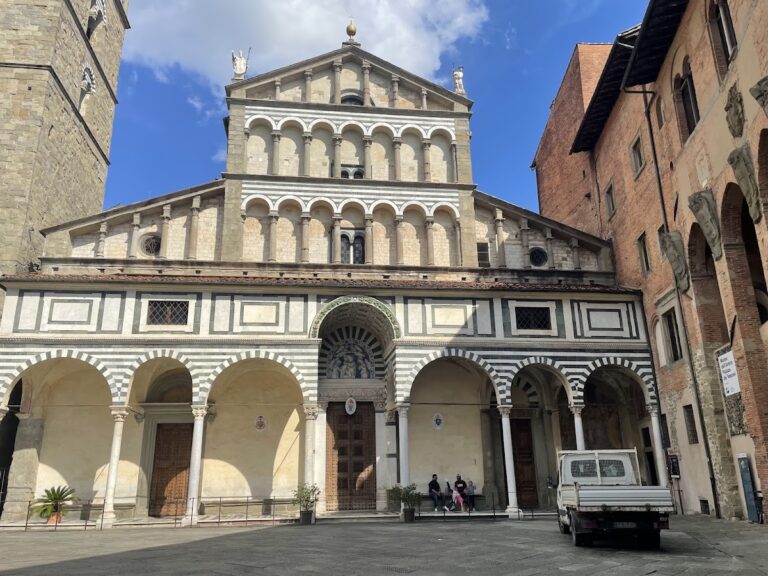
The church has a basilican plan with three aisles, and its facade is arranged in three vertical axes corresponding to those interior divisions. Its bichrome marble facing reflects Tuscan Romanesque architecture with a strong Pisan influence, a regional form often described as Romano-Pisan. Four columns with Corinthian capitals support arcades faced with two types of marble. The two outer axes contain blind arcades above the doors, while corner pilasters frame the facade. Above these arcades, a band of marble lozenges runs beneath the cornice.
The facade follows Pisan models and is described as unfinished. A simple gable closes its upper edge, with a circular window set within it. The small statue of Saint Andrew in the upper lunette, the semicircular area above a doorway or within an architectural frame, was added later than the facade and was made by a sculptor closely familiar with Giovanni Pisano’s manner. The decorated column capitals are attributed to Master Henry.
Main portal
Three bas-reliefs are incorporated into the main portal. They represent the Journey or Procession of the Magi, the Meeting with Herod, and the Adoration of the Christ Child. The architrave, the horizontal element above the doorway, specifically shows the Journey of the Magi. These sculptures form the principal figurative decoration of the entrance and relate to the church’s position on the Via Francigena.
Interior structure and furnishings
Plan and medieval sculpture
The interior is organized as a three-aisled basilica without a transept, ending in a semicircular apse. The central nave rises above the side aisles and is divided by arcades carried on columns whose capitals follow the Corinthian order. A wooden Crucifix by Giovanni Pisano stands on the first altar on the right, while another Crucifix occupies the first altar on the left. The attribution of the baptismal font remains uncertain.
Pulpit of Sant’Andrea
The Gothic pulpit by Giovanni Pisano was made between 1298 and 1301, probably with assistance from Tino di Camaino. It is hexagonal and supported by six porphyry columns, joined in pairs by trefoil arches, together with a central column. Their bases alternate between conventional plinths and forms supported by atlantes and lions. The central column rests on a group of eagles, griffins, and lions, while the capitals are richly carved in the Corinthian order.
Figures of prophets occupy the trefoil spandrels, and Sibyls appear at the corners. The five relief panels show the Annunciation and Nativity, the Adoration of the Magi and Flight into Egypt, the Massacre of the Innocents at Bethlehem, the Crucifixion, and the Last Judgment. Their figures are carved almost fully in the round and convey intense dramatic expression. The pulpit also includes Aaron, David, Jeremiah, Isaiah, and angels at its corners.
Organ
The Trunci organ is placed on the floor of the right side aisle. It has mechanical action, in which the keys operate the valves through direct linkages, and fifteen stops, each controlling a rank or set of pipes that determines a particular tone or timbre.