St Margaret’s Church, Durham: A Medieval Chapel of Ease


Site at a Glance
- Rating
- 4.6
- Popularity
- Very Low
- Country
- United Kingdom
- Primary era
- Medieval
- External website
- Open
- Eras represented
- Medieval, Early Modern, Modern
- Civilizations
- British, English
- Site type
- Religious
- Remains
- Church
On this page18 sections
History
St Margaret’s Church is a Church of England church in Durham, United Kingdom, established in the twelfth century as a Chapel of Ease for the inhabitants of Crossgate. Its surviving early fabric is Norman, the Romanesque style introduced into England after the Norman Conquest and associated with round arches and substantial masonry. The church was founded within the parish of St Oswald and remained under the jurisdiction of the Prior of Durham, the head of the cathedral priory that governed Durham Cathedral and its dependent churches. The Dean and Chapter of Durham remain patrons of the living.
Parish Rights and Medieval Development
As a Chapel of Ease, St Margaret’s served people who were separated from the main parish church while remaining institutionally connected to it. Crossgate residents were initially still required to attend St Oswald’s at certain times and to pay parish dues there. A dispute in 1343 exposed the limits of St Margaret’s independence. The Prior of Durham ordered the removal of its font, but the Bishop directed that it be returned while warning that parishioners had no right to use it.
The congregation later gained permission to marry, receive churching, and be baptized at St Margaret’s. In 1431, the surrounding Church Garth was consecrated for burials. These changes gave the church a more complete role in the religious life of Crossgate, while its medieval fabric continued to develop through alterations to the aisles, clerestory, Lady Chapel, and tower.
Nineteenth-Century Restoration
St Margaret’s was restored internally and externally during the second half of the nineteenth century. The work substantially rebuilt the North Aisle and installed a complete set of stained-glass windows. The restoration forms an important part of the church’s present appearance, alongside the earlier medieval structure.
Parish Life and Wider Work
The church is dedicated to St Margaret of Antioch, a Christian saint traditionally venerated as a virgin martyr associated with Antioch. It is part of the Diocese and Archdeaconry of Durham and the Deanery of Durham. Although formerly Roman Catholic, it is now an active Church of England parish described as Liberal Catholic in churchmanship.
During the 1960s, under Rector Stephen Davis, the church experienced Charismatic Renewal with a Catholic and sacramental character. This modern Christian movement emphasizes spiritual gifts, healing, and lively worship, while sacramental practice gives particular importance to rites such as the Eucharist and baptism. During the 1970s and 1980s, St Margaret’s became a leading centre of charismatic worship in northern England. After Davis retired in 1988, later rectors combined charismatic, Catholic, and contemplative emphases, shaping the church’s present character.
St Margaret’s has also maintained connections with education and community work. Its Church of England primary school, founded in the nineteenth century, marked its 150th anniversary in 2011 and moved to Archery Rise in the mid-1970s. The former school buildings on Margery Lane are leased to St Margaret’s Centre, founded in 1991 to help people with mental-health problems develop new skills. Members of the church continue to serve as the centre’s trustees.
St John’s Church at Neville’s Cross
Toward the end of the nineteenth century, St Margaret’s built St John’s Church at Neville’s Cross as a Mission Church on a green-field site intended to serve the residential development that followed. Bishop Sandford dedicated the building on 8 April 1896. It was designed for later enlargement, with tall arches in its east and west walls prepared for future openings. The eastern arch was used in 1908, when a chancel was added in memory of G. S. Ellam, a former curate who died in a motorcycle accident.
A Church Centre was added at the west end in 1994 and opened by Bishop Michael Turnbull. St John’s remained a Chapel of Ease of St Margaret’s throughout the twentieth century, with St Margaret’s curates later serving in practice as its priests-in-charge. In 2000, it became an independent parish and the building was consecrated. It is also known as “The Church at the Cross-roads.”
Modern Interpretation and Community
Bertram Colgrave, an Anglo-Saxonist and former worshipper at St Margaret’s, wrote a historical guide to the church. The guide was thoroughly revised in 2008 and remains in print. Since 2007, the church grounds have hosted an annual Eco-Festival, a large free community event reflecting the church’s concern with global justice and ecology.
St Margaret’s is a Grade I listed building, a status that recognizes exceptional architectural and historical importance. The listing was made on 6 May 1952.
Remains
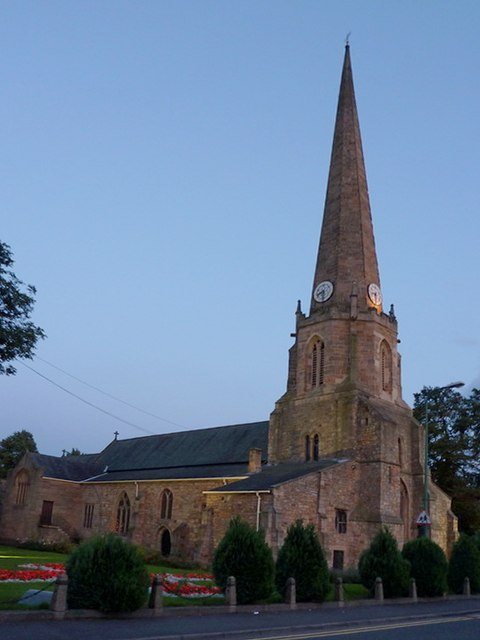
St Margaret’s stands on Crossgate in Durham. Its compact but spacious interior has an asymmetrical appearance created by successive building phases. The earliest surviving fabric dates from around AD 1150, when the church probably comprised a nave, a South Aisle, and a chancel. A North Aisle was added toward the end of the twelfth century. The two nave arcades are both Norman, although the North Nave arcade is taller and more elaborate than the South Nave arcade.
Twelfth-Century Fabric
Norman Arcades and Windows
The early arcades preserve the church’s principal Norman structural evidence. The twelfth-century font remains inside the church, together with two Norman windows, one in the chancel and another in the South Nave clerestory. A clerestory is an upper row of windows above the roofs of adjoining aisles, designed to bring light into the nave.
Later Medieval Additions
South Aisle and Clerestory
During the episcopate of Bishop de Bury in the fourteenth century, the South Aisle was remodelled and new clerestory windows were inserted above the nave. These alterations survive as part of the church’s layered medieval form.
Lady Chapel and Tower
A Lady Chapel, a chapel dedicated to the Virgin Mary, was added south of the chancel during the fifteenth century. The church tower was built in the same century. Two of the three bells date from the fifteenth century, while the remaining bell dates from the sixteenth century.
Nineteenth- and Twentieth-Century Features
North Aisle and Stained Glass
The North Aisle, as seen from the street, was largely rebuilt during the nineteenth-century restoration. The same period produced the church’s complete set of stained-glass windows, described as being of good quality for their time.
Organ and Lectern
The organ was made by Harrison & Harrison in 1917. Arthur Harrison, who was then a churchwarden at St Margaret’s, donated the Choir division. An eagle lectern dating from 1909 commemorates members of the Shafto family who were killed in the Boer War, the conflict fought in southern Africa between the British Empire and the Boer republics from 1899 to 1902.
Memorials and Sculpture
Memorials
The church contains numerous memorials, chiefly marble plaques from the eighteenth and nineteenth centuries. A large ledger slab on the nave floor marks the burial place of Sir John Duck, a seventeenth-century mayor of Durham known as “Durham’s Dick Whittington” because of his poor origins. A ledger slab is a large flat memorial stone laid over or marking a burial place, usually bearing an inscription.
Madonna and Child
A statue of the Madonna and Child, made by the local art teacher Brian Scraton on the theme of “Universal Motherhood,” was installed in 1993.