Saint-Materne Basilica: A Gothic Marian Basilica in Walcourt, Belgium


Site at a Glance
- Rating
- 4.5
- Popularity
- Very Low
- Country
- Belgium
- Primary era
- Medieval
- External website
- Open
- Eras represented
- Medieval, Early Modern
- Civilizations
- Holy Roman Empire
- Site type
- Religious
- Remains
- Basilica
On this page17 sections
History
Saint-Materne Basilica is a Roman Catholic church in Walcourt, Belgium, dedicated to Saint Maternus and administered by the Diocese of Namur. It began as a Romanesque collegiate church and was transformed into a Gothic five-aisled building between the thirteenth and sixteenth centuries. Standing above the confluence of the Eau d’Heure and Yves rivers, it became both the religious center of Walcourt and a Marian pilgrimage destination.
Traditions before the collegiate church
Local tradition associates Walcourt with Maternus of Cologne, an early Christian bishop linked with the Christianization of parts of the Rhineland and neighboring regions. According to this tradition, Maternus evangelized the area in the fourth century and carved a wooden Madonna for an oratory at Walcourt. The oratory is also said to have been destroyed by Vikings. The Madonna’s later presence at the church became central to Walcourt’s religious identity.
The first documented church was built by Oduin, lord of Walcourt, with financial support from his wife, Erembruge. Bishop Réginard of Liège consecrated it in 1026. Oduin endowed the church with a chapter of eight canons, establishing it as a collegiate church, meaning that it was served by a chapter of clergy rather than governed solely as a monastery. Walcourt belonged politically to the County of Namur, but its ecclesiastical administration then lay within the Diocese of Liège.
Fire, rebuilding, and the rise of pilgrimage
Most of the collegiate church was destroyed by fire in 1228. Tradition holds that the Madonna survived the flames miraculously and was later found in a tree in a nearby garden. The rebuilding included the reconstruction of the choir between 1225 and 1250. Thierry II, lord of Walcourt, is traditionally said to have vowed to rebuild the church and establish a monastery after the disaster.
In documented terms, Thierry II founded the Cistercian nunnery of Jardinet Abbey by a charter of 1232 and provided for its maintenance. The Cistercians were a Western Christian monastic order that emphasized austere communal life. French revolutionary troops destroyed the abbey in 1793, and it closed in 1796. An annual procession between the basilica and the former abbey site continued afterward.
The Madonna’s presence and reputed miraculous powers made Walcourt a popular Marian pilgrimage center from the thirteenth century. Medieval penitents traveled there as acts of penance. During a plague epidemic that devastated Walcourt in 1329, a procession through the lordship was organized in thanksgiving for the Virgin Mary’s intervention. This event formed the basis of the later Grand Tour of the Trinity procession. French revolutionary troops temporarily curtailed pilgrimage, but it expanded again during the nineteenth and twentieth centuries. About 40,000 people participated in the Trinity Day procession in 1907.
Medieval construction and later damage
The church developed through successive medieval building campaigns. Construction work was directed by Gilles Dameaussins in 1355, and Jehan de Franchimont was responsible for roof repairs in 1481. The structure was pillaged and seriously damaged by French and Lorraine soldiers in 1477. The prince-bishops of Liège provided repair funds several times in the late fifteenth and early sixteenth centuries. A further fire damaged the church in 1615.
The church remained in the Diocese of Liège until 1561, when it became part of the Diocese of Namur. French troops briefly used it as a barracks after the Battle of Jemappes in 1792, an encounter during the French Revolutionary Wars that helped secure French control in the Austrian Netherlands. A large renovation begun in the 1850s continued through most of the nineteenth century.
War, restoration, and basilica status
German artillery damaged the church in August 1914 during the First World War, and fighting caused further damage in May 1940 during the Second World War. The spire was reconstructed in 1926. The church was listed as a protected building in 1941 and recognized as exceptional heritage in 2013.
On 23 May 1950, Pope Pius XII raised the collegiate church and Marian sanctuary to the rank of minor basilica. A minor basilica is a church granted a special papal title because of its religious and historical importance. This status reflects the basilica’s continuing place as a major center of devotion to the Madonna of Walcourt.
Remains
Setting and overall plan
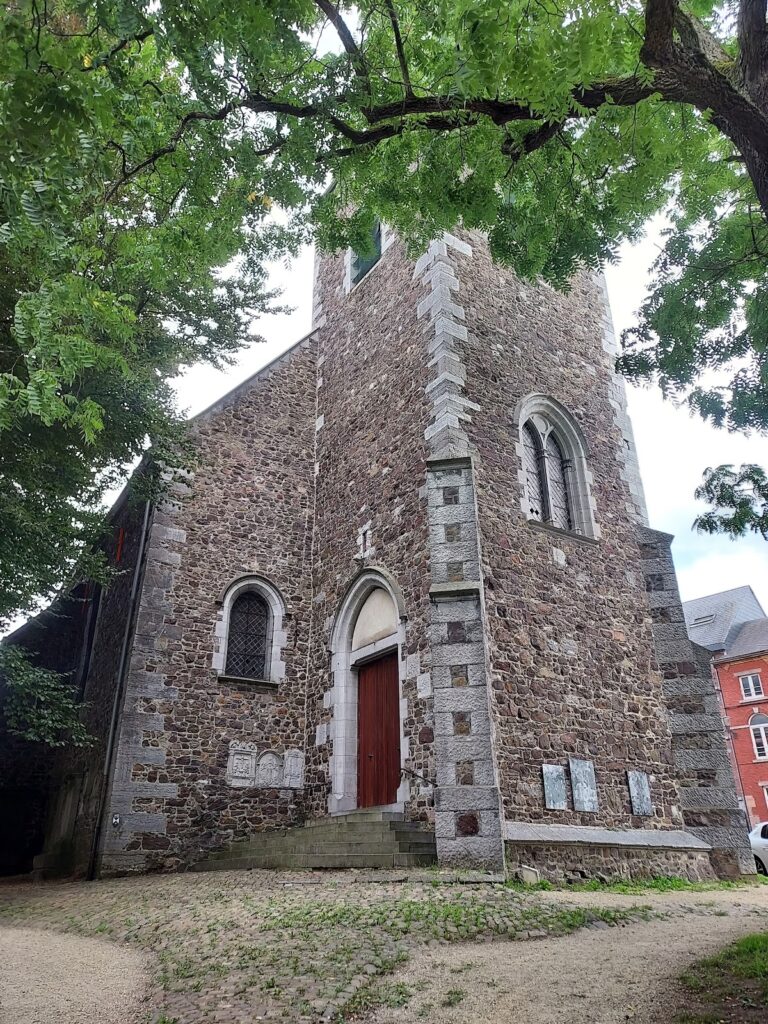
The basilica occupies a rocky spur approximately 30 metres above the Eau d’Heure and Yves rivers. Its elevated position makes it visible from a considerable distance and gives it a prominent place in the landscape of Walcourt. The building is approximately 53 to 54 metres long and 27 metres wide across the transept. Its plan includes a western tower, a five-bay nave with two aisles, a transept, and a three-bay chancel surrounded by an ambulatory, or passage around the sanctuary, ending in a pentagonal apse.
Medieval fabric and architectural phases
Western tower
The lower sections and foundations preserve evidence of an earlier Romanesque church. The oldest surviving part is the tower base, probably dating from the second half of the twelfth century and associated with Mosan Romanesque architecture. The present bell tower rises 64 metres. Its seventeenth-century upper structure has a distinctive bulbous roof, originally flanked at the base of the spire by four turrets.
Chancel and transept
The Gothic chancel dates approximately from 1220 to 1250. It is enclosed by an ambulatory without chapels and has large paired windows from the thirteenth century. The transept dates from the fourteenth century. Together with the chancel and nave, it creates an almost Greek-cross plan. The chancel’s architecture has been compared with Notre-Dame de Dinant and the former abbey church of Notre-Dame de Mouzon.
Nave, vaults, and spire
The nave began to be rebuilt in the fourteenth century, while the triforium, an upper-level passage or gallery within a church interior, was added around 1400. The visible chancel vaults date from the third quarter of the fifteenth century, and the transept and nave vaults were built between 1481 and 1500. The spire was constructed in 1621 by Jean le Coustre, a master carpenter from Beaumont, in a form resembling the spire he had made for the church of Solre-le-Château around 1616. It was rebuilt in 1926.
Chancel furnishings
Rood screen
A white-stone rood screen separates the chancel from the transept. Dated 1531, it contains 29 niches holding statuettes of regional saints and biblical figures in different sizes and styles. A large Calvary surmounts the screen, which also bears the arms of Emperor Charles V. Tradition therefore attributes its donation to Charles V. A rood cross above the screen depicts Mary and John the Evangelist.
Choir stalls
The oak choir stalls date from approximately 1510 to 1520. Their 40 seats have carved misericords, small supports beneath folding choir seats. The carvings include satirical scenes of everyday life and an image representing the Madonna’s alleged rescue from the church fire.
Madonna and treasury
Romanesque Madonna
The Romanesque Madonna is carved from lime wood and dates approximately from 950 to 1020. It is regarded as one of the oldest preserved Marian devotional statues in Western Christianity. The seated Virgin faces forward and holds the infant Jesus on her lap, while the child looks in another direction.
The statue has been covered with silver plating since approximately the twelfth or thirteenth century. Since the seventeenth century, silver masks have concealed the faces of the Virgin and child. Their darkening over time produced the appearance associated with a Black Madonna. The statue stands on the altar of the basilica’s left transept.
Ecclesiastical treasure
The basilica’s treasure is kept in the presbytery and includes valuable liturgical objects, two examples of Mosan goldsmiths’ work, and thirteenth-century reliquaries. One reliquary is said to contain a fragment of the True Cross. A reliquary cross is attributed to Hugo d’Oignies, a renowned early thirteenth-century goldsmith, or to a goldsmith from his school. The collection also includes a fourteenth-century silver statue of the Virgin holding a blue sapphire.