Santa Maria della Spina: A Pisan Gothic Church in Pisa


Site at a Glance
- Rating
- 4.6
- Popularity
- Medium
- Country
- Italy
- Primary era
- Medieval
- External website
- Open
- Eras represented
- Medieval, Early Modern, Modern
- Civilizations
- Italian, Republic of Florence, Republic of Pisa
- Site type
- Religious
- Remains
- Church
On this page13 sections
History
Santa Maria della Spina is a small Roman Catholic church in Pisa, Italy, built around 1230 by the Gualandi family in the Pisan Gothic style. Affiliated with the Archdiocese of Pisa and dedicated to the Passion of Jesus, it stands beside the Arno and is known for the richly decorated marble exterior created through successive medieval building phases.
Foundation and Medieval Enlargement
The church was first known as Santa Maria di Pontenovo, meaning Santa Maria by the New Bridge. Its name referred to a bridge linking Via Sant’Antonio and Via Santa Maria. The bridge collapsed during the fifteenth century and was never rebuilt.
In 1322, the commune of Pisa approved an enlargement, and construction began the following year. The work was complete before 1376, probably under Lupo di Francesco. From the fifth decade of the fourteenth century, the workshops of Andrea and Nino Pisano succeeded the earlier workshop and contributed to the church’s sculptural program.
A thorn reputedly belonging to Christ’s crown of thorns, the Christian relic traditionally associated with the Passion and Crucifixion, reached the church in 1333. The relic gave the building its present name, della Spina, meaning “of the thorn.” It was transferred to Santa Chiara in Pisa during the nineteenth century.
Riverbank Damage and Nineteenth-Century Reconstruction
The church required repeated restoration because the ground beneath it subsided and its position beside the Arno allowed water infiltration to threaten the structure. After Italian unification, Pisa’s municipal council and a commission involving members of the Academy of Fine Arts decided that it should be dismantled and rebuilt in a safer position.
Led by the architect Vincenzo Micheli, the rebuilding took place from 1871 to 1875. The church was moved several metres eastward and raised by about one metre. The intervention caused extensive losses of marble material, and many fragments were placed in the storerooms of the National Museum of San Matteo, Pisa’s museum of medieval and early modern art.
The reconstruction changed the building in several ways. Steps were inserted, some plastered areas were replaced with marble bands, and a number of statues were poorly restored or replaced. The projecting sacristy that had stood over the river was not rebuilt. John Ruskin, who visited Pisa in 1872, strongly criticized these alterations.
Administration and Later Use
The commune of Pisa has traditionally administered Santa Maria della Spina, as it has other oratories associated with bridges. For brief periods during the seventeenth and eighteenth centuries, responsibility passed to the local hospital. Repairs were carried out in 2015 and 2016, and the interior is now used for contemporary-art exhibitions.
Remains
Santa Maria della Spina has a small rectangular plan and a single interior room. Its exterior is faced with polychrome marble, with dark bands set against a white ground. Pointed cusps, tympana, tabernacles, marble inlay, rose windows, and sculpture combine to form an elaborate Pisan Gothic design. The building may originally have consisted of a single open loggia facing south beneath a gabled roof. The present wooden ceiling was decorated during the nineteenth-century reconstruction.
Exterior Sculpture and Openings
West Façade
The west façade has two entrances with round arches carrying horizontal lintels. Between them stands a tabernacle, a small architectural shrine or niche for a statue or sacred object, containing a Madonna and Child attributed to Giovanni Pisano. Two angels flanking the figure were added in the seventeenth century. Two further tabernacles at the sides contain fourteenth-century angels attributed to followers of Giovanni Pisano.
Three upper tabernacles rise on the summits of two lateral tympana and a central tympanum. A tympanum is the usually triangular field above a doorway or opening. These shrines contain figures of Christ and the Angel and Virgin of the Annunciation. The sculptures are associated with a Sienese-school workshop and date approximately to 1320–1340. Their attribution is difficult to assess because of their condition and the nineteenth-century replacement of some heads.
South Side
The south side contains three windows with multiple openings and a doorway beneath a gallery of seventeen pointed tabernacles of different sizes. The twelve larger shrines above the windows and doorway hold the Apostles, while five smaller ones are empty. A projecting tabernacle contains Christ, and five additional upper tabernacles contain prophets.
The Apostles, Christ, and prophets are attributed to unidentified followers of Giovanni Pisano and date approximately to 1320–1340. Twelve small figures of saints and angels on the tympana were made by Nino Pisano’s workshop or are modern replacements.
Apse and Eastern Side
On the southern side of the apse, the part of the church surrounding the main altar, a large doorway is framed by two rows of marble inlay. Its reused lintel is a Greek-Syriac piece dating to the third century AD. Above it, a tympanum contains two rose windows and an eagle representing John the Evangelist. The symbols of the other three Evangelists are placed on the rear side.
A tabernacle above the apse contains a Madonna and Child by Giovanni di Balduccio, dating approximately to 1320–1340. The eastern side also has tabernacles with statues of Saints Peter, Paul, and John the Baptist. These works are attributed to Nino Pisano’s workshop and date approximately to 1360–1376.
The east side has three pointed arches with simple windows that replaced earlier multi-opening windows. Their tympana carry the symbols of three Evangelists, while the eagle of John the Evangelist appears above the southern portal. High pyramidal cusps, pointed ornamental terminations, above the presbytery are crowned by a Madonna and Child by Nino Pisano, flanked by two angels by the same sculptor. These works date approximately to 1360–1368.
North Wall
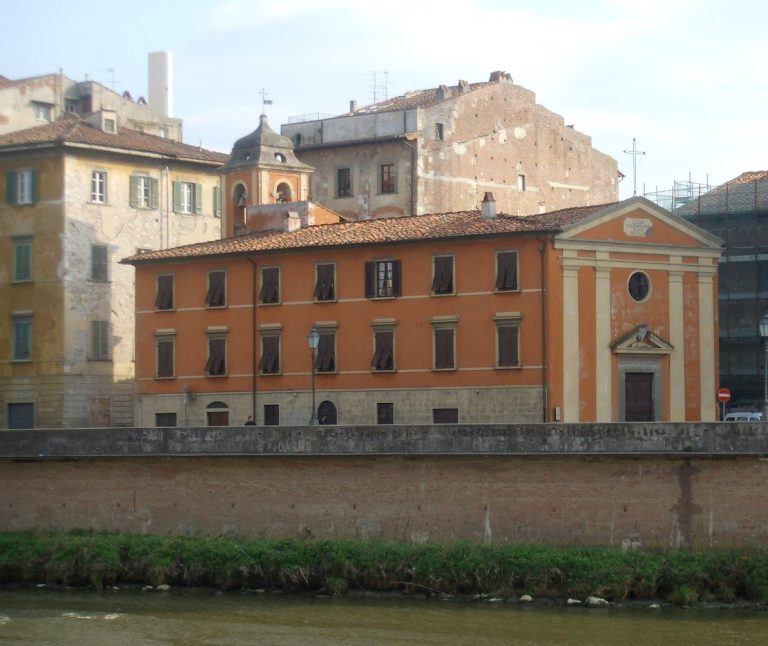
The north wall faces the Arno and has no sculptural decoration. Eight delicate paired-arched windows can be seen from the opposite riverbank.
Interior and Removed Works
Presbytery and Choir
The interior is comparatively plain beside the richly ornamented exterior. At the centre of the small presbytery stands the marble Madonna della Rosa, made by Andrea and Nino Pisano in the mid-fourteenth century. Marble figures of Saint Peter and John the Baptist are positioned on either side.
A marble choir made by the Florentine sculptor Andrea Guardi in 1453 was added under Medici rule. The Medici were a Florentine family that controlled Florence’s government and later produced the grand dukes of Tuscany. A tabernacle made by Stagio Stagi in 1534 once held the thorn relic.
Works Transferred Elsewhere
All freestanding statues currently visible on the exterior are copies. Since 1996, the originals have been gathered in a dedicated room and in the deposits of the National Museum of San Matteo. Some were in poor condition, and several heads were replaced during the nineteenth century.
The church formerly contained Sacra Conversazione, a painting made in 1542 by Giovanni Antonio Bazzi, known as Il Sodoma. It is now in the National Museum of San Matteo. The Madonna del Latte, made for the church by Andrea and Nino Pisano, once stood in a small tabernacle on the counter-façade, the interior wall opposite the main entrance. A plaster copy now occupies that position, while the original was transferred to the National Museum of San Matteo after the Second World War.
A marble Annunciation group by Stoldo Lorenzi, formerly associated with Santa Maria della Spina, is now venerated in Santa Chiara.