St. Andreas: A Brick Gothic Church in Lübeck-Schlutup
Site at a Glance
- Rating
- 4.7
- Popularity
- Very Low
- Country
- Germany
- Primary era
- Medieval
- External website
- Open
- Eras represented
- Medieval, Early Modern, Modern
- Civilizations
- Holy Roman Empire
- Site type
- Religious
- Remains
- Church
On this page16 sections
History
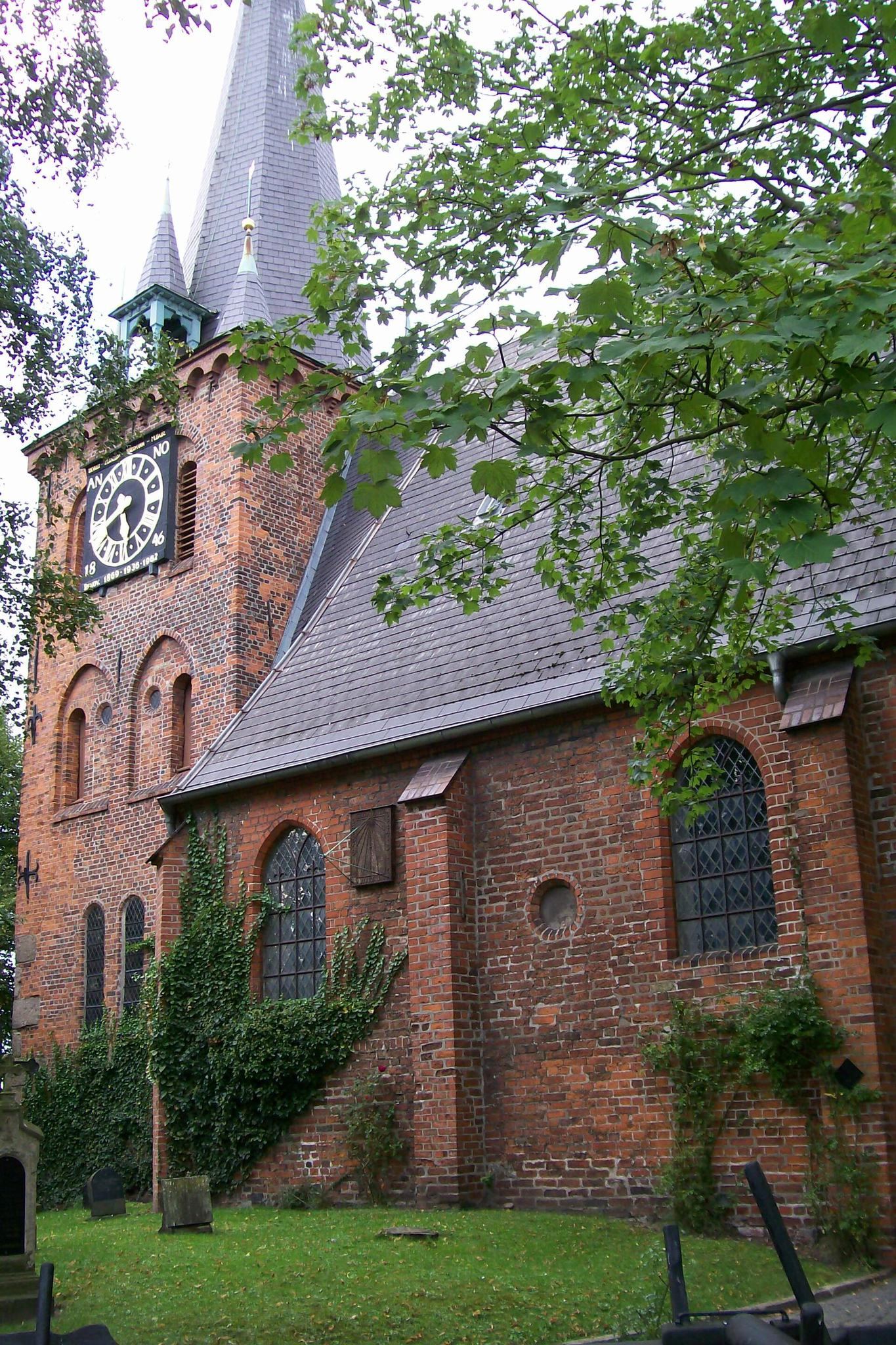
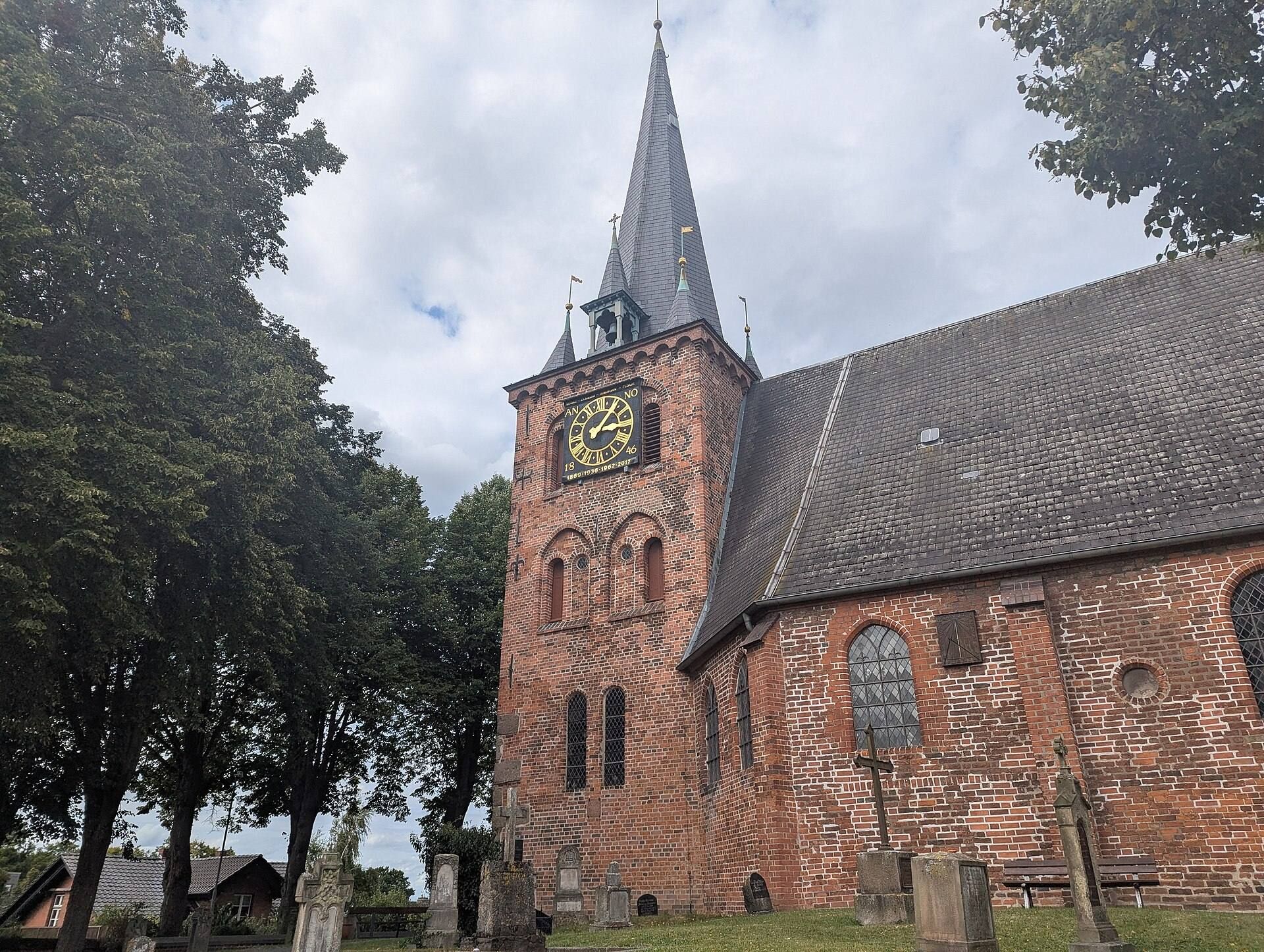
St. Andreas is an Evangelical Lutheran church in Lübeck-Schlutup, Germany. Built in the Brick Gothic tradition, it took shape around 1436, when Schlutup became an independent parish, and is dedicated to Andrew, one of the Twelve Apostles who is traditionally associated with fishing. The church served the former fishing village on the Trave and remains closely connected with its religious and local history.
From chapel to parish church
A chapel at the settlement then known as Vretup was recorded in 1425 as belonging to Lübeck’s parish of St. James. Schlutup became an independent parish in 1436, around the time construction of St. Andreas began. The new church therefore marked a change in the settlement’s religious organization, providing the parish with its own place of worship.
Wartime use and damage
During the Great Northern War, a conflict fought between 1700 and 1721 by Sweden and a coalition of northern European powers, the church held Swedish soldiers captured in 1711. In the mid-eighteenth century, Schlutup’s fishermen also used it as a meeting room, giving the building a civic function alongside its religious one.
Napoleonic troops occupied Schlutup in 1806 during the campaigns of Napoleon Bonaparte, the French military ruler whose wars reshaped much of Europe. Prussian soldiers were imprisoned in the church, and the interior was badly devastated. The walls and ceiling had once been painted in colors, but they were overpainted white in 1924. Some sections of the earlier wall surfaces were later uncovered.
Preservation and changing furnishings
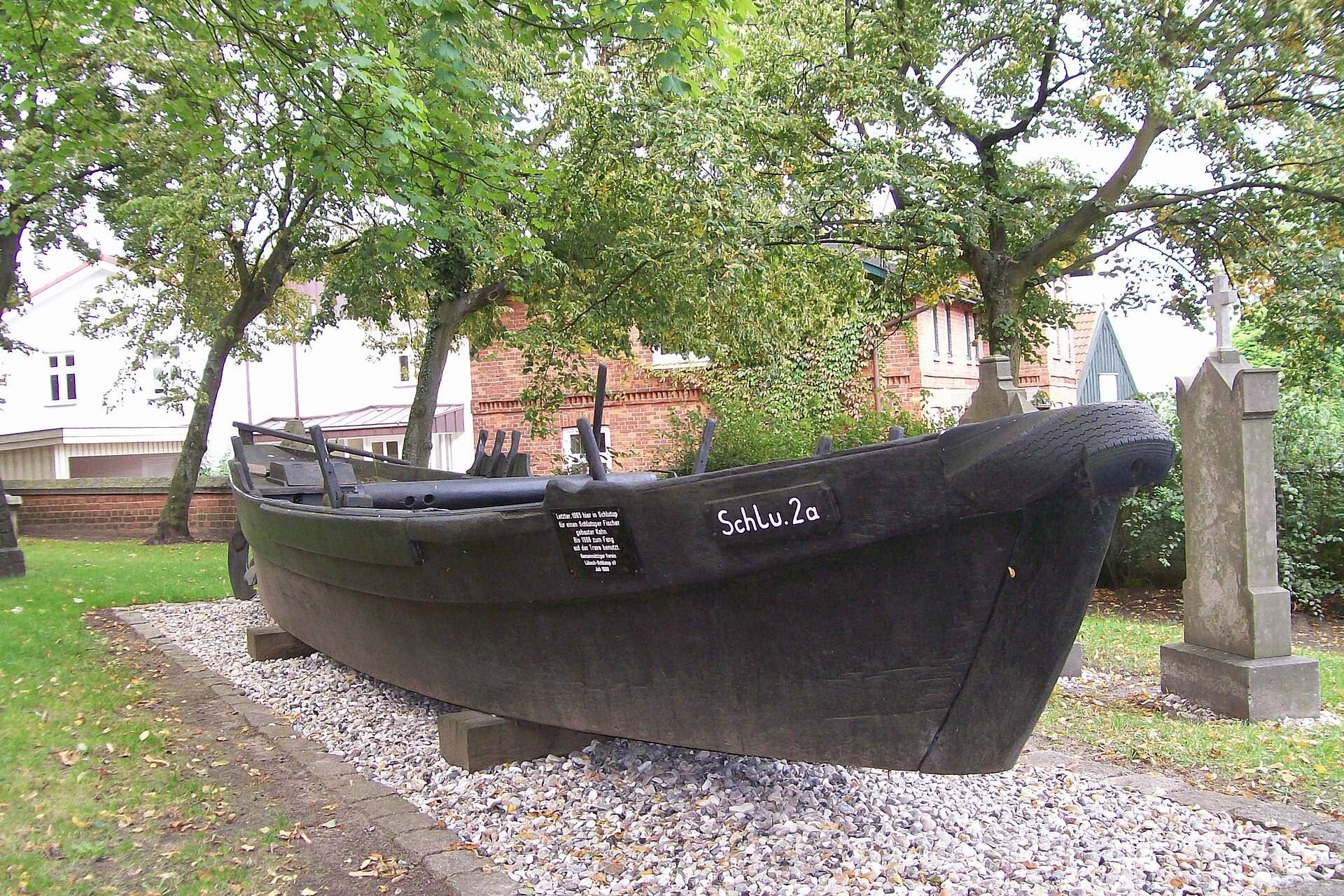
The church’s historic organ was replaced in 1989, while earlier furnishings and memorials continued to preserve evidence of Schlutup’s religious life. The former Gothic altarpiece, made around 1500 by the artist conventionally called the Master of the Schlutup Altarpiece, was removed in 1847 and is now held by the St. Anne’s Monastery Museum in Lübeck. The churchyard’s fishing boat, placed there in 1988, later added a material reminder of the community’s older work on the Trave.
Remains
St. Andreas is an octagonal hall built of brick, with a plan that narrows toward the east and has been compared with the broad, rounded form of a Hanseatic cog, a type of northern European merchant vessel. A square-plan tower was added in the late sixteenth century. The surviving interior brings together a thirteenth-century stone font, Renaissance and Baroque furnishings, painted gallery panels, twentieth-century stained glass, bells, and a modern organ.
Church building
Octagonal hall
The hall measures 22 metres in length. Its western end is 12.30 metres wide, narrowing toward the east to 11.30 metres. This unusual plan gives the church its distinctive shape and accounts for the comparison with a Hanseatic cog. The building belongs to the Brick Gothic tradition, a northern European form of Gothic architecture that uses brick instead of, or together with, dressed stone for major structural and decorative work.
Square tower
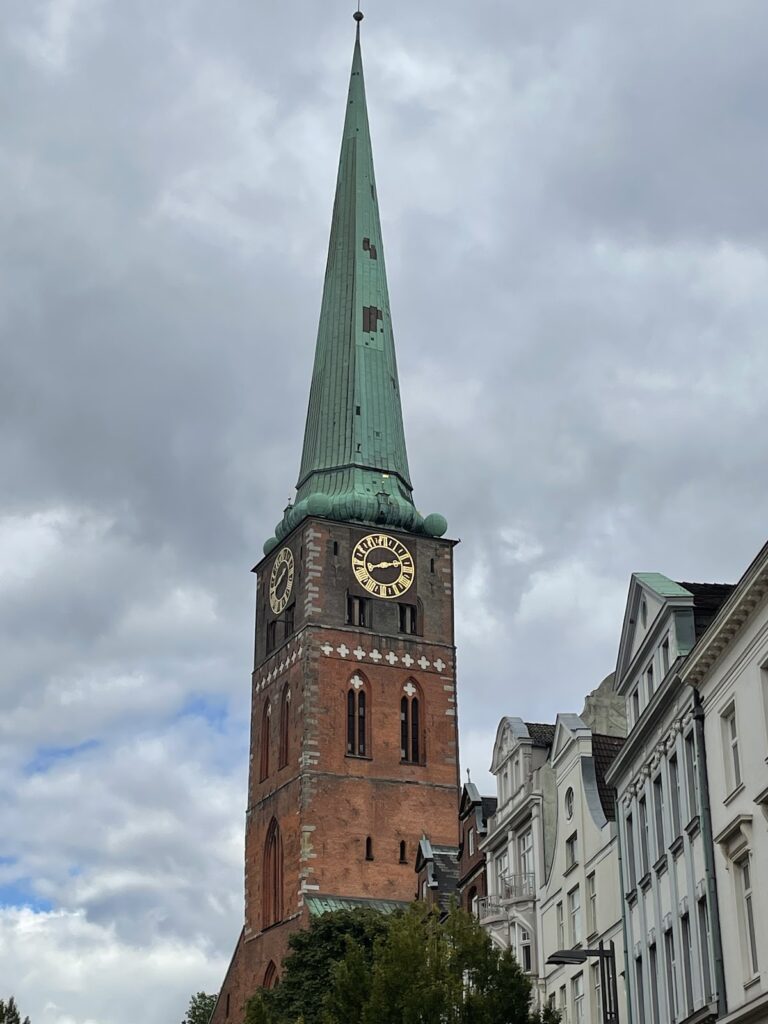
A square-plan tower was added in the late sixteenth century. It is already shown in a view of Schlutup dated 1601 and forms the church’s western vertical feature.
Altars, font, and pulpit
Baroque altar
The present altar dates from 1716 and was donated by the Lübeck merchant Adolf Brüningk. It was probably produced within the circle of Hieronymus Hassenberg. Its central painting represents the Last Supper, while a wooden panel shows the crucified Jesus with Mary and John.
Baptismal font
The baptismal font is the oldest item in the church’s furnishings and remains in use. Its bowl is made of Gotland sandstone and dates from the thirteenth century. The foot was renewed in the fifteenth century, and the wooden cover was donated in 1641 by Asmus Witte, who served as church sexton for 63 years and died in 1667 at the age of 83.
Pulpit
The pulpit was made in 1649 and 1650 by the Lübeck joiner Hans Silmann. Its design stands between the Renaissance and Baroque, and the door carries the date 1649. The soundboard belonged to an earlier pulpit, was donated in 1587, and was reworked by Silmann in 1651.
Gallery and organ
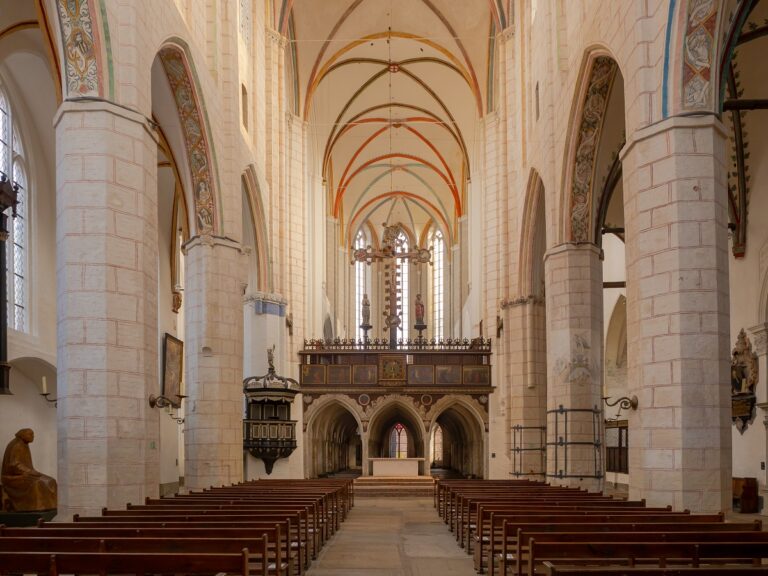
The western organ gallery is richly painted. Its present cycle was formed in 1871 by combining three earlier gallery cycles. Two paintings removed in 1970 are now displayed in the tower room, including one depicting a prophet. An eleven-picture cycle from 1731 illustrates episodes from the life of Jesus, includes biblical verse references, and partly follows models by Merian and Marten de Vos. A six-picture cycle from 1735 mainly presents scenes from the Old Testament, with biblical references and compositions largely based on Merian. Music links the selected scenes.
An organ probably existed in the church before 1550. Philipp Furtwängler & Sons built the instrument installed in 1871. The present organ was made in 1989 by the Danish firm P. Bruhn & Søn of Årslev-Rødekro. It has 21 stops on two manuals and pedals, with a swellable Rückpositiv, a small organ division positioned behind the organist in the gallery rail. Its key and stop actions operate mechanically.
Chandeliers, pews, and windows
A Renaissance chandelier in the central aisle dates from 1587. It bears a double-headed eagle and a double lion’s head. The pews were once arranged in three blocks. They were renewed and reorganized into two blocks in 1905, with a central aisle between them, while parts of the older pew ends were reused. The oldest surviving pew end dates from 1585. Its folding seats facing the aisle remain fixed in place because of concern about damage.
Six twentieth-century stained-glass windows carry biblical motifs. The window showing Andrew was donated in 1928 by the fish-industry entrepreneur Gustav Herbst. Three windows installed in 1936 depict Peter’s miraculous catch of fish, the Good Samaritan, and the Good Shepherd; they were donated respectively by Albert Holst, Hans Westphal, and Johannes Lenschow. The two windows beside the altar, installed in 1954, depict the Nativity and the Resurrection. The designs from 1936 and 1954 were made by the Lübeck painter Curt Stoermer, and all six windows were produced in the Lübeck workshop Berkentien.
Memorials and bells
The church contains epitaphs, memorial monuments honoring deceased people, for Regina Küsel, the pastor’s wife who died in 1612, and Pastor Rudolph Hinrichsen, who died in 1672. A life-size portrait commemorates Pastor Michael Leopold, who died in 1691. The memorial for Asmus Witte accompanies the wooden font cover he donated in 1641.
The historic bell ensemble consists of three ringing bells and a confession bell mounted on the outer tower roof. A confession bell is associated with the call to confession or other penitential religious practice. The two large ringing bells were cast by Matthias Benningk in 1590 and 1597, while the smaller ringing bell was cast by Johann David Kriesche in 1772. The two large bells have almost exactly the same strike pitch. Their inscriptions include the church’s name, Benningk’s name, the year 1597, and Pastor Lambert Risewick. Another inscription identifies a bell cast for the church by Benningk in Lübeck, while a further inscription expresses a prayer about the bell’s sound, God, and judgment after death.
The largest original bell was transferred to Vorwerk Cemetery in 1908 and was used for funerals until 1942. A replacement cast in 1908 by the Lübeck foundry M. & O. Ohlsson was later melted down for armaments during the Second World War. After the war, Benningk’s large bell returned from the Hamburg bell cemetery to Schlutup.
Fishing boat in the churchyard
The churchyard contains a fishing boat built in Schlutup in 1965. It was made for a Schlutup fisherman and used by local fishermen on the Trave until 1986. The Lübeck-Schlutup civic association donated it to the church in July 1988. Its presence preserves a direct physical link with the fishing tradition that shaped the former village and the dedication of its church.