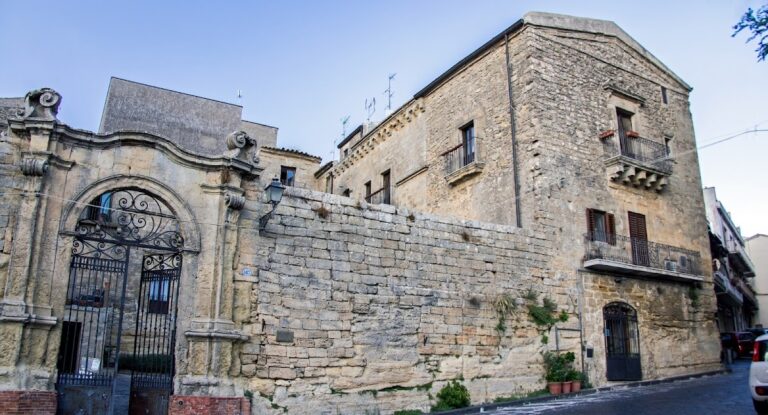
San Nicola: Gangi’s Principal Catholic Church and Historic Campanile


Site at a Glance
- Rating
- 4.6
- Popularity
- Low
- Country
- Italy
- Primary era
- Early Modern
- Eras represented
- Medieval, Early Modern
- Civilizations
- Kingdom of Sicily, Spanish
- Site type
- Religious
- Remains
- Church
On this page13 sections
History
San Nicola, formally the Duomo di San Nicola di Bari, is the principal Catholic church in Gangi, Italy. Dedicated to Saint Nicholas of Bari, the fourth-century bishop whose cult became closely associated with the southern Italian city of Bari, the building took shape mainly during the fourteenth and fifteenth centuries. It is listed under the Diocese of Acireale, while its reconsecration involved the bishop of Cefalù.
Medieval origins and civic role
A local tradition presents San Nicola as the sole parish and mother church of the settlement during the Norman period. That attribution remains uncertain. The proposed Norman settlement of Maqara or Beqara was probably located elsewhere rather than on the Marone site of present-day Gangi, and the heraldic symbols of the Ventimiglia, Graffeo, and Bongiorno families, together with those of the counts and marquises of Geraci, do not establish a Norman foundation for the church. These families and feudal lineages nevertheless had Sicilian roots reaching back to the Norman reconquest.
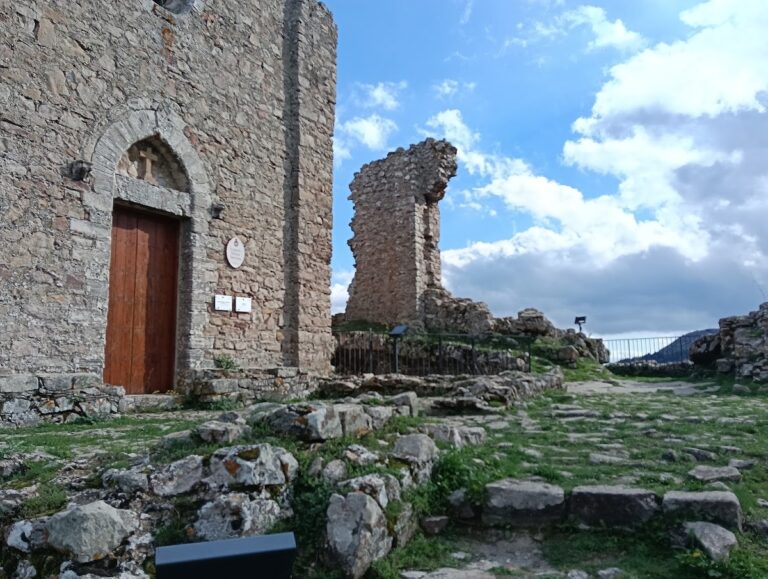
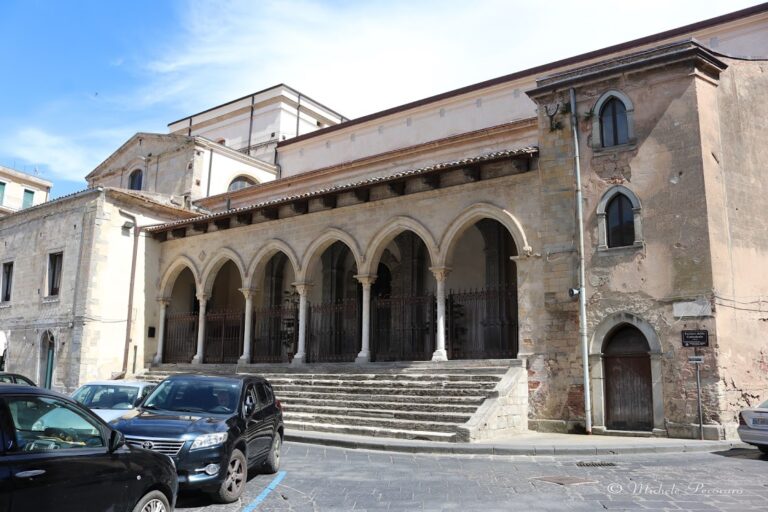
By 1429, the Ventimiglia Tower had become the church’s adjoining campanile, or bell tower, and San Nicola was recognized as the settlement’s principal church. Along the southern side, the covered ground-floor portico known as the pinnata formed a commercial and political centre with the fourteenth-century castle. The town council met beneath the portico, having previously held its meetings inside the church.
Expansion and later religious life
During the Spanish period, the church was enlarged toward the piazza and lengthened along its main axis. The former tower was incorporated into the developing complex. Later alterations gave the building a basilical arrangement of three naves and a Latin-cross plan, in which a long central axis meets a transverse arm. The dome over the crossing is documented around 1680.
A contract of 27 September 1654 names Lucas Morina of Militello, then resident in Nicosia, as the maker of the blind portal on the façade at the left nave. Although it is often called the Portal of Saint Sebastian, that name is incorrect. The small marble aedicule associated with it, and the local cult of Saint Sebastian, probably emerged after the plague epidemic that affected much of Sicily in 1422.
From 1736 to 1737, the choir was reorganized with stucco decoration that has not survived. A new organ was installed between 1738 and 1740 under the direction of Michele Andronico, an organ maker from Palermo. The church was later reconsecrated in the presence of Domenico Valguarnera, bishop of Cefalù, the Valguarnera princes, and the archpriest La Punzina.
Eighteenth-century building and associations
A new sacristy was built from 1748 to 1750 above the bastion behind the right transept. In 1758, Crispino Riggio of Palermo decorated the Oratory of the Blessed Sacrament and of the Cappuccinelli with frescoes. Between 1773 and 1779, Francesco Lo Cascio, Nunzio Pirrone of Tusa, and Mariano Castello of Gangi rebuilt the dome under the direction of the Gangi architect Gandolfo Felice Bongiorno. The original eighteenth-century maiolica covering was later replaced by lead and copper for structural reasons.
The closure of the old pinnata resulted in the construction of a new vaulted building, or dammuso, behind the baptistery. The building now houses Gangi’s Municipal Historical Archive. Religious life around San Nicola included the Confraternity of Maria Santissima del Rosario, also known as the Confraternity of the Masters, documented from 1703, as well as the Confraternities of the Holy Trinity, the Blessed Sacrament, the Cappuccinelli, and the Thirty-Three. A confraternity was a lay religious association devoted to shared worship, charity, or devotional activity.
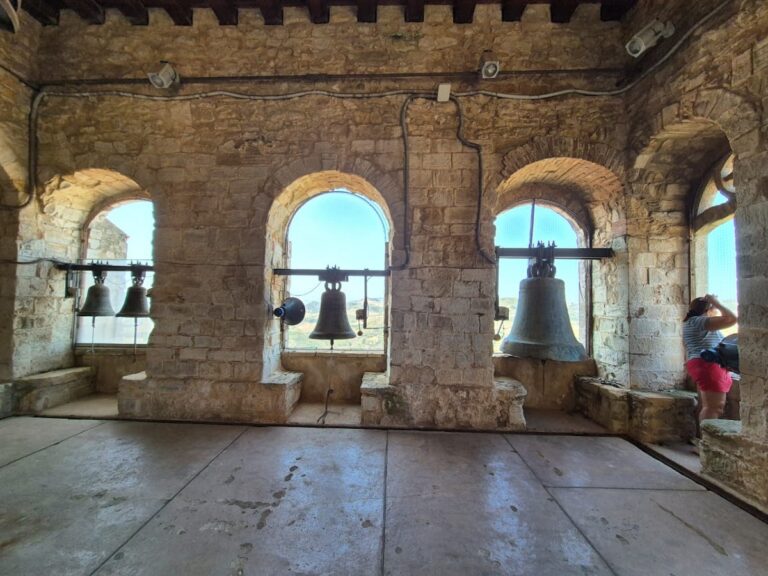
The Ventimiglia Tower was linked with the Ventimiglia family and the Hospitallers, the religious-military order also known as the Knights of Malta. Its symbols remained on the tower until the second half of the nineteenth century. In the eighteenth century, the parish priest permitted the municipal administration to raise the tower for a public clock, but the work stopped when the structure threatened to collapse. After the danger had passed, a clock with bells but no clock faces was installed in 1758. The tower received substantial restoration in 2005, commissioned by the municipality of Gangi with support from the Regional Province of Palermo.
Remains
San Nicola is organized as a three-naved church on a Latin-cross plan, with the former Ventimiglia Tower integrated into the complex. The main body is the enlarged successor to an earlier, shorter and narrower single-naved church. That earlier building had a transept, a presbytery chapel, and arms ending in semicircular apses, while its exterior had a gabled façade and a two-pitched roof carried by wooden trusses. The present crossing is covered by a dome, whose earlier maiolica surface was replaced by sheets of lead and copper.
Church interior
Naves and chapels
The counter-façade carries a singers’ gallery with an organ. Along the right nave, deep spaces form chapels enclosed on three sides. The left nave has wall altars or niches framed by arches. Its second bay contains the Chapel of Saint Francis of Assisi and a statue of the saint. The fourth bay holds the Chapel of the Souls in Purgatory, with Mary Liberating the Souls in Purgatory, a painting attributed to Crispino Riggio and dated 1731. The fifth bay contains the Chapel of Saint Sebastian and its statue. Wooden pulpits are attached to columns in the fourth and fifth bays.
Transepts and presbytery
The right transept has an apsidiole, a small apse-like chapel, containing the Chapel of the Madonna of the Rosary. Its central statue of the Madonna is flanked by wooden figures of Saint Dominic of Guzmán and Saint Vincent Ferrer, made by Filippo Quattrocchi in 1797. The left transept has an apsidiole containing the Chapel of the Blessed Sacrament.
The presbytery is reached by a two-flight staircase with a marble balustrade made by the Catanian marble worker Lorenzo Viola, who died in Gangi and was probably buried in the cathedral. Filippo Quattrocchi made the wooden choir stalls along the apse walls. On the right wall of the presbytery chapel is The Last Judgment, an oil painting probably commissioned from Giuseppe Salerno after the plague of 1624. It was intended as a lasting warning about the danger from which the population had escaped. Salerno was one of the two artists known as the “Gangi Hunchbacks.”
Artworks and devotional spaces
The statue of Saint Nicholas of Bari was made by Scipione Li Volsi in 1661. The sacristy contains Madonna delle Grazie by Giuseppe Salerno, transferred there from the Chapel of Saint Anthony of Padua. The Oratory of the Blessed Sacrament retains frescoes dating from 1758.
Campanile and associated spaces
Ventimiglia Tower
The former Ventimiglia Tower serves as the campanile. Its thirteenth-century base once functioned as an urban gate. It consists of a square portico with pointed-arch openings passing through it and a ribbed cross vault. The first level, dating from the fourteenth century, has two mullioned windows on each façade. The second level, from the fifteenth century, has three single-light windows on each façade. The eighteenth-century third-level project was left incomplete after the threat of collapse, while the 1758 installation provided timekeeping bells without clock faces.
Archive building
Behind the baptistery, the vaulted dammuso built after the closure of the old southern portico now houses the Municipal Historical Archive. Its vaulted form preserves the later building solution adopted when the former civic and commercial space was closed.
Crypt
A crypt lies beneath the cathedral and contains numerous mummified members of the clergy together with some laypeople. Known locally as “the pit of the priests,” it reflects the practice of embalming priests at San Nicola between 1725 and 1872.