Tromøy Church: A Medieval Parish Church in Norway


Site at a Glance
- Rating
- 4.7
- Popularity
- Very Low
- Country
- Norway
- Primary era
- Early Modern
- Eras represented
- Medieval, Early Modern
- Civilizations
- Danish, Norwegian
- Site type
- Religious
- Remains
- Church
On this page8 sections
History
Tromøy Church is a medieval parish church in Norway, standing on Tromøy Island near Færvik. It is a church of Norway’s Evangelical Lutheran denomination and belongs to Tromøy parish, Arendal deanery, and the Diocese of Agder og Telemark. The church is conventionally dated to around 1150, although another dating places its construction around 1300. Its exact age remains uncertain, but its early form and surviving details suggest that it may be among Norway’s oldest surviving churches.
Medieval foundation and enlargement
The first surviving written reference to the church dates from 1320. A court document names Sira Ifvar as its priest and gives the church the name Thrumu. It was formerly Catholic, before becoming part of the Evangelical Lutheran Church of Norway. During the Middle Ages, the building was enlarged eastward, probably between 1300 and 1400, when the choir was extended. This phase belongs to the Gothic period, a medieval architectural era associated with pointed forms and more vertically oriented designs.
The church served a wide parish for centuries. As late as 1794, it was the parish church of Holt, whose extensive territory made winter journeys difficult and dangerous for many parishioners. Tromøy and the mainland part of the parish became separate parishes in 1878. The mainland parish then stretched from Strømsbu, west of Arendal, to Eydehavn and included part of Austre Moland Municipality. Tromøy Church was the main church of Tromøy Municipality from 1878 until the municipality was dissolved in 1992.
The 1748 rebuilding
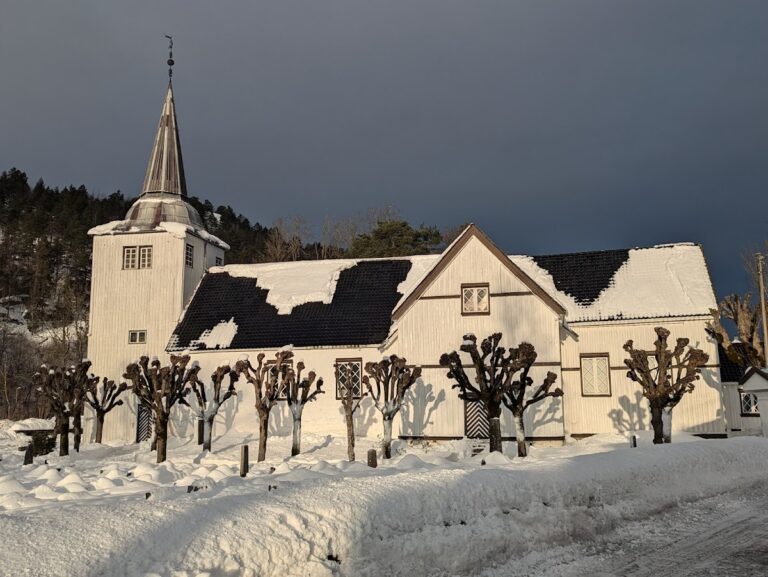
In 1748, the church was completely rebuilt under the direction of Ole Nilsen Weierholt. The medieval long church was divided and incorporated into a new cruciform building, while a wooden nave and choir were added. The walls were raised, and the ceiling received a barrel vault, a ceiling formed by extending a continuous curved section along the length of a space. This rebuilding created the basic form of the church that survives today.
Jørgen Schultz decorated the interior with elaborate Rococo ornament in the 1750s. Rococo was an eighteenth-century decorative style known for delicate, asymmetrical, and richly worked designs. The decoration was painted over during the 1880s, then uncovered during a major restoration carried out between 1926 and 1939. The restoration therefore recovered an important part of the church’s eighteenth-century appearance.
Church, parish, and nation
In 1814, Tromøy Church served as an election church and polling station during the process that selected representatives for the Norwegian Constituent Assembly. The assembly met at Eidsvoll and produced the Norwegian Constitution. Each parish first elected intermediaries known as electors, who then helped choose the representatives to the assembly.
The church’s medieval status gives it automatic protection under Norway’s cultural-heritage regulations. Its history therefore joins a medieval foundation, centuries of parish use, an extensive eighteenth-century rebuilding, and later conservation that restored parts of its earlier decorative scheme.
Remains
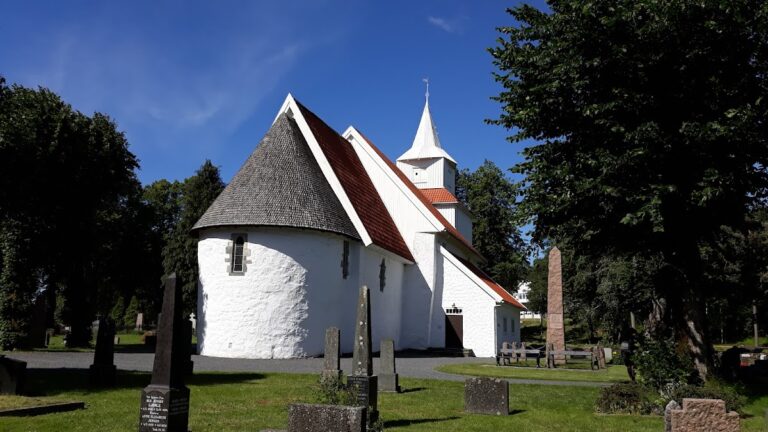
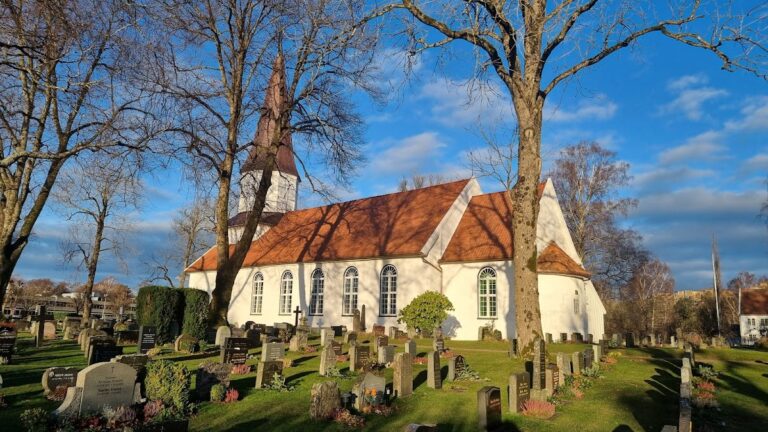
Tromøy Church is a white stone building with a cruciform plan and seating for approximately 290 people. It stands at Brekka on the east coast of Tromøy Island, between Hove and Brekka, on the island’s outer shore. The present structure combines a surviving medieval stone core with the wooden additions made during the 1748 rebuilding.
Medieval stone fabric
The earliest church probably had a rectangular plan ending in an east-facing apse, a rounded or polygonal termination commonly placed behind the altar. Its walls are approximately 1.5 metres thick. The medieval building was enlarged eastward when the choir was extended, probably during the period between 1300 and 1400. The surviving medieval section now forms the crosswise part of the later church, known as the transept, which intersects the main axis and produces the cruciform plan.
The church also retains a reworked Romanesque portal, with two stone grotesques placed on opposite sides. Romanesque architecture is a medieval style associated with thick masonry, rounded arches, and massive forms. One grotesque shows a face with a hand pulling its beard; the other shows a face sticking out its tongue. Similar but stylistically different motifs occur at Hedrum Church in Vestfold and Lunner Church.
A local tradition explains the two figures as the severed heads of thieves who stole the church silver, were captured and executed, and had their heads built into the wall. This is a legend rather than an established account of the sculptures. It gives the portal a place in local storytelling while the carved forms themselves remain part of the church’s medieval fabric.
Baroque and Rococo interior
The church contains a medieval baptismal font carved from soapstone, a soft and workable stone used for the basin. The altar and pulpit date from 1725 and were made by Mogens Christian Trane. These furnishings predate the 1748 rebuilding and remain part of the interior’s historical sequence.
The wooden chancel screen bears the monogram of Frederick V, king of Denmark and Norway from 1746 to 1766. Lions and angels flank the monogram. Ole Nilsen Weierholt carved the screen and probably also made other interior woodwork, including the fronts of the galleries and the confessional. Together with the recovered Rococo decoration, these carvings preserve the character of the church’s eighteenth-century interior.
A votive ship dated 1751 hangs from the ceiling. Such a model vessel is placed in a church as a religious dedication, memorial, or expression of gratitude. The model represents the frigate Dronningen av Danmark, or Queen of Denmark, associated with a voyage from Copenhagen to the East Indies. Jens Boye presented the ship to the church and also donated a book describing the vessel’s voyage to China.
Organ and maritime landmark
An organ dating from around 1750 was formerly kept in the church. It is now preserved at the Norwegian Museum of Cultural History in Oslo, while the church’s other furnishings and architectural elements continue to express its long religious and local history.
Before afforestation in the late twentieth century, Tromøy Church could be seen from the sea and served as a navigation landmark in the Skagerrak. It was marked on nautical charts, and the National Office for Lighthouses and Coastal Safety was responsible for painting its south walls white until 1940. This maritime role formed an important part of the building’s relationship with the surrounding coast.