St. Mary’s Church Strausberg: Medieval Town Parish Church in Germany


Site at a Glance
- Rating
- 4.3
- Popularity
- Very Low
- Country
- Germany
- Primary era
- Medieval
- External website
- Open
- Eras represented
- Medieval, Early Modern, Modern
- Civilizations
- German, Holy Roman Empire, Kingdom of Prussia, Margraviate of Brandenburg
- Site type
- Religious
- Remains
- Church
On this page10 sections
History
St. Mary’s Church is a medieval church in Strausberg, Germany, founded around 1250 when the town received town rights and a parish. Built during the transition from Romanesque to Gothic architecture, it became the town parish church and is regarded as Strausberg’s oldest and tallest building. It is also among the largest surviving fieldstone churches in the historical Mark Brandenburg, the former margraviate centered on Brandenburg.
Foundation and medieval rebuilding
The church was established in the thirteenth century as Strausberg developed its civic and parish institutions. A fire in 1341 and 1342 prompted renovation and the partial construction of vaults. Further damage followed another fire in 1432, when parts of the interior collapsed.
Rebuilding began in 1448. The work transformed the medieval interior through the construction of a new choir with a star vault, a ribbed vault whose ribs form a star-like pattern, and the insertion of rib vaulting beneath the nave’s original flat roof. A bell chamber was created in the tower, and a round-arched window was installed there. Vault paintings were completed during the same year. The extensive Late Gothic paintings were renewed in 1524.
Early modern alterations
The vault of the Annen Chapel was removed in 1549. In 1747, the tower was enlarged by a 50-metre-high Baroque wooden superstructure carrying a lantern, sphere, and cross. This addition was demolished in 1922, leaving the earlier tower as the principal vertical element of the church.
A portico was added to the Annen Chapel in 1815. Made around 1790 in the early Neoclassical style, it had originally been intended for a tomb monument in the landscape park at Garzau created by Friedrich Wilhelm Karl von Schmettau. The inscription “H. 1815” on the gable refers to its donation by senior inspector F. W. Haberkorn, who was probably also serving as a superintendent at the time.
Organs, bells, and modern parish history
St. Mary’s first organ was a small positive organ, a stationary instrument of compact design, made in 1534. Martin Voigt of Coburg supplied a replacement in 1594. It was heavily damaged during the Thirty Years’ War, the European conflict of 1618 to 1648 fought through intertwined religious and dynastic struggles, and was restored only in 1707.
Ernst Julius Marx of Berlin built another organ in 1773 and 1774. It was replaced in 1929 by an instrument from W. Sauer Orgelbau of Frankfurt an der Oder. The earlier organ’s large front pipes were requisitioned for war production during the First World War, while the 1929 instrument survived the Second World War undamaged. Christian Scheffler of Sieversdorf renovated it in 2015.
The church now belongs to the Oderland-Spree church district of the Protestant Church in Berlin, Brandenburg, and Silesian Upper Lusatia. Strausberg marked the 750th anniversary of St. Mary’s in 2004. In 2024, the side portal and its associated antechamber required renovation, leading the parish to launch a conservation fundraising campaign.
Remains
Layout and medieval fabric
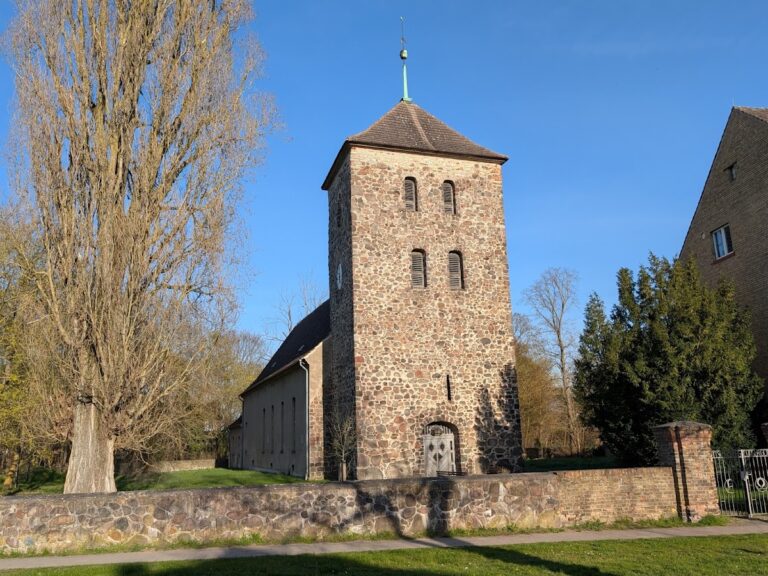
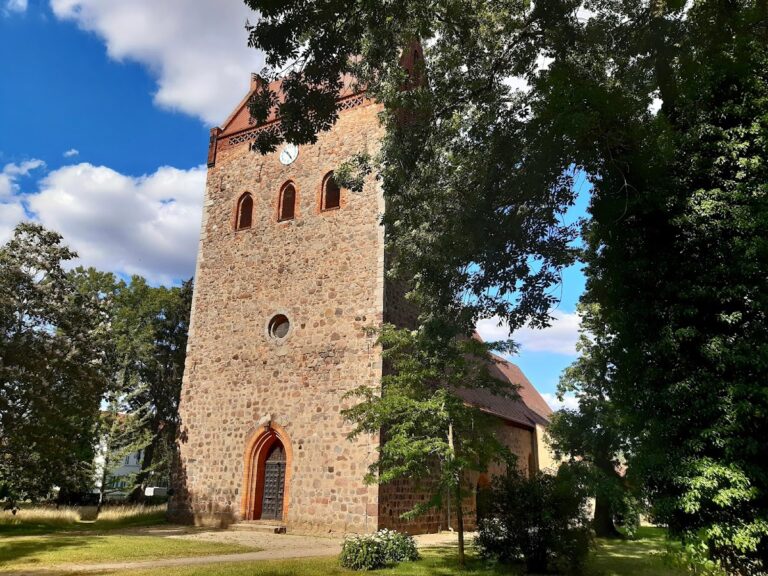
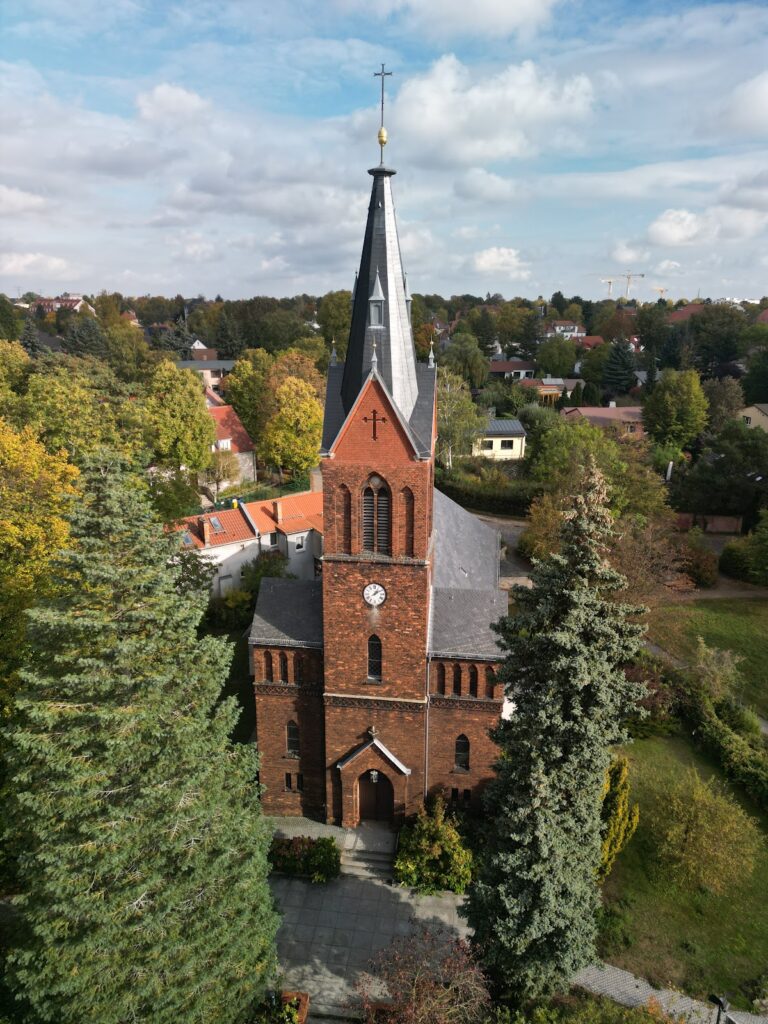
St. Mary’s stands on Predigerstrasse, a side street of Große Strasse in central Strausberg, near the eastern shore of Straussee and the town wall. The church is an austere three-aisled pillar basilica, with a central nave and side aisles divided by substantial piers. Fieldstone and brick form its fabric. The massive tower is the dominant surviving feature, while the small Annen Chapel projects from the south side of the choir.
Vaults and paintings
The choir retains its Gothic star vault, while the nave has the rib vaulting inserted during the fifteenth-century rebuilding. The Late Gothic paintings cover substantial areas of the vaults. In the choir, they include the Judge of the World, the Coronation of the Virgin Mary, and musical angels. Foliate tendrils in the nave have given the interior the name “Heavenly Meadow.”
Altar, pulpit, and commemorative features
A winged altar carved from rosewood dates from 1520. Its central section presents the Virgin Mary with the Christ Child beneath a halo of rays, with saints enthroned on either side. The wings show the twelve Apostles. A Baroque wooden pulpit from the early eighteenth century carries biblical sayings, and the church contains the epitaph of Andreas Angelus, a sixteenth-century pastor, historian, and chronicler of the history of the Mark Brandenburg.
The building also preserves a penitential cell, an unusually rare feature in a town parish church, together with two children’s gravestones dating from around 1620.
Side portal and antechamber
The side portal dates from around 1784 and is probably attributable to Carl Gotthard Langhans, the German architect best known for Berlin’s Brandenburg Gate. It originally served as the entrance to Langhans’s tomb pyramid, which comprised an antechamber and a main room, each with an oculus, or round opening. In 1815, F. W. Haberkorn acquired the portal and had the letter “H” and the year “1815” carved into its tympanum, the enclosed field of the portal’s frame. The portal and antechamber were in need of renovation in 2024.
Organ and bell installations
The 1773 and 1774 organ had 27 main stops and seven secondary stops, with 1,451 pipes. Financial constraints led to the omission of the five highest notes and the lowest note. Its richly carved case survives, including an Eye of God and two putti. The 1929 replacement has 37 stops and 2,460 pipes arranged across three manuals and a pedal, a hand-operated keyboard and a foot-operated keyboard, while retaining the earlier case with lateral extensions.
The five-bell peal consists of two electrically rung bronze bells cast in 1928 and 1950, and three hand-rung steel bells cast in 1960. The steel bells were originally made for St. Matthew’s congregation in Berlin-Tiergarten, presented to St. Mary’s congregation in 1989, and installed in the tower in 1994. They were rung only on special occasions until 2016, when they were incorporated into the main peal.