Church of the Beheading of Saint John the Baptist (Skramníky): A Neo-Gothic Filial Church in Czechia

Site at a Glance
- Rating
- 4.6
- Popularity
- Very Low
- Country
- Czechia
- Primary era
- Modern
- Eras represented
- Medieval, Modern
- Civilizations
- Habsburg, Holy Roman Empire, Kingdom of Bohemia
- Site type
- Religious
- Remains
- Church
On this page14 sections
History
The Church of the Beheading of Saint John the Baptist is a Roman Catholic church in Skramníky, Czechia, rebuilt in 1906 in the Neo-Gothic style. It belongs to the Parish of Pečky, the Kolín Vicariate, and the Prague Archdiocese within the Czech ecclesiastical province. A sanctuary probably stood here by 1056, when monks from Sázava Monastery, a medieval Benedictine monastery associated with the Christianization and religious culture of Bohemia, are traditionally said to have founded it.
Medieval origins and later alterations
The first written record of the church dates from 1656. By that time, an earlier Gothic building stood on the site. Its nave was altered during the sixteenth century, while the tower underwent repair in 1696. Further changes at the end of the seventeenth century gave the building Baroque features, reflecting the period’s preference for dramatic forms and rich ornament.
A wooden belfry supported on corbels, or projecting blocks carrying a structure, was formerly built above the sacristy. It had an external staircase and was dismantled in 1906, the year in which the older church was demolished.
Rebuilding and modern status
In 1906 the church was rebuilt in Neo-Gothic form to a design by the Prague architect Gabriel. Neo-Gothic architecture revived medieval Gothic forms, including pointed arches, traceried windows, and steep gables. The rebuilt church was repaired and equipped with electric lighting in 1930.
The church entered the Central List of Cultural Monuments of the Czech Republic in 1963. Since 1 January 2005, it has been a filial church, meaning an institutionally dependent church serving a subsidiary worshipping community under a main parish church. The church, rectory, mortuary, cemetery enclosure wall, granary, stables, and the rectory enclosure wall with its gate and wicket are protected together as a Czech cultural monument.
Remains
Setting and exterior
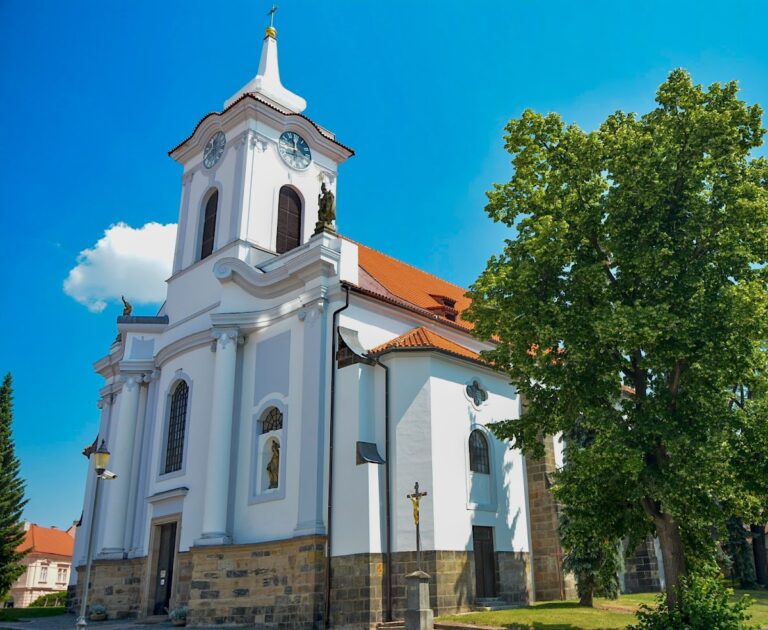
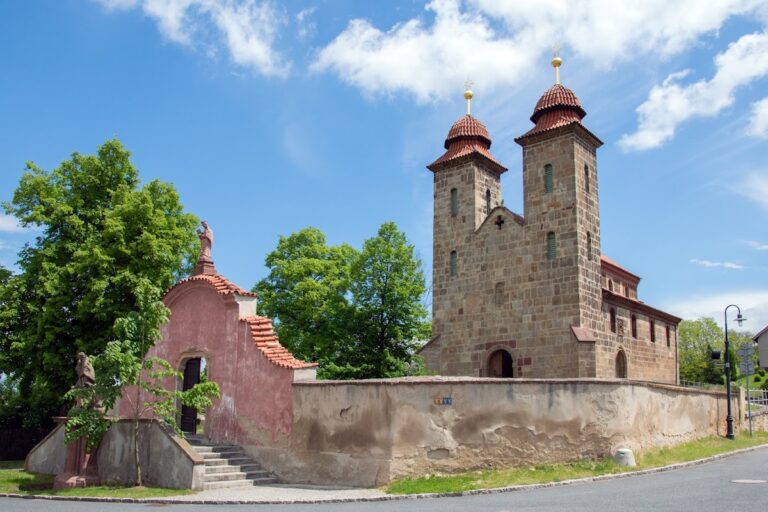
The church stands on elevated ground in the centre of Skramníky. Its complex, together with the rectory, farm buildings, and disused cemetery, is enclosed by a wall constructed from rubble stone and brick. The building is oriented and single-nave, with masonry walls on a rectangular plan. At its eastern end is the presbytery, the part reserved principally for the altar and clergy, terminating in a three-sided apse, a polygonal end of the church described as dating from the fourteenth century.
North tower
A square tower rises on the north side. Its smoothly plastered masonry lower section has corners finished with stone blocks. Above it is a boarded upper stage containing two bells, and the tower is capped by a pyramidal roof. The north entrance bears the date 1696 above its lintel, preserving the memory of the tower’s repair. The ground floor houses the sacristy.
Facades and roof
The west facade is dominated by a tall triangular gable. Its entrance, leading beneath the gallery, has stone surrounds and a segmental arch. A stone angel stands on either side, while a circular gallery window above is flanked by two narrow windows. A red-sandstone corbel carved with a human face is built into the wall above the south-eastern window.
On the south side, a square vestibule contains a Gothic portal. The church is covered by a gabled roof surfaced with ceramic pantiles. These elements combine with the pointed openings and gable to express the Neo-Gothic character of the 1906 rebuilding.
Interior architecture and furnishings
Presbytery and nave
The presbytery has a six-part vault whose moulded ribs rest on consoles. Its walls contain Gothic traceried windows, whose ornamental stone frameworks divide the openings into patterned sections. The nave has a flat-beamed ceiling and two windows in each side wall. At the junction between nave and presbytery, the pointed chancel arch carries a painting of the Last Supper supported by two angels.
Gallery and liturgical furnishings
A masonry gallery rests on two columns, with three barrel-vaulted bays beneath it. The interior furnishings are predominantly Baroque and date from the eighteenth century. The high altar bears a 1917 painting of the Beheading of Saint John the Baptist by Láďa Novák of Žhery, while its upper section contains a sculptural group of the Holy Trinity.
Other furnishings include a painting of the Holy Kinship from the second half of the seventeenth century, an eighteenth-century Rococo pulpit, and Adolf Liebscher’s 1887 painting of Christ Crowned with Thorns. A Baroque painting of Our Lady of Sorrows stands in a Rococo frame dated 1759, and the church also has a pewter baptismal font dated 1704.
Organs
The gallery formerly held an organ made in 1780 by Pavel František Horák, an organ builder from Kutná Hora. In 1908, it was replaced there by a one-manual instrument with seven stops made by the Prague firm of Josef Rejna and Josef Černý.
Historic bells
Maria and John the Baptist bell
The Gothic bell Maria and John the Baptist was cast in 1503 by Ondřej Ptáček, a bell founder from Kutná Hora. It measures 115 centimetres in diameter and 88 centimetres in height. Reliefs of Saint John the Baptist and the Virgin Mary decorate its surface. Its Latin inscription says that it was cast in honour of God, the Virgin Mary, and Saint John the Baptist, and describes the bell as proclaiming fire, war, feast days, and honourable funerals.
Renaissance bell
A second bell was cast in 1584 by the Prague bell founder Brikcí of Cimperk. It is 124.5 centimetres in diameter and 102 centimetres high. Reliefs of the Virgin Mary and Saint John the Evangelist appear with the coats of arms of the Smiřický of Smiřice and Zajíc of Házmburk families.
Its inscription expresses the Christian belief that Christ died for human sins and rose for human justification. It urges the pursuit of God’s kingdom and righteousness and presents the bell as a summons to true Christian faith. The text names the people of the Skramníky parish who commissioned it, the parish priest and evangelical preacher Frydrych Bohdanecký, and Jaroslav Smiřický of Smiřice and Kateřina Smiřická of Házmburk. The bell was requisitioned in 1942 and returned after the end of the Second World War.