Dorfkirche Zehlendorf: An Evangelical Village Church in Berlin


Site at a Glance
- Rating
- 4.4
- Popularity
- Very Low
- Country
- Germany
- Primary era
- Early Modern
- Eras represented
- Early Modern, Modern
- Civilizations
- Holy Roman Empire, Kingdom of Prussia
- Site type
- Religious
- Remains
- Church
On this page13 sections
History
Dorfkirche Zehlendorf is an Evangelical village church in Zehlendorf, Berlin, Germany, built in 1768 in the Baroque style as an unusually planned octagonal central church. It replaced a medieval village church destroyed after wartime plundering and was erected under the patronage of Friedrich II, King of Prussia, whose rebuilding policy shaped the site’s later history.
Medieval village church
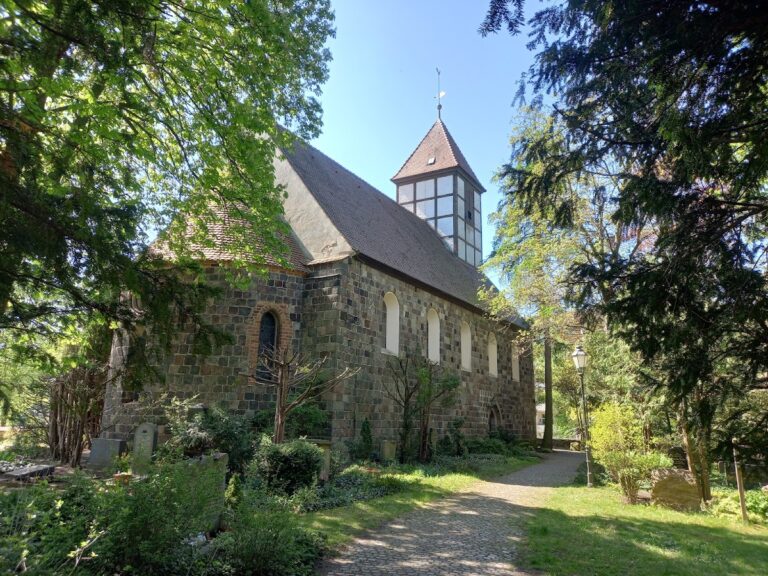
Zehlendorf developed around 1230 as a broad linear village. A wooden church was probably first built near the village center, on the western side of the village street. A stone replacement probably followed around 1250. A village church with a block-like tower was mentioned in a document in 1264 and was probably a four-part church with an apse, built from fieldstone blocks and fitted with a transverse tower as wide as the nave.
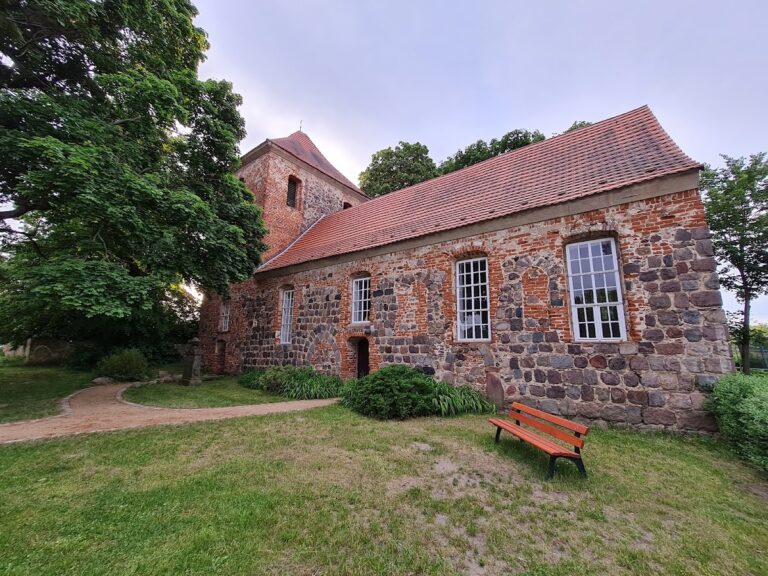
Elements of this medieval building survived within the later church. When most of the exterior plaster fell away during the Second World War, the brickwork revealed a substantial amount of fieldstone that had already belonged to the earlier structure.
Royal rebuilding after the Seven Years’ War
In May 1732, Friedrich Wilhelm I, King of Prussia from 1713 to 1740, welcomed Salzburg Protestant exiles in front of the village church. These were Protestants expelled from the Archbishopric of Salzburg during the 1730s because of their faith, many of whom were admitted to Prussian territories.
The Seven Years’ War, a European conflict fought from 1756 to 1763, brought military damage, occupation, and plundering to parts of Brandenburg-Prussia. Zehlendorf was plundered in 1760, and the village church was left in ruins. Tradition holds that Friedrich II, also known as Frederick the Great, saw the ruin as a disgrace while changing horses in Zehlendorf on the road between Berlin and Potsdam. He ordered the remains demolished in 1767 and commissioned a representative replacement, supplying building timber and 6,000 thalers.
The new church was erected in 1768 with almost 300 seats, including those in the gallery, although the village itself had fewer than 300 inhabitants. The reason for its unusual eight-sided plan is unknown. A later legend attributed the design to an embezzling builder who fled after exhausting the funds, but the church’s capacity was not small in comparison with conventional village churches. The architect probably came from the royal building office in Potsdam. Friedrich II also arranged the rebuilding of the war-damaged village church in Schöneberg, where a conventional hall plan was used instead.
Changing parish use
Population growth led to the construction of Paulus Church on Kirchstraße between 1903 and 1905. After its inauguration in 1905, Dorfkirche Zehlendorf no longer served as a place of worship until 1953. Alterations in 1912 converted it into a parish hall for the Paulus congregation, a role it retained until the congregation’s building on Teltower Damm was completed in 1930.
In the late 1930s, renewed use as a church was considered because National Socialist ideology presented the building as a “people’s church.” The church council set aside money for repairs, and an interior reconstruction in Baroque form was planned. This included the proposed transfer of a Baroque pulpit-altar, a combined preaching and altar installation, from the village church in Lankwitz. Government support was withdrawn in early 1939, however, and the church remained an unfinished building site throughout the war years.
Restoration and later preservation
The church’s visible deterioration after 1945 did not result from wartime damage. Initial repairs began in 1951, supported by donations and assistance from the Berlin Senate. Bishop Otto Dibelius reconsecrated the restored church on the First Advent of 1953. The restoration gave the exterior its tall segmental-arched windows, whose arches are formed from less than a semicircle, and its portal arrangement with a round or oval oculus above the door.
Since the 1950s, the church has housed works from the former Chapel of the Holy Spirit. It is protected as a historic monument and forms part of Berlin’s group of more than 50 village churches. By 2017, dry rot, a fungal decay that weakens timber, had damaged the roof structure. Some beams were entirely missing, the roof’s weight was pushing the walls outward, and cracks had appeared in the masonry.
Remains
The surviving church stands in the historic center of Zehlendorf, in the area known as Zehlendorfer Eiche. Its plan is an octagon organized around a central space rather than the longitudinal arrangement more usual in village churches of the Mark Brandenburg, the historic margraviate that formed a core territory of Prussia. Smooth-plastered wall surfaces lie between pilasters at the eight corners, and restoration gave those pilasters a block-like plaster finish.
Exterior and roof
Octagonal structure
The 1768 building is an unusually rare octagonal central church among the village churches of the Mark Brandenburg. A sacristy is attached to the church. The facade is divided into two levels, with an oculus above a low segmental-arched window. These facade axes belong to the 1953 restoration, as do the tall windows and the portal arrangement.
Roof and bells
The church originally carried an eight-sided tent roof crowned by a lantern-like central tower. Two bells hung in that tower, but it was dismantled in 1788 because its connection with the roof structure could not withstand the movement caused by the bells. An open half-timbered bell frame with a thatched roof was then erected in the churchyard. The finial, weather vane, and cross from the former tower now complete the present tent roof.
One bronze bell has no date or inscription, but its Romanesque figural and band frieze places it in the early thirteenth century. Since 1912, it has been in St John’s Church in Schlachtensee. The other bell dates from 1270.
Interior and churchyard
Interior arrangement
The original interior fittings were no longer present when the church was rebuilt. During its conversion into a parish hall, the organ and pulpit-altar were transferred to a congregation near Züllichau in the Neumark, the historic Brandenburg region east of the Oder River. The present interior was redesigned with reference to the building’s historical division. Galleries run around the room on an inner ring of columns, while the gallery is interrupted at the altar area to give that part of the interior greater breadth.
Organ and altar furnishings
Above the entrance is an organ built in 1991. Its case dates from around 1720 and is in the Franconian Baroque style; it formerly stood in Berlin’s destroyed Trinity Church. The wooden altar is framed by two double-sided painted altar wings from around 1480 that came from Berlin’s Monastery Church.
Eleven panel paintings dating from 1577 to 1646 hang on the walls. They originally came from the former Chapel of the Holy Spirit, adding an assemblage of artworks to an interior that did not possess these furnishings during its earlier phases.
Churchyard memorials
The churchyard contains a memorial plaque commemorating the arrival of the Salzburg Protestant exiles. It also holds the grave of Wilhelm Dubrow, who served, among other roles, as a head of the Zehlendorf local administration.