Collegiate Church of St Mary, Youghal: A Medieval Collegiate Church in Ireland


Site at a Glance
- Rating
- 4.8
- Popularity
- Low
- Country
- Ireland
- Primary era
- Medieval
- External website
- Open
- Eras represented
- Medieval, Early Modern
- Civilizations
- English, Norman
- Site type
- Religious
- Remains
- Church
On this page9 sections
History
The Collegiate Church of St Mary, Youghal, is a medieval church in Ireland, built by the medieval Christian community of Youghal in the early thirteenth century. Dedicated to the Virgin Mary, it now belongs to the Church of Ireland and forms part of the Youghal Union of Parishes in the United Dioceses of Cork, Cloyne and Ross. Its present form dates from about 1220, when the church was rebuilt in the Gothic period.
Early churches and medieval development
The church stands on a site occupied by at least one earlier church, and possibly two. Local tradition connects an early monastic foundation with Declán of Ardmore, an Irish Christian saint associated with missionary activity in the region, during the mid-fifth century. That church was supposedly rebuilt in an Irish Romanesque style around 750. An eleventh-century building was damaged in 1192, and traces of it remain within the present structure. The roof timbers have been carbon-dated to about 1170, providing evidence for the chronology of the earlier building.
The early-thirteenth-century rebuilding was directed by masters from four local guilds of operative masons. Their marks survive on the pillars that support the Gothic arches. A vestry-book entry records parish accounts from 1201, while a papal taxation list from 1291 described Youghal as the richest benefice in Cloyne. A benefice was an ecclesiastical office carrying an income, and the list of clergy associated with the church can be traced to this period.
The collegiate foundation
On 27 December 1464, Thomas FitzGerald, 7th Earl of Desmond, established Our Lady’s College of Youghal and made St Mary’s a collegiate church. A collegiate church was served by a community of clergy organized under a warden or similar head. At Youghal, the institution trained seminarians, students preparing for religious service, and was served by a warden, eight fellows, and eight singing men.
After the Reformation, the church and its assets passed to the Established Church, the state-recognized church in the jurisdiction. The predominantly Roman Catholic population was required to worship in private premises, and the Penal Laws, legal restrictions that limited Catholic rights and religious practice in Ireland, prevented the construction of another Catholic church in Youghal until 1796. Thomas Allen was the last Catholic warden in 1533. Roger Skiddy, appointed by King Edward VI, was described as Warden of Youghal in 1567. About sixty years later, the endowments were acquired by the Earl of Cork, and in 1639 the rectory was united with the wardenship. A Catholic succession of wardens continued until 1709, when Richard Harnet held the office only in a titular capacity. In the Anglican succession, the Bishop of Cloyne was, and remains, regarded as warden.
Destruction and rebuilding
In 1597, insurgent forces led by Gerald FitzGerald, 15th Earl of Desmond, plundered the college house and left it in ruins. The Desmond Rebellion was an uprising against English rule in Munster during the late sixteenth century. The attackers also unroofed the High Chancel, the principal elevated eastern part of the church containing the high altar.
Sir Walter Raleigh was Mayor of Youghal in 1588 and lived in the warden’s residence. Richard Boyle, 1st Earl of Cork, bought Raleigh’s land for £1,000 in 1596 and purchased the church on 29 March 1606. Boyle, an English-born landowner and powerful political and economic figure in early-seventeenth-century Ireland, spent £2,000 in 1608 rebuilding the church and repairing damage from the rebellion. He also encouraged English settlers in an effort to increase Youghal’s population.
During the civil war that began in 1641, Boyle strengthened the residence and its grounds with two large towers, five circular park turrets, and an earthen artillery platform commanding the town and harbour. He also erected a large marble monument for himself and his family. In 1649, during the Commonwealth campaigns in Ireland, Oliver Cromwell used Youghal as a base and delivered a funeral oration from a chest preserved in the church.
Later religious and architectural history
In 1734, George Berkeley, Bishop of Cloyne and an Anglican philosopher, took up residence as warden of the college and conducted services at St Mary’s. John Wesley, the founder of Methodism, visited Youghal in 1765 and attended Divine Service in the church. In 1782, the residence passed to Nicholas Giles, who converted it into a dwelling, while most of its defensive towers were removed.
The High Chancel was re-edified during a large restoration carried out from 1851 to 1854. The church roof was slated in 1833 after the parish received a grant of £200, creating the present roof. A remedial restoration followed from 1970 to 1973. In the late 1980s, a chapel was created in the north transept using furnishings from the closed church of Templemichael. The church itself is dedicated to St Mary the Virgin, so this chapel is not a Lady Chapel.
St Mary’s is a National Monument of Ireland and is under government care through a lease between the Church of Ireland Representative Church Body and Youghal Urban District Council. It is listed in the Record of Monuments and Places as CO067-029003. Richard Boyle, 1st Earl of Cork, was buried in the church graveyard. The building also has a continuing musical history, hosting recitals, concerts, and festivals, including events associated with the East Cork Early Music Festival. The removal of lime plaster from the rubble walls during the 1970s affected its choral acoustics, although the church remains suitable for instrumental and folk music.
Remains
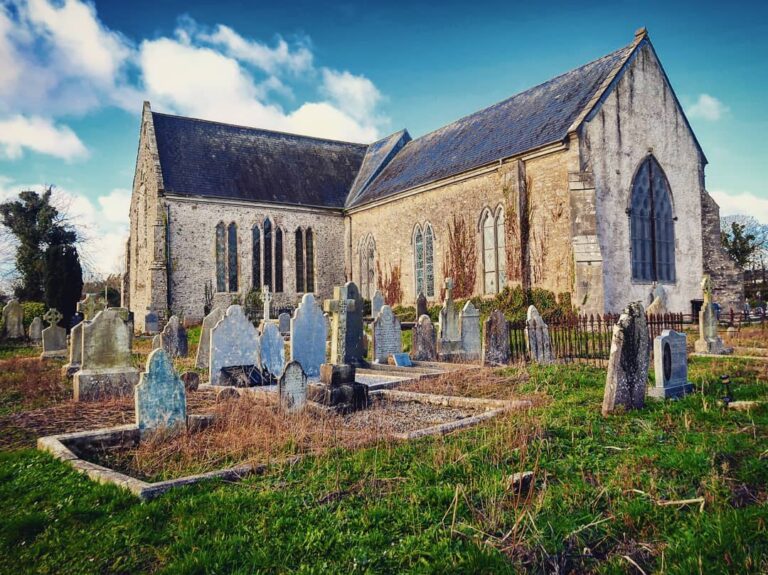
St Mary’s is a large cruciform church, with a nave crossed by transepts to form a cross-shaped plan. It is one of the three largest surviving thirteenth-century Gothic churches in County Cork, alongside Cloyne Cathedral and St Multose Church in Kinsale. The building combines surviving traces of the earlier eleventh-century church with the early-thirteenth-century Gothic rebuilding and later repairs.
Church fabric
The west window of the nave is an example of Early English Gothic, a phase of Gothic architecture associated with pointed arches, lancet windows, and developing stone construction. The pillars supporting the Gothic arches preserve the marks of the four local mason guilds involved in the rebuilding. The High Chancel, which was unroofed during the attack of 1597, was re-edified in the nineteenth-century restoration. Its surviving form therefore reflects both the medieval church and the work of 1851 to 1854.
Residence and defensive remains
The former warden’s residence, now called Myrtle Grove, survives with two of its original defensive towers. Its wider defensive complex included five circular turrets around the park and an earthen artillery platform overlooking the town and harbour. Most of the residence’s other defensive towers were removed when the building was converted into a dwelling in 1782.
Monument and musical furnishings
A large marble monument to Richard Boyle, 1st Earl of Cork, and his family rises almost to the roof of the chapel. The church also preserves the chest associated with Oliver Cromwell’s funeral oration in 1649.
An organ purchased in 1812 stood in a gallery built at the west end of the nave. A replacement made by Telford and Telford of Dublin arrived in 1861 and was removed in 1965 because of its poor condition and continuing expense. In 2007, a larger organ formerly installed in St Michael on the Mount Without in Bristol was moved to Youghal, restored by an Irish organ-building firm, and installed in the north bay of the crossing.