Repton Abbey: An Anglo-Saxon Benedictine Double Monastery in England


Site at a Glance
- Rating
- 4.7
- Popularity
- Low
- Country
- United Kingdom
- Primary era
- Medieval
- External website
- Open
- Eras represented
- Medieval
- Civilizations
- Anglo-Saxon
- Site type
- Religious
- Remains
- Monastery
On this page11 sections
History
Repton Abbey was an Anglo-Saxon Benedictine double monastery for monks and nuns in Repton, United Kingdom. Its foundation date is uncertain, with tradition placing it around AD 600 under Saint David, the sixth-century patron saint of Wales, while another tradition dates its establishment to about AD 675 by the Mercian royal family. The monastery developed from an earlier settlement and became a religious and dynastic centre in Mercia, the Anglo-Saxon kingdom that occupied much of the English Midlands.
Foundation and early community
One foundation tradition says that Prince Friduricus granted the land to Hædda, abbot of Breedon on the Hill. Archaeological excavation has shown that buildings already occupied the site before the monastery was established. Several timber structures were gradually replaced by stone buildings, indicating a developing settlement rather than a single construction project.
Repton was governed by an abbess, and its monks and nuns came mainly from noble and aristocratic families. Saint Werburgh, also known as Werberga, died in 699 and is locally regarded as the first known abbess. She was the daughter of Wulfhere, king of Mercia, and Saint Ermelida. Saint Edburga of Repton, who died around 700, is thought to have been the daughter of King Ealdwulf of East Anglia. Under the patronage of Wulfhere, she became abbess after Elfrida and was later translated to Southwell, where tradition held that she was buried.
In 697, while Abbess Alfthritha headed the community, Guthlac came to Repton to receive the tonsure, the ritual cutting of the hair that marked entry into religious life. He also received religious clothing and undertook penance before leaving the monastery to live as a hermit.
A royal burial place
Repton became a burial place for members of the Mercian ruling family. Merewalh, sub-king of the Magonsæte, was buried there between 670 and 685. King Æthelbald of Mercia was interred at Repton after he was murdered at Seckington in 757. King Wiglaf was buried there after his death in 839, and Wiglaf’s grandson, Wigstan, was murdered in 840 and interred in the crypt in 849. Two of the thirty-seven Mercian kings were buried within the crypt.
Wiglaf renovated the eastern end of the abbey church and its crypt. Reports of miracles at Wigstan’s tomb made Repton a pilgrimage centre, and Wigstan came to be venerated as a saint. When the monks and nuns fled the Viking invasion, they carried his remains with them. The relics later returned to Repton before King Cnut removed them for reburial at Evesham Abbey.
Viking occupation and later church history
The Great Heathen Army, a large Viking force that campaigned against the Anglo-Saxon kingdoms, reached Repton in the autumn of 873. It established winter quarters there before completing its conquest of Mercia in 874. The monastic community fled with Wigstan’s remains, and the occupation appears to have ended the abbey’s institutional life. The monastery is not recorded after 873–874.
The Vikings destroyed many of the monastic buildings and incorporated the church walls into their fortifications. After their departure, the church was restored roughly 40 to 50 years later as a parish church rather than a monastery. In the twelfth century, its advowson, the medieval legal right to appoint or nominate the parish priest, was granted to the newly established Repton Priory. The church was then rebuilt and enlarged between the thirteenth and fifteenth centuries.
Excavations in the 1980s by Martin Biddle and Birthe Kjølbye-Biddle revealed a mass grave at Repton. Later analysis announced in 2018 indicated that the remains could all date to the late ninth century, consistent with the army’s winter occupation. The earlier discrepancy in radiocarbon dates was attributed to the marine reservoir effect, a dating distortion caused by older carbon in ocean food entering the bodies of people who consumed substantial quantities of seafood.
Remains
The surviving site combines Anglo-Saxon church fabric, the crypt later incorporated into the Church of Saint Wystan, and archaeological evidence for the Viking occupation. The abbey grounds lay between the church and the River Trent when the river ran beside the site. The river now flows about a quarter of a mile north of the village. Later rebuilding left the church with medieval additions while preserving important elements of the earlier complex.
The crypt and Anglo-Saxon church
The royal crypt
The crypt was built over a natural spring during the first half of the eighth century, probably before AD 740. It may originally have served as a baptistery before becoming a royal mausoleum. The square chamber has three rows of three domical vaults, each with a rounded, dome-like form. Two pilasters, which are flattened supports attached to a wall, stand against each wall, while four free-standing pillars occupy the corners of the central vault.
The crypt was incorporated into the later Church of Saint Wystan. Additional staircases were added to control the movement of pilgrims after Wigstan’s tomb became a focus of pilgrimage. The dimensions and design of the chamber have also been suggested as possible influences on the spiral-columned shrine of Edward the Confessor and the Cosmati Coronation Pavement in Westminster Abbey, both commissioned by Henry III. Cosmati work is a medieval technique using patterned inlaid stone and glass.
Surviving church fabric
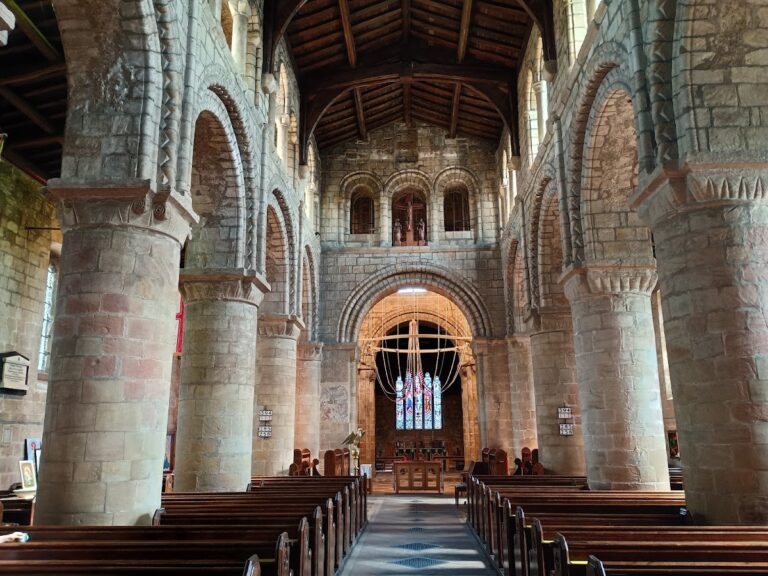
Anglo-Saxon elements remain in the church’s chancel, the eastern part around the main altar, as well as in the north-eastern and south-eastern parts of the crossing, where the nave and transepts intersect. Part of the north transept, a crosswise section of the church, also survives. Porticoes, or covered entrances and colonnaded porches, were added to the north and south sides around the ninth century. The church was decorated with multicoloured stained glass, stone sculpture, and stucco wall mouldings.
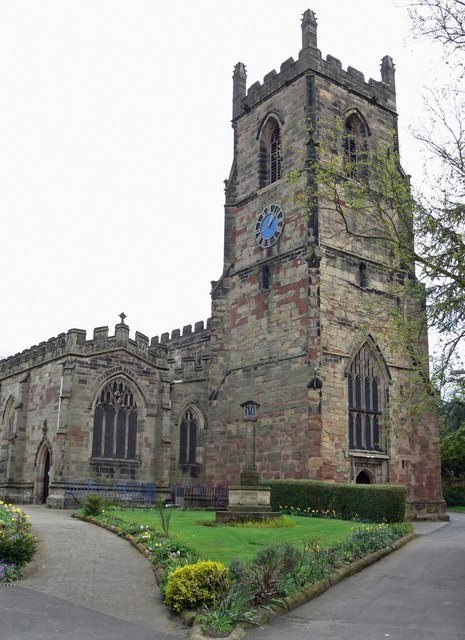
A fragment of a cross found in the church shows a mounted warrior wearing a diadem. It may have formed part of a memorial to King Æthelbald of Mercia. The later parish church has a tower and spire about 212 feet, or 65 metres, high, added in the fifteenth century. Much of the upper walling and the entire roof of the earlier church were rebuilt after destruction or damage during the Viking period.
Viking-period archaeological remains
Encampment and burial mound
The Great Heathen Army built a fortified encampment in the abbey grounds between the church and the River Trent. A Viking burial mound in the area now occupied by the vicarage lawn contained the remains of approximately 200 Viking men and 49 Anglo-Saxon women. Other Viking mounds and cenotaphs survive at the nearby Heath Wood barrow cemetery.
Mass grave
The mass grave excavated at the church contained roughly 300 sets of human remains, about one-fifth of them women. Around 80 percent were men aged between 18 and 45, and many showed signs of violent injury. Viking objects, including a pendant associated with Thor, were found among the bones. The late ninth-century dating proposed for the remains connects the grave with the period of the army’s winter occupation at Repton.