Stadtkirche St. Jakobus: Gothic Parish Church in Brackenheim, Germany

Site at a Glance
- Rating
- 4.6
- Popularity
- Very Low
- Country
- Germany
- Primary era
- Medieval
- External website
- Open
- Eras represented
- Medieval, Early Modern, Modern
- Civilizations
- Duchy of Württemberg, German, Holy Roman Empire
- Site type
- Religious
- Remains
- Church
On this page11 sections
History
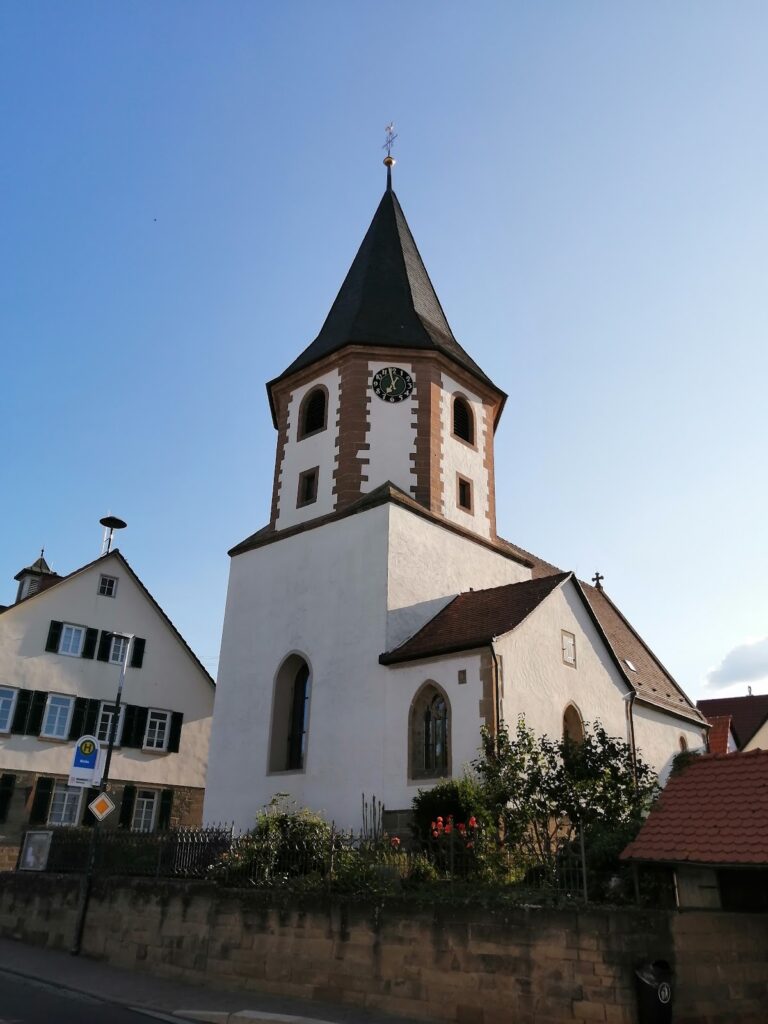
Stadtkirche St. Jakobus is a Protestant parish church in Brackenheim, Germany, whose present form developed from a medieval chapel and a Gothic tower-choir church. Its origins remain uncertain. A chronicle note from 1634 attributes its foundation in 914 to King Conrad I and says that he dedicated it to the Apostle James, around whom the settlement supposedly developed. More recent research instead associates the church with a chapel founded by local citizens around 1100, probably serving pilgrims connected with the developing journey to the apostle James’s tomb at Santiago de Compostela.
From Chapel to Parish Church
The early chapel was probably destroyed by fire during military conflict. Around 1300, Brackenheim’s citizens built a Gothic tower-choir church on the site. A tower-choir church places the choir, the principal liturgical space, within the lower level of the tower. The church was first mentioned in 1389, and several extensions and alterations followed up to 1500, establishing the basic form that survives today.
The sacristy was added in 1509, and the church became Brackenheim’s parish church in 1510. It replaced St. John’s Church, which stood in the cemetery outside the town. A preaching office, an appointment created specifically for preaching, was established at St. Jakobus in 1512.
Reformation and Protestant Administration
During the Reformation, the sixteenth-century movement that created Protestant churches and reshaped Catholic worship, administration, and religious art in parts of Europe, Konrad Sam led Brackenheim’s first Protestant congregation in Old Württemberg from about 1519 to 1524. Old Württemberg was the historic central territory of the Duchy and later Kingdom of Württemberg. After Sam was forced to leave in 1524, Catholic preachers briefly returned, but the Reformation in Württemberg was completed in 1534. Brackenheim became the seat of a deanery in 1536. A deanery is a church administrative district supervised by a dean.
The change in worship also altered the church interior. Wall paintings that had probably covered much of the building were whitewashed, and the former side altars were removed around 1540. The reduction of liturgical practices lowered the number of pastoral positions from five to two. The historical high altar, dedicated to Saint James, was sold by the congregation to the Württemberg State Museum in 1880.
Clergy, Fire, and Musical Life
The church maintained close connections with the University of Tübingen. Its pastor and deacon positions were generally filled by educated Tübingen theologians, many of whom later moved to higher offices. Pastors included Andreas Grammer, who served from 1568 to 1582, Erhard Weinmann from 1608 to 1620, Johann Melchior Nicolai from 1635 to 1659, Christian Gottlob Moser from 1834 to 1839, and Gustav Petzold from 1894 to 1910. Among the second pastors were the writer Karl Heinrich Paret, who served from 1849 to 1858, and Karl Eugen Rieker, later a professor of canon law in Erlangen, who served from 1884 to 1890.
Stadtkirche St. Jakobus survived the town fire of 1691 almost undamaged and was the only building in the burned area to do so. In 1716, the town hospital funded a new organ, while retaining its organ case. The instrument and its setting became part of the church’s continuing musical history.
Renovation and Later Changes
Major interior renovations took place in 1863 under Carl Beisbarth the Elder and in 1914 under Martin Elsaesser. A fundamental renovation in 1964, led by chief building officer Klaus Ehrlich, uncovered medieval frescoes and Gothic windows that had been blocked. It restored the chancel arch to a Gothic form, installed new pews and a gallery, added a new altar and baptismal font, and placed a new organ in the historic case. The furnishings were also rearranged from a transverse church arrangement to a longitudinal one.
Further work in 2012 repaired deteriorated masonry in the tower and renewed the roof structure. The interior renewal was completed in 2017 with three new stained-glass works. The church’s three historical tower bells were thoroughly refurbished in 1970. The largest bell had been surrendered for armaments production during the Second World War, but returned to Brackenheim after the war. Since 1 January 2025, the congregation has belonged to the Heilbronn-Brackenheim church district of the Evangelical State Church in Württemberg, having previously belonged to the Brackenheim church district.
Remains
Tower and Choir
Stadtkirche St. Jakobus is a late Gothic tower-choir church with an east-facing choir occupying the lower storey of its 52-metre-high tower. The square choir measures 5.85 by 5.85 metres and has a stone quadripartite rib vault, a ceiling supported by intersecting structural ribs. Its elaborate keystone forms the centre of the vault. Externally, the tower changes from a square lower section to an octagonal upper section and ends in an octagonal pyramidal roof covered with slate. An old circular stairwell rises through the tower on its north side. The adjoining sacristy, added in 1509, has a Gothic net vault whose ribs form a network-like pattern.
Nave and Wall Paintings
A relatively low Gothic chancel arch separates the choir from the nave. The nave measures approximately 12.5 by 25.6 metres and was probably extended northward and westward from the original tower-choir church at the beginning of the seventeenth century, leaving it asymmetrical in relation to the choir. A historic wooden barrel vault covers the space and is painted with floral tendrils. The south wall contains windows of different sizes. Two smaller Gothic windows in the south facade were blocked for a period and reopened during the 1964 renovation. Medieval frescoes survive on the north wall, including paintings of the Three Magi and Saint Catherine. The Gothic window reveals uncovered in the south wall in 1964 bear paintings of apostles and flowers.
Devotional and Liturgical Features
A late Gothic Holy Sepulchre occupies a niche in the north wall. This devotional representation of Christ’s burial contains a larger-than-life half-relief of the dead Christ resting on a sarcophagus. An inscription dates the figure to 1464. Painted frescoes of the customary accompanying figures cover the rear wall of the niche and the church wall above its crown. Blind tracery decorates the niche and the lower edge of the sarcophagus. A seventeenth-century painting of the Baptism of Jesus hangs on the north wall of the choir.
The Renaissance pulpit stands in the southeast corner beside the chancel arch. Its octagonal basket contains four panel paintings of the Evangelists, Matthew, Mark, Luke, and John, shown with their traditional attributes of an angel, lion, ox, and eagle. The sounding board has richly carved architectural decoration representing the Heavenly Jerusalem and is crowned by a statuette of the risen Christ. Paintings of prophets and praises of God appear on its underside in German, Latin, Greek, Aramaic, Hebrew, and Syriac, reflecting a tradition associated with Christian Kabbalah. The pulpit was moved to its present position during the 1963 to 1964 renovation. Before that, it stood from 1617 on the south wall between two large windows and served as the spatial and liturgical centre of the former transverse arrangement.
Two large carved donor panels in the style of epitaphs hang between the south-wall windows. Duchess Barbara Sophia, the widow of Duke John Frederick and a princess of Brandenburg by birth, donated them in 1630. The Württemberg arms appear above the Brandenburg arms on each panel, while six relief scenes from the Passion occupy the centre. The altar and baptismal font are made of calcareous tufa, a porous limestone deposited by mineral-rich water, and were acquired during the 1964 renovation. The wooden crucifix on the altar dates from about 1510 to 1520 and comes from the Heilbronn workshop of Hans Seyffer. Its face presents Christ as the Man of Sorrows, an image emphasizing his suffering and death.
Windows, Gallery, and Organ
Most of the church windows were replaced during the 1964 renovation. Stuttgart artist Wolf-Dieter Kohler created the overall artistic concept, including the choir and south windows with scenes from the New Testament and the Sermon on the Mount. A slender choir window donated by the family of town mayor Wendel was designed by Franz Heinrich Gref in 1916 and produced at the Saile stained-glass workshop in Stuttgart. It depicts the calling of James and John, the Transfiguration, and the Resurrection of Christ. Gref also made the sacristy window showing the Adoration of the Magi. Bernhard Huber created three further windows in 2017, one for the tympanum above the entrance portal and two for the round windows in the west wall.
A continuous gallery runs along the west gable wall and the north side wall, with the organ on its western section above the entrance area. Georg Friedrich Schmahl built the original organ in Heilbronn in 1716. It formerly stood on a large gallery spanning the chancel arch. After several alterations, E. F. Walcker and Company installed a new organ in the historic Baroque case in 1966. The present instrument has 27 stops on two manuals and pedals.
Historical Bells and Treasury
The three historical tower bells are made of bronze and form one of the oldest bell peals in Baden-Württemberg. The oldest is the Cross and Arbitration Bell, dating from the thirteenth century. Its inscription names Thomas of Trier as its founder. The bell has a nominal pitch of A-flat, a diameter of 984 millimetres, and a weight of 575 kilograms. The Baptismal Bell was cast around 1300 and bears the names of the four Evangelists. It is the smallest bell, with a nominal pitch of D-flat, a diameter of 726 millimetres, and a weight of 242 kilograms.
The largest and youngest bell is the Prayer, or Lord’s Prayer, Bell, cast in Heilbronn by Bernhard Lachmann in 1497. It has a nominal pitch of F, a diameter of 119.6 centimetres, and a weight of 1,028 kilograms. Its inscription includes the name of the founder and the date of casting. The church treasury includes a seventeenth-century baptismal set consisting of a bowl and jug. The set was used at the baptism of Theodor Heuss, the first President of the Federal Republic of Germany, on 9 March 1884. A Renaissance-period sacristy cabinet is also preserved in the treasury.