Franziskanerkirche: Former Franciscan Monastery Church in Überlingen, Germany


Site at a Glance
- Rating
- 4.7
- Popularity
- Very Low
- Country
- Germany
- Primary era
- Medieval
- External website
- Open
- Eras represented
- Medieval, Early Modern
- Civilizations
- Holy Roman Empire
- Site type
- Religious
- Remains
- Church
On this page14 sections
History
Franziskanerkirche is a former Franciscan monastery church in Überlingen, Germany, founded by the Franciscan friars in the medieval period and consecrated in 1348 as a three-aisled basilica in the Gothic tradition. Dedicated to the Immaculate Conception of Mary, it became an important religious and civic institution on the northern edge of the historic town.
Franciscan foundations in Überlingen
Franciscan women, known as the Sisters on the Wies, are recorded in Überlingen from 1259 and may have been present there since about 1240. Their first foundation stood outside the town walls on the site of the present municipal cemetery and included the Heiligkreuzkirche, which was demolished in 1529. Franciscan friars may also have established themselves in Überlingen around 1240. In 1259, the guardian of the order legally represented a Franciscan sister during a donation.
The friars belonged to the Lake Constance Custody of the Upper German, or Strasbourg, Province, known as Provincia Argentina. In 1300, Countess Elisabeth of Königsegg donated land at the northern boundary of the inner town-wall ring, beside the gate later called the Franciscan Gate. Konrad von Schertweg made a further donation toward the church’s construction in 1308. The resulting church was consecrated in 1348 by Ulrich Pfefferhard, Bishop of Constance. It was enlarged during the fifteenth century, and the choir was rebuilt in 1519 and 1520.
Religious and civic life
The church and monastery were closely connected with the people of Überlingen. Citizens were buried inside the church or in the monastery cemetery, while burial fees and payments for anniversary masses provided an important source of income. The tailors’ servants, and later the tailors’ guild, maintained a shared burial place in the church. The Sebastian Brotherhood of the crossbowmen and the bakers’ brotherhood each had its own altar.
The monastery usually housed between ten and fifteen friars. During the sixteenth and seventeenth centuries, it repeatedly served as the residence of the provincial of Provincia Argentina or the custos of the Lake Constance Custody. A custos was the official responsible for such a regional division of a religious order, while a provincial led the wider province. Several provincial chapters were held in Überlingen.
Monastery rooms also served civic purposes. Elections for the mayor, town magistrate, judges, and some council members took place there, as did civic drinking gatherings and banquets. The friars maintained alms-collecting stations in Ebringen, Meersburg, Mengen, Pfullendorf, Riedlingen, Saulgau, Schönenberg, Sigmaringen, and Stockach. In the seventeenth century, they resumed three annual collecting tours across a district reaching toward the Danube. Austria prohibited collecting in its territory in 1782.
Reformation and seventeenth-century pressures
During the Reformation, the monastery’s reading master preached in a Lutheran manner even though the town council opposed the Reformation. The council expelled him from Überlingen and appointed secular priests as preachers. The friary’s finances weakened after alms collection was prohibited, while burials increasingly shifted to a municipal cemetery established outside the town in 1532.
The council allowed the monastery cemetery to function again in 1582, but imposed a high tax on its associated income. Internal disciplinary and financial problems also required intervention by the superiors of Provincia Argentina. In 1643, the guardian was removed because of his financial administration, and in 1647 the monastery surrendered its parish responsibilities. At the end of the Thirty Years’ War, a conflict that devastated much of Central Europe between 1618 and 1648, only four friars remained.
The Capuchins, a reform branch of the wider Franciscan tradition, founded a monastery and church in Überlingen around 1620. They soon became more popular with the local population than the Franciscans. During the Thirty Years’ War, the Franciscans took pastoral responsibility for the parishes of Andelshofen and Lippertsreute, but these parishes were removed from their care in 1647.
School, rebuilding, and Baroque transformation
In 1653, the town council proposed transferring the Franciscan monastery to the Jesuits so that it could house a grammar school. The Franciscans responded by agreeing in 1658 to operate the school themselves. They offered philosophical studies from 1675. Although teaching was later temporarily reduced to the lower classes, the full grammar-school curriculum and philosophical studies returned from 1742 to 1796 and again from 1802 until the monastery was dissolved in 1808. The town paid the school’s costs, and the Franciscans built a new schoolhouse on the monastery grounds in 1712.
The convent buildings were rebuilt between 1700 and 1709 because of their poor condition. Between 1752 and about 1766, the church was transformed from a High Gothic building into a Baroque church. Johann Michael Beer provided the plans for the architectural work. The nave received a new vaulted roof structure, and in 1753 the Constance court painter Franz Ludwig Herrmann decorated it according to a fixed pictorial program that included a painted false dome. A stucco artist named Bantle carried out additional decoration. The choir was rebuilt and slightly enlarged from 1754, and its tall pointed Gothic windows were altered into smaller windows. Sebastian Schilling, a Franciscan friar from Villingen, painted the choir. The conversion was completed in the mid-1760s.
Secularization and later uses
The Franciscan monastery was secularized in 1808. After the House of Baden took over the Capuchin monastery, the last Überlingen Capuchins lived in the former Franciscan buildings until 1820. Four Capuchins were still there in 1817, and the last died in 1820.
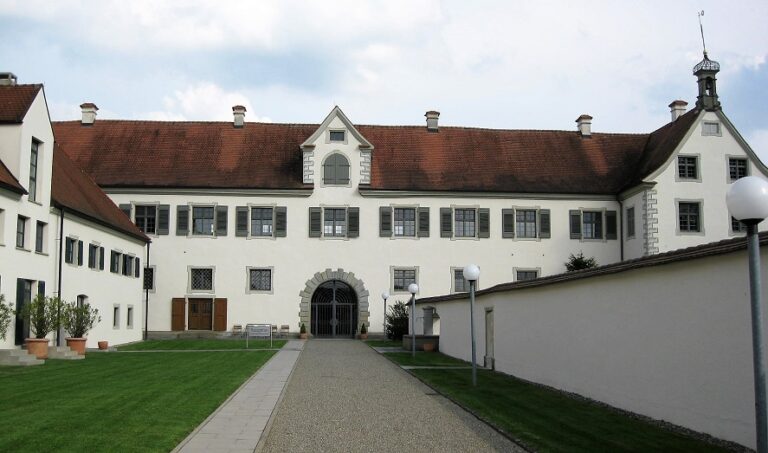
The former monastery then passed between the Baden state and the town. Its uses included a primary school, barracks, a grand-ducal district court, and a prison. The Heilig-Geist Hospital of Überlingen acquired the complex in 1855, and the hospital moved there in 1857 from the area of the present landing place. After a new hospital was built on the Mühlberg in the late 1880s, the former monastery became the St. Franziskus home for elderly people, which continues to serve as a care institution.
The church belongs to the town of Überlingen and is made available to the town parish for worship, including regular Sunday and morning services. It also serves as a concert venue. A major interior renovation took place from 1975 to 1977, followed by exterior renovation in 1994. The church is the second-largest in Überlingen after St. Nicholas Minster and belongs to that church’s parish. It is a Roman Catholic church in the Archdiocese of Freiburg, with the Immaculate Conception celebrated liturgically on 8 December. The church and former monastery complex are recognized as a cultural monument.
Remains
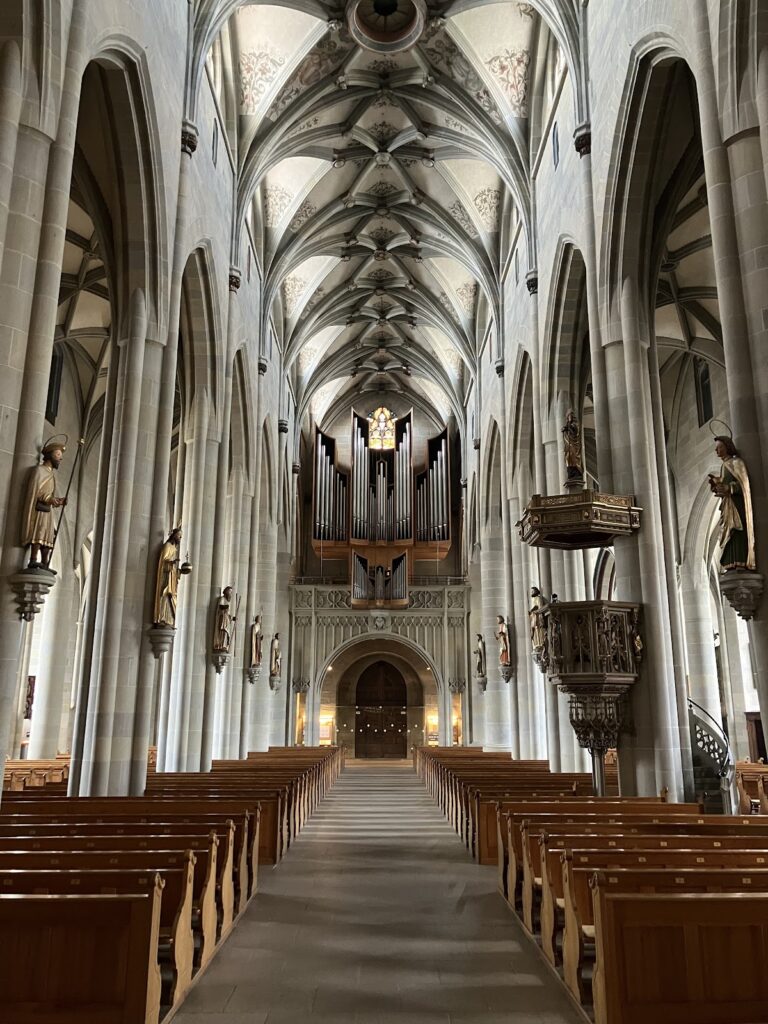
Franziskanerkirche stands in Überlingen’s historic center between Spitalgasse and Franziskanerstraße, beside the Franciscan Gate and near the northern medieval town wall. Its surviving form combines a three-aisled basilica, with a raised central nave and lower side aisles, and an eighteenth-century Baroque interior. A small Baroque roof turret rises above the building and provides its principal vertical accent.
Baroque church interior
Nave and choir
The nave retains the structure of the medieval church but received a new vaulted roof structure during the Baroque rebuilding. In 1753, Franz Ludwig Herrmann painted the nave according to a planned pictorial program that included a false dome, while Bantle added further stucco decoration. The choir was rebuilt and slightly enlarged from 1754. Its tall pointed Gothic windows were stripped of their tracery and divided into smaller openings. Sebastian Schilling painted the choir, completing the interior’s transformation into a Baroque setting by the mid-1760s.
Principal altar
The principal altar was made in 1754 and 1759. Four columns surround an image of the Virgin Mary standing on a globe and crushing the serpent’s head, representing the Immaculate Conception, the Catholic teaching that Mary was conceived without original sin. Adam and Eve appear beside her, the Trinity is shown above, and Joachim and Anna stand at her feet. John Duns Scotus, a medieval Franciscan theologian whose writings influenced Franciscan teaching on the Immaculate Conception, kneels at the edge of the composition.
White limewood figures of Saints Lawrence and Stephen stand on the altar’s stucco-marble columns. Above them rises a canopy surmounted by an angel of judgment. Joseph Anton Feuchtmayer created the altar with Franz Anton Dirr, while Gottfried Bernhard Göz supplied the painted work. It is a double altar: its rear side, known as the Chörle, is reached from the monastery building and consists of a carved relief.
Side altars and pulpit
The Bonaventure altar stands to the left of the choir arch, and the John of Nepomuk altar stands to the right. Both date from 1763. At the front ends of the side aisles are the Francis altar and the Anthony of Padua altar, both made in 1764. The Sebastian altar on the longitudinal wall of the northern aisle was donated by the Sebastian Brotherhood in 1766. Opposite it, on the southern side of the choir area, is the Bakers’ Altar, donated by the Überlingen bakers’ guild in 1763.
Franz Anton Dirr made all the side altars and the pulpit of 1761. The altar furnishings also include sculptures of Saints Lawrence, Stephen, Francis, and Anthony. Together, these works form the principal surviving group from the church’s eighteenth-century rebuilding.
Earlier furnishings and organ
Medieval and early-modern works
Little is known about the original furnishings of the Gothic church, but several earlier works remain associated with its history. The former high altar, made in 1519 and 1520, is now held in the municipal museum. A sculpture of John the Baptist from the first half of the fourteenth century and a life-size crucifix dated to 1340 to 1350 are also associated with the earlier church.
Organ
Johann Georg Aichgasser, an organ builder from Überlingen, constructed the original organ in 1755. Its case survives, while the instrument underwent several alterations and reconstructions. The present organ was completed by Xaver Mönch in 1958. The surviving prospect dates from 1757, and the current instrument has 36 stops.
Nearby sites