Tolga Katholikon: An Orthodox Cathedral in Yaroslavl, Russia


Site at a Glance
- Rating
- 4.8
- Popularity
- Medium
- Country
- Russia
- Primary era
- Early Modern
- External website
- Open
- Eras represented
- Early Modern, Modern
- Civilizations
- Russian
- Site type
- Religious
- Remains
- Cathedral
On this page9 sections
History
Tolga Katholikon is an Orthodox cathedral in Russia, located in Yaroslavl and completed in 1683 as part of Tolga Convent. Formally dedicated to the Entry of the Most Holy Theotokos into the Temple, an Orthodox feast commemorating Mary’s presentation at the Temple in Jerusalem, it belongs to the Yaroslavl Diocese and remains an active church.
Foundation and Early Cathedral
According to tradition, people from Yaroslavl discovered the Tolga Icon of the Mother of God on 8 August 1314. A wooden church was built at the place of the discovery, and Archbishop Prokhor consecrated it that same day. The icon became closely associated with the convent’s foundation and with the cathedral’s dedication.
Abbot Feodosy built a stone church on the site in 1553 using funds donated by Ivan the Terrible, the English name for Ivan IV, the first Russian ruler to use the title tsar. The 1627–1629 cadastral record names chapels dedicated to St Nicholas the Wonderworker and Dmitry of Thessalonica, providing the first surviving reference to the completed building.
Seventeenth-Century Rebuilding
In 1681, Abbot Gordian received permission from Metropolitan Jonah Sisoevich of Rostov to dismantle the earlier church and replace it. Yaroslavl merchants named Sverchkov financed the construction. Tsar Feodor Alekseevich gave 50 rubles, while his brothers Ivan and Peter and his sister Sophia each contributed 50 rubles for the wall paintings. Vasily Zhirovoy-Zasekin paid for the chapels associated with the wonderworking ancestors Fyodor, David, and Constantine. The new cathedral was finished in 1683.
Painting and Later Alterations
The main volume was painted in 1690, followed by the altar, galleries, chapel, and porch in 1691. Twenty-six artists from Yaroslavl and Kostroma took part. Patriarch Nikon’s visit to the monastery in 1681 may have influenced the original conception of the painted program.
A new iconostasis, the screen of icons separating the sanctuary from the main worship space, was installed in 1839–1840, when the wall paintings were renewed and the cast-iron floor was relaid. Further repainting took place in 1870 and in the chapels in 1912 under the supervision of the Imperial Archaeological Commission, the Russian imperial body responsible for archaeological and monument-protection work. The art historian Igor Grabar studied the paintings during the 1912 campaign.
Closure and Restoration
Soviet authorities closed the cathedral in 1928. During the 1930s, the monastery housed Volgostroi, and an operating model of the Rybinsk Hydroelectric Complex was installed in the cathedral in 1932 for testing. From 1950 the building served as a warehouse, and by the 1960s it was in an emergency condition.
Roof repairs began in 1968 under specialists from Yarrestavratsiya, followed by scientific restoration in 1982–1984. Restoration of the wall paintings began in 1998 under the direction of the artist-restorer E. B. Chernyaev. The cathedral is now a federally significant cultural-heritage monument of the Russian Federation.
Remains
Cathedral Building
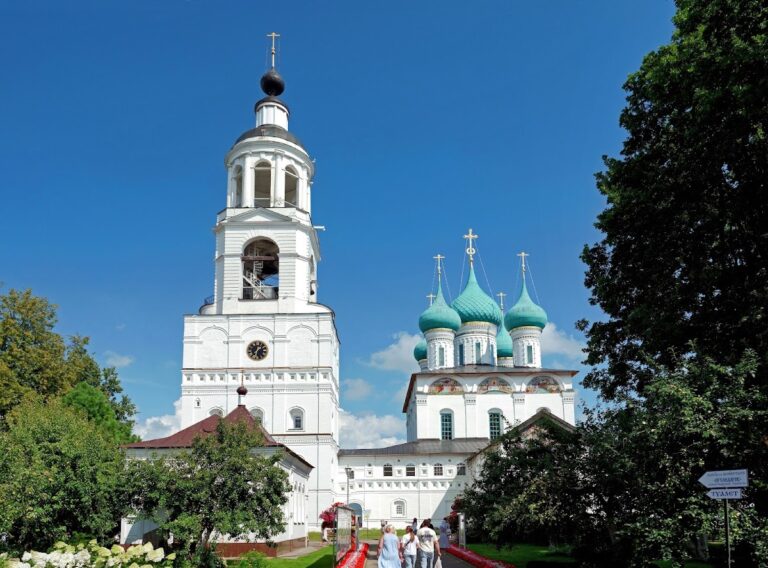
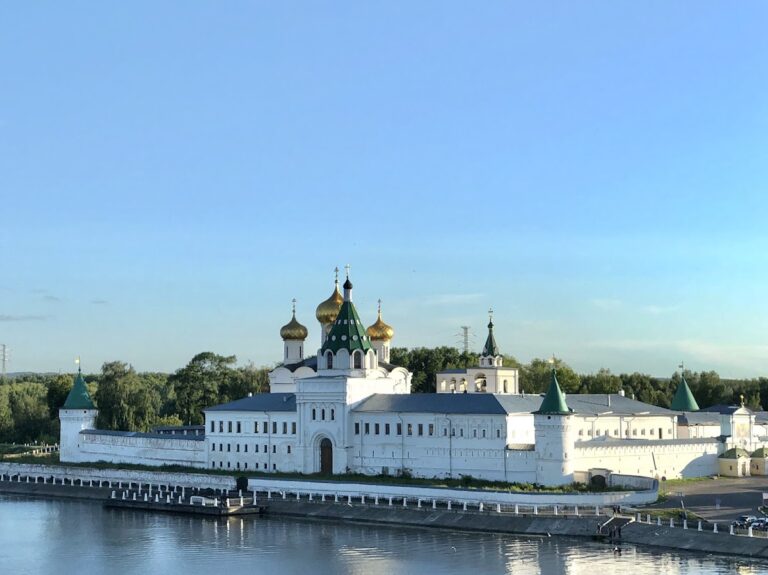
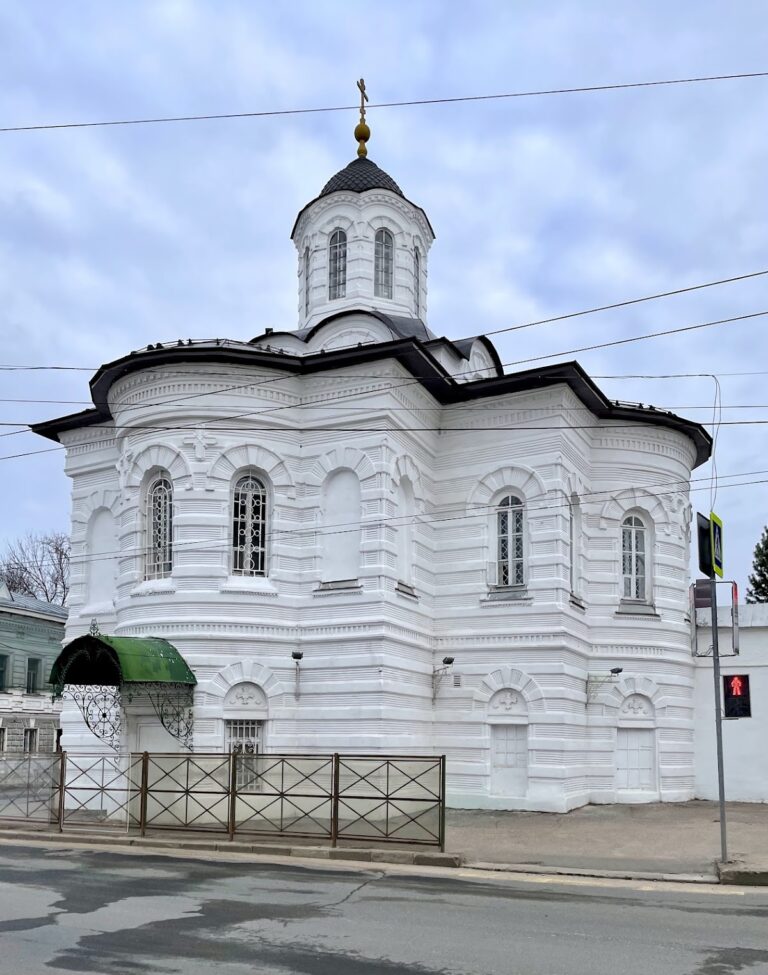
The cathedral is a brick, four-pillar church with three apses, semicircular or polygonal projections that contain the altars, and five cupolas that admit light. Three two-tier vaulted galleries surround the building, while a high lower level was intended for use as a burial vault. A large and ornate porch forms part of the entrance arrangement. Mosaics made on the exterior walls in 2008 were created under the direction of Andrei Markin.
Wall Paintings
The interior paintings were executed by Dmitry Semyonov, Fyodor Fyodorov, Vasily Osipov, Vasily Fyodorov, and other artists and apprentices. Their names were written into the painting on the splayed reveal of the western wall. The program includes scenes devoted to the Tolga Icon of the Mother of God, while the pillars carry scenes from the Acts of the Apostles, the New Testament book describing the activities of Christ’s apostles after the Resurrection.
The paintings are organized in seven tiers. The upper three present episodes from Christ’s life and parables. The fourth contains the Beatitudes, the Lord’s Prayer, and the Creed, followed by the Passion of Christ in the fifth tier. The sixth and seventh tiers concern the history of Tolga Convent. The compositions draw on reworked illustrations from Nicholas Ioannis Piscator’s 1650 Theatrum biblicum, also known as the Picture Bible.
Restoration preserved surviving nineteenth-century repainting, although severe humidity exposed portions of earlier work beneath it. After the nuns installed a new iconostasis and other carved and gilded fittings, parts of the decoration were reconstructed in a seventeenth-century style and color scheme. The reconstruction used the original incised preparatory drawings and comparisons with late-seventeenth-century monuments in Yaroslavl and Kostroma.
Belfry and Chapels
A separate four-tier belfry with a rectangular plan stands beside the cathedral. Built in 1683–1685 with funds from Prince N. Y. Lvov, it was rebuilt as a bell tower in 1825–1826 to a design by the architect Pyotr Pankov. The present cathedral’s chapels are associated with Fyodor, David, and Constantine, while the earlier church had contained chapels dedicated to St Nicholas the Wonderworker and Dmitry of Thessalonica.
Nearby sites