SS. Giovanni e Paolo (Spoleto): A Romanesque Church and Painted Crypt


Site at a Glance
- Rating
- 4.4
- Popularity
- Very Low
- Country
- Italy
- Primary era
- Medieval
- External website
- Open
- Eras represented
- Classical, Medieval, Early Modern
- Civilizations
- Roman
- Site type
- Religious
- Remains
- Church
On this page12 sections
History
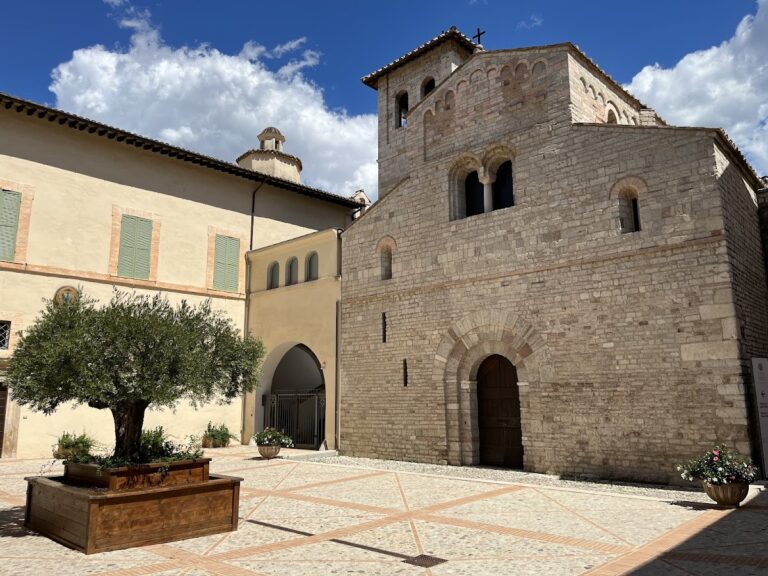
SS. Giovanni e Paolo is a Romanesque church in Spoleto, Italy, consecrated in 1174 during the medieval Christian period. Located in the city’s historic centre, it formed part of the Filitteria quarter, which was known in the late medieval period as Spoleto’s Byzantine quarter. The modest church became a parish building and preserves paintings that span the late twelfth to the sixteenth century, providing important evidence for the city’s pictorial culture.
Medieval foundations
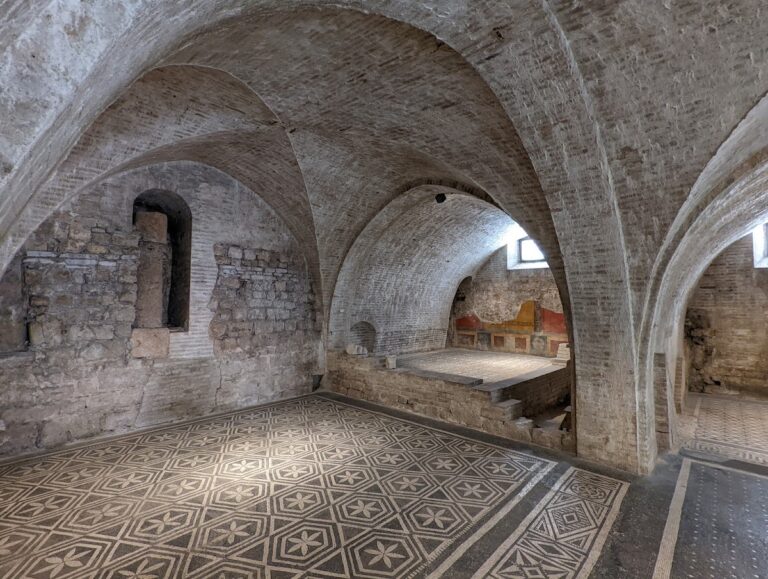
The church was built above a lower crypt, perhaps created in the eleventh century by adapting an earlier Roman building. Archaeological work in the late 1970s revealed earlier walls and pavements in the complex, along with a stone sarcophagus covered by a slab. These discoveries established that the Christian building occupied a site with earlier construction phases.
The oldest paintings belong broadly to the period from the church’s consecration to the second quarter of the thirteenth century. A monographic study completed in 1987 proposed that two principal works were made roughly eighty years apart and involved two artistically different hands working in close collaboration. Questions about their authorship and interpretation remain unresolved.
Frescoes, patronage, and later use
Several of the Romanesque paintings have been associated with Alberto Sotio, a twelfth-century painter connected with Spoleto. Their style was compared with his signed and dated Crucifix of 1187, which may originally have stood on the church’s high altar before being moved to Spoleto Cathedral in 1877. Later research recognized stylistic relationships but questioned whether the paintings and the proposed original location could securely be connected with Sotio.
The fresco of the martyrdom of Thomas Becket may have been painted around 1173, after the archbishop of Canterbury was canonized and shortly before the church’s consecration. Becket’s conflict with King Henry II of England ended with his assassination in Canterbury Cathedral in 1170 and helped spread his cult. Another interpretation places the painting after 1227 and connects it with the political struggle between the papacy and the Empire over the Duchy of Spoleto, involving Pope Gregory IX, Pope Innocent IV, and the emperor Frederick II. The later interpretation also relates the image to the wider diffusion of Becket’s cult after the translation of his bones in 1220.
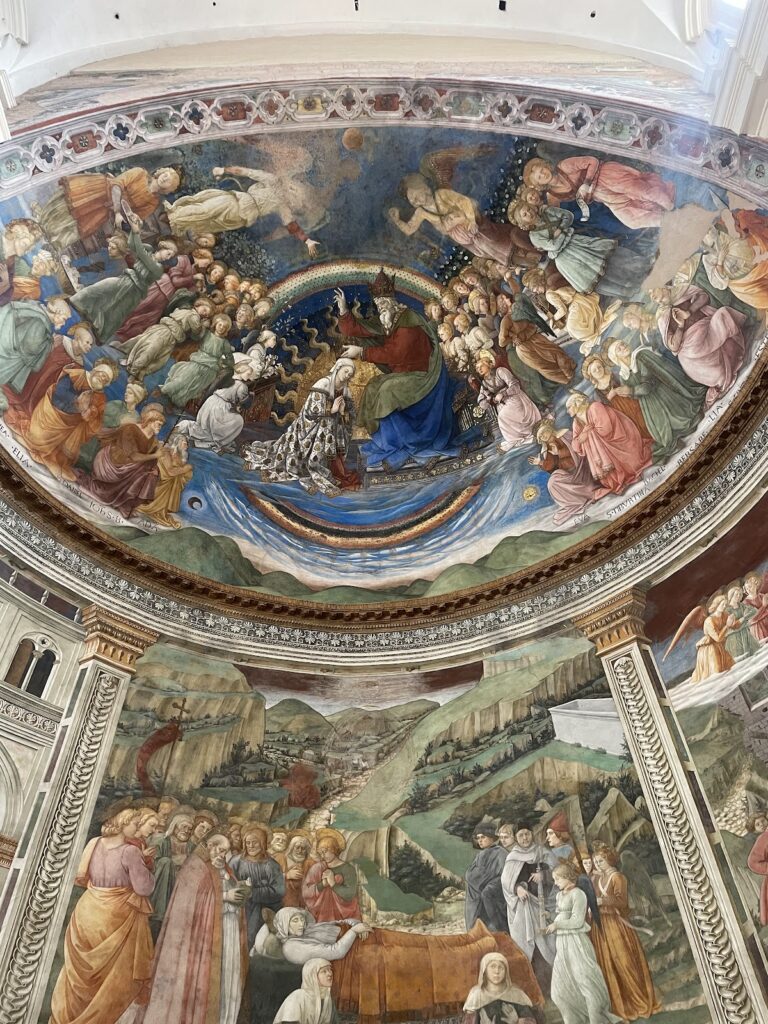
Major restoration work in the sixteenth century brought changes to the church and its presbytery. Piermatteo Gigli painted the presbytery frescoes, and in 1565 he assumed responsibility for the church. In 1610, he stated that he had copied the ancient act of consecration into an inscription on the presbytery’s right side. After the counts of Travaglini acquired the adjoining palace in 1755, they could attend services from a private gallery inside the church, reached through an internal passage from the palace, later known as Palazzo Zacchei Travaglini.
Study and conservation
Umberto Gnoli first studied the frescoes in 1923. Restoration in 1922 and 1926 had left extensive retouching and overpainting, but later interventions removed these additions. At Gnoli’s urging, an air space was installed in 1925 to protect the crypt paintings from damp. The fresco of the martyrdom of Saints John and Paul was detached in 1961 and is now conserved at the National Museum of the Duchy of Spoleto.
The church’s bells had long been kept in municipal storehouses. They were returned to the bell chamber in 2015, after a prolonged period during which the church was closed.
Remains
The complex consists of two superimposed buildings joined together, with the church above a lower crypt. The single-nave upper church is constructed from worked stone and reused Roman building material. Its simple, linear façade has a narrow portal with a lunette, a semicircular painted or sculptural field, and a rose window set within a square frame. The presbytery is raised above the nave and was added during the sixteenth-century restoration. A wooden altar occupies the elevated area.
Upper church and presbytery
The rear wall of the presbytery carries Piermatteo Gigli’s fresco of the Madonna in Glory with the Child. Angels crown the central figures, while John the Baptist, John the Archbishop, Joseph, John the Martyr, Jerome, Anthony of Padua, Mary Magdalene, and Paul the Martyr accompany them. Marian inscriptions flank the composition. Below the throne is an image of the Man of Sorrows, and the vaulted ceiling contains representations of the Evangelists.
On the outside left wall, beneath a roof slope, is a large thirteenth- or fourteenth-century fresco of the Madonna and Child with four saints. It is badly damaged and has been repainted. Fragments of late-thirteenth-century frescoes by the artist known as the Master of the Palazze survive in the attic. This conventional name refers to an unidentified painter associated with a group of works linked to the Palazze.
Nave paintings
Banquet of Herod
A Romanesque fresco on the nave walls depicts the Banquet of Herod. A crowned king and queen sit at a table beside a dancer generally identified as Salome. The scene contains no allusion to John the Baptist. Gnoli attributed the painting to Alberto Sotio, while later assessments accepted the artist’s influence without establishing secure authorship.
Saints and devotional images
Romanesque figures of Saint Michael the Archangel, Saint Margaret of Antioch, and Saint Thaddeus have been attributed to a follower of Alberto Sotio. Frescoes of Saint Leonard, Saint Gregory the Great, and Saint Catherine are associated with the Master of Eggi and dated between 1445 and 1449. The Master of Eggi is a conventional name for an unidentified artist or workshop connected with works associated with Eggi.
A thirteenth-century fresco of the Madonna of the Girdle with Saint Francis of Assisi is badly deteriorated. Its author is unknown, and the image is considered one of the earliest representations of Saint Francis. The nave also contains an anonymous fifteenth-century Crucifixion and a fifteenth-century votive fresco of the Madonna of the Milk.
Thomas Becket and Saint Nicholas
The Martyrdom of Thomas Becket occupies the church’s left wall. It shows the killing of the archbishop of Canterbury, while its possible connections with the conflict between the papacy and the Empire give the image a wider political interpretation. Beside it, and continuous with the composition, is a frontal figure of Saint Nicholas of Bari wearing episcopal vestments. His head, perhaps originally made as a sculpture, has been lost.
Lower crypt
The lower crypt is an inaccessible chamber beneath the church, adapted from an earlier Roman structure, perhaps during the eleventh century. Its lunette contains the Martyrdom of Saints John and Paul, measuring 128 by 238 centimetres. The painting unfolds in three scenes. Emperor Julian and the prefect Terenziano appear on one side, while on the other an executioner, having decapitated one saint, prepares to kill the second. At the centre, the two titular martyrs move toward the gate of Paradise, with God the Father above them. The fresco was detached in 1961 and is preserved at the National Museum of the Duchy of Spoleto.
Associated Crucifix
The Crucifix dated 1187 and linked with SS. Giovanni e Paolo is painted on parchment stretched over a wooden cross 2.78 metres high and 2 metres wide. It bears the painter’s signature and date. The work was placed in 1877 in the left nave chapel of Spoleto Cathedral, and it may originally have stood on the high altar of SS. Giovanni e Paolo.