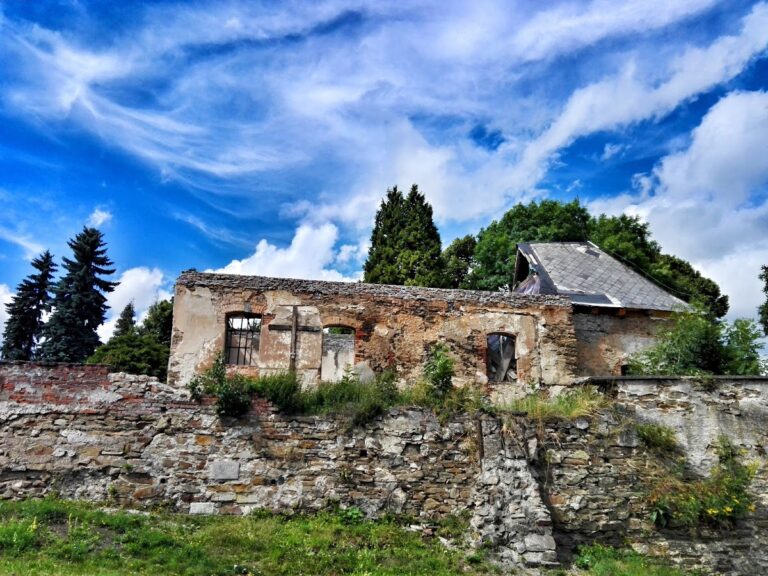
Franciscan Monastery in Kadaň: A Historic Friary and Pilgrimage Shrine in Czechia


Site at a Glance
- Rating
- 4.7
- Popularity
- Low
- Country
- Czechia
- Primary era
- Medieval
- External website
- Open
- Eras represented
- Medieval, Early Modern
- Civilizations
- Holy Roman Empire, Kingdom of Bohemia
- Site type
- Religious
- Remains
- Monastery
On this page21 sections
History
The Franciscan Monastery in Kadaň is a former Franciscan friary in Czechia, on the edge of Kadaň near the Ohře River. Built by the Order of Friars Minor, or Franciscans, its institutional life lasted from 1473 to 1950 and centered on a pilgrimage shrine dedicated to the Annunciation of the Lord and the Fourteen Holy Helpers. The Fourteen Holy Helpers were a group of saints traditionally invoked for protection against illness, danger, and other needs, especially in Central Europe and the German-speaking lands.
The pilgrimage chapel and Franciscan foundation
Franciscan Observant teaching reached Kadaň during John Capistran’s missionary journey through Bohemia between 1451 and 1454. The Observants were reform-minded Franciscans who emphasized stricter adherence to the order’s original rule. After several townsmen had travelled on pilgrimage to Rome, the Fictum family supported the establishment of a small chapel outside the town, beside the trade route to Saxony. Dedicated to the Fourteen Holy Helpers, it was built shortly after 1468 and is first recorded in 1469.
The chapel soon attracted Catholic pilgrims from the Czech lands and Germany. In 1470, the Bishop of Meissen granted visitors indulgences, a form of remission of the temporal punishment associated with sin under specified conditions. This strengthened the shrine’s religious importance. In 1473, Pope Sixtus IV authorized the chapel’s transfer to the Franciscans, with the permission of Vladislaus II, the late fifteenth-century king of Bohemia and Hungary. Gabriel, provincial of the Bohemian-Moravian Franciscan province, took possession on behalf of the order. A temporary convent was followed by a stone monastery and church.
Jan Hasištejnský of Lobkowicz and his brother Bohuslav became the principal benefactors of the new complex. Jan enlarged the monastery, supported its construction and decoration, and established the Hasištejnský family burial place in the church. The first completed part of the church, probably the sanctuary and an unfinished section of the choir, was consecrated on 24 September 1480 by Johann Ludovici, Bishop of Hierapolis. The nave was completed and consecrated in 1493, while the monastery complex reached completion around 1500.
Jan Hasištejnský’s journeys to Rome brought two papal privileges to Kadaň. One permitted people returning from the Utraquist Church to Catholicism to do so during a single solemn procession in the parish church. The other granted indulgences to visitors to the monastery church. These privileges increased pilgrimage to Kadaň and contributed to the prosperity of both the monastery and the town. Bohuslav Hasištejnský, a humanist nobleman, composed a poem honoring the Fourteen Holy Helpers.
Franciscan expansion and religious conflict
The monastery hosted a provincial chapter, the governing assembly of a Franciscan province, in 1506, when approximately 150 friars attended. Another chapter was held there in 1514. Its reputation as a pilgrimage center continued to grow, although Protestantism spreading from Bohemia and Lutheranism arriving from Saxony restricted further development. A provincial Franciscan school was established in the monastery in 1522.
The friars temporarily moved to Tachov in 1564. The unoccupied buildings began to deteriorate, prompting Kadaň’s municipal council to ask the Franciscans to return. They came back in 1569 but lacked sufficient funds for repairs. Reconstruction gained support after Antonín Brus of Mohelnice, Archbishop of Prague, made a thanksgiving pilgrimage to the monastery in October 1569 following his recovery from illness. He provided material assistance and visited the friars several more times.
Between 1571 and 1590, Jiří Popel of Lobkowicz financed the restoration of the monastery and its Lobkowicz residence. He assumed the monastery’s founder’s rights and became known as its second founder. During this phase, the complex was completed as a major architectural work with diamond vaults, a late Gothic form in which intersecting ribs create diamond-shaped panels.
The Bohemian Revolt, an uprising against Habsburg rule that formed part of the religious and political conflicts preceding the Thirty Years’ War, brought renewed violence. Protestants desecrated and looted the monastery on 2 November 1618 and partially plundered it again on 1 September 1619. The guardian was arrested and taken to Prague, and the friars were forced to leave.
On 31 May 1623, during the forcible re-Catholicization of Bohemia, Karel I of Liechtenstein, the royal governor of Bohemia, ordered Kadaň to support the monastery. The friars returned around 1627. At about the same time, an organ from the Church of Saint Anne was transferred to the monastery church. In 1640, the community consisted of three priests, one cleric, and three lay brothers. Fighting in and around Kadaň during the Thirty Years’ War continued until 1648 and severely damaged the monastery and church.
Renewal, expansion, and the eighteenth century
Comprehensive renewal began after 1662. The monastery was repaired and enlarged with a new wing, and by 1678 it housed 23 religious brothers. Bernard Sannig, a minister of the Franciscan province, directed the restoration. He also ordered the demolition of the Lobkowicz residence, ending the complex’s association with that residence.
The eighteenth century brought further building and further disruption. A dispute with Kadaň over burial rights was settled in 1713. Construction of the Loreto chapel, a devotional chapel associated with the Holy House of Loreto, was continuing by 1720, and the church was completed in 1739. During the War of the Austrian Succession, a conflict over the Habsburg succession, French troops occupied and fortified themselves in the monastery in 1742. Imperial soldiers stormed the complex, producing a bloody confrontation and causing additional damage.
In 1746, the monastery housed 25 friars in 25 cells. A novitiate, where candidates prepared to enter the order, was added on the west side between 1747 and 1749. Novices were trained there until the Josephinian reforms, the church and monastic measures introduced under Joseph II in the 1780s. Training resumed after several interruptions in 1812 and continued until 1950.
A fire destroyed the convent building in 1752 and damaged the church. The complex reached its final eighteenth-century form in the 1770s, when the pilgrimage route was extended with a Portiuncula chapel, associated with the Franciscan sanctuary near Assisi. The monastery narrowly escaped dissolution during Joseph II’s reforms in 1785, although its community was reduced from 36 to 12 friars.
The friars had established a pharmacy and dispensary with basic surgical equipment in 1771. Their care for poor sick people from the surrounding area helped prevent the monastery’s abolition. During the nineteenth and early twentieth centuries, the community also supported the Czech minority in Kadaň and its surroundings.
War, suppression, and later cultural use
During the Second World War, the Franciscans were required to surrender the monastery to the German Wehrmacht, Nazi Germany’s armed forces, for use by the Hitler Youth, the Nazi youth organization. After the war, German religious members were expelled and Czech Franciscans came to Kadaň.
The communist-era Operation K ended the religious community in 1950, when State Security units raided the monastery and removed the friars. The monastery church closed in 1953. The buildings were first used by an archive and, from the 1970s, by the Chomutov Museum. Inadequate maintenance contributed to their deterioration.
After the fall of the communist government, some Franciscans resumed activity at the monastery between 1991 and 1994. The buildings were transferred to the Diocese of Litoměřice, which leased the monastery, except for the church, to the town of Kadaň in 1995. The church remained under the care of the local Roman Catholic parish and was reconsecrated that year, restoring religious use to the complex. The monastery was designated a national cultural monument in 1995.
The town subsequently supported the reconstruction of the valuable interiors and wall paintings. In 1999, the former novitiate was given to the primary school of music, dance, and fine arts, later named the Klement Slavický Primary School of Arts. A permanent exhibition on mineralogical discoveries, fossils, and archaeology was established in the cellars, and the Municipal Museum of Kadaň opened in the monastery in May 2004. Restoration of the church’s wall and ceiling paintings and furnishings continued from 2004 to 2021, including work carried out through the IROP programme between 2016 and 2021.
On 15 April 2023, the Municipal Museum opened The Monastery and Its Lord to mark the 550th anniversary of the monastery’s foundation in 1473 and the 530th anniversary of Jan Hasištejnský’s pilgrimage to the Holy Land in 1493.
Legends of the shrine
Local tradition connects the shrine’s foundation with a story about five brothers condemned after offending their monarch. The eldest was selected by lot for execution but survived three days and nights on the gallows while praying to the Fourteen Holy Helpers. According to the legend, this miracle led Kadaň’s council to remove the gallows and establish a shrine on the site.
Another story concerns a woman who mocked the Fourteen Holy Helpers and said that she would rather give birth to fourteen children than believe in them. At the town gate, traditionally identified as the Holy Gate, she gave birth to eleven boys and three girls.
Remains
The monastery occupies the edge of Kadaň near the Ohře River, above the Kadaň Reservoir and facing Úhošť Hill on the opposite slope of the Ohře valley. Its surviving buildings and grounds bring together a late Gothic church, monastery rooms with unusual vaults, later Baroque furnishings and chapels, burial monuments, a pilgrimage avenue, and cultivated land.
Church and interior decoration
Late Gothic church
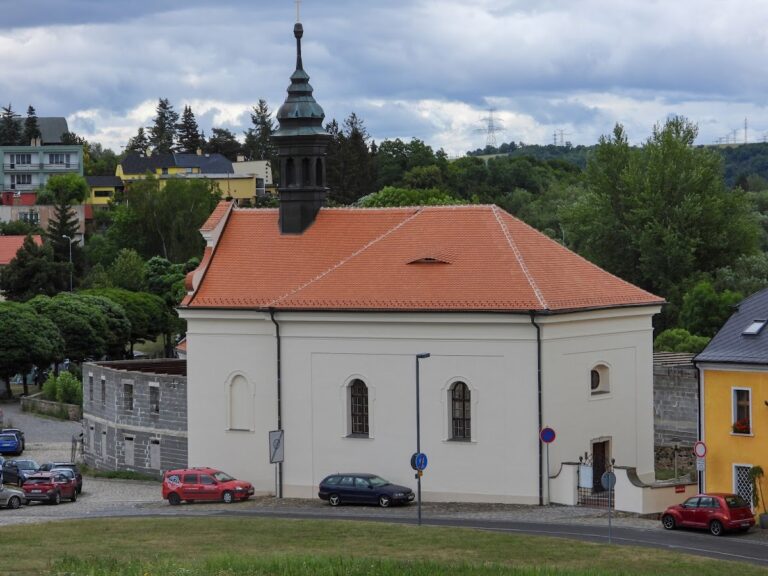
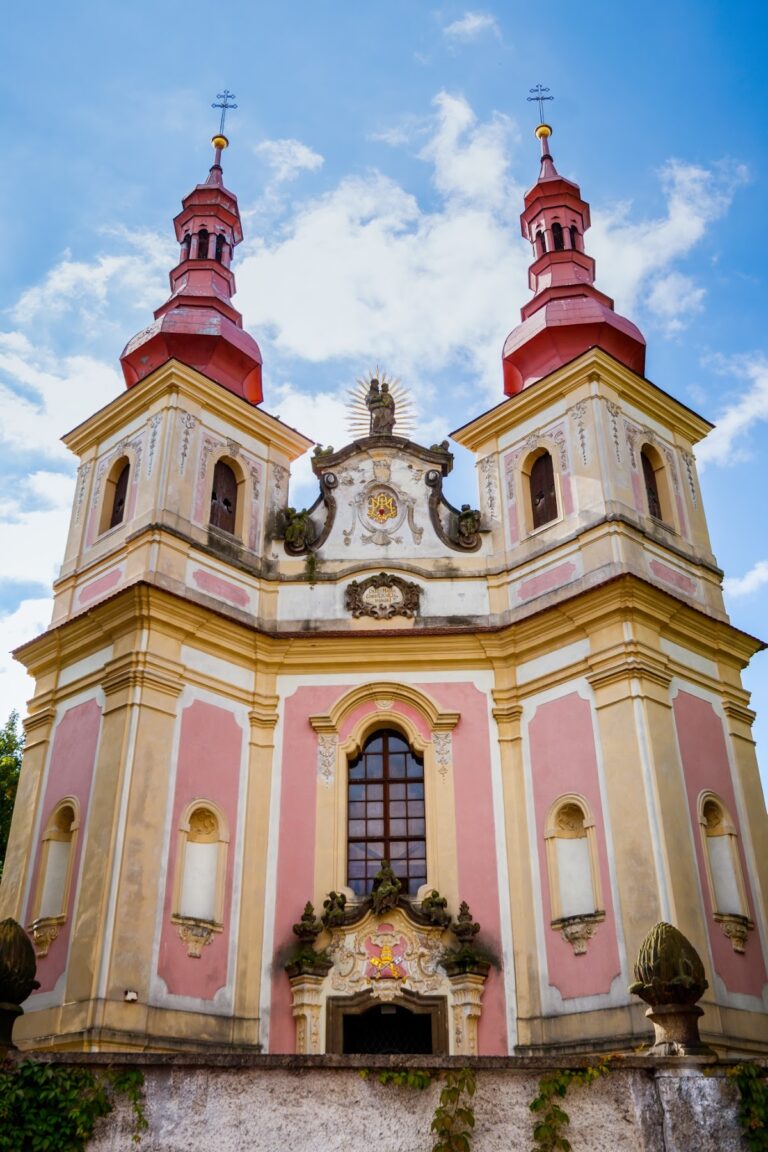
The monastery church is a late Gothic three-aisled building with pointed windows and ribbed vaults. Its sanctuary has a quadripartite rib vault, divided into four sections, while the nave, the main central part of the church, has a sexpartite rib vault divided into six sections. The church’s interior also contains Baroque furnishings and equipment, reflecting the complex’s later phases of use and renewal.
Paintings and altars
Figures of Franciscan saints appear across the vaulted surfaces, including John Capistran, Bernardino of Siena, and the Fourteen Prague Martyrs, Franciscan friars killed in Prague during the religious conflicts of the early seventeenth century. The paintings also include scenes from the foundation legend and the story of the impious woman. Jan Hasištejnský commissioned a cycle of frescoes showing the life of Christ. It includes the oldest known view of Kadaň and the monastery, and its artistic affinities have been tentatively associated with the school of Lucas Cranach.
The high altar is a dominant feature of the church. It includes statues of Saint Francis of Assisi and Saint Anthony of Padua holding the infant Jesus. The former high altar was a folding wooden altarpiece with painted wings and sculptures of the Virgin Mary and the Fourteen Holy Helpers; it is now deposited in the National Gallery in Prague.
Burials and commemorative monuments
Hasištejnský family tomb
The Hasištejnský family tomb stands in the sanctuary. Its stone tomb chest bears two reliefs, one showing a living knight and the other a dead knight. The sculptural decoration was made in 1516 by Ulrich Creutz, a Saxon stonemason and sculptor active in the early sixteenth century.
Other tombs and epitaphs
Late Gothic and especially Renaissance tombs and epitaphs were erected in the church, the cloister, and the Chapel of Saint Catherine. Members of the Fictum and Weitmile families, Kadaň townsmen, and other prominent families used these spaces for commemorative monuments.
Pilgrimage route and chapels
Pilgrimage avenue
A pilgrimage avenue connected the monastery with Kadaň. It was lined with early Baroque niche chapels containing sandstone reliefs of the Passion and the coats of arms of noble benefactors. The first chapel on the right when travelling from the town bears a double-headed imperial eagle commemorating Emperor Leopold I’s visit.
Stations of the Cross
Seven Baroque Stations of the Cross lead from the Holy Gate to the shrine. Each station depicts one of Christ’s falls. Tradition holds that the route is the same length as the road from Pilate’s house to Calvary.
Later devotional chapels
The pilgrimage route was completed in the eighteenth century with the addition of the Portiuncula chapel. Construction of the Loreto chapel was continuing by 1720, and the church associated with the pilgrimage complex was completed in 1739.
Monastery rooms and grounds
Vaulted rooms and former novitiate
Several monastery rooms retain late Gothic diamond vaults, a comparatively rare form in Bohemia. The former novitiate stands on the west side of the complex and now houses the Klement Slavický Primary School of Arts.
Gardens and working land
The monastery was built among vineyards, and the friars cultivated land for their livelihood from the beginning. The grounds include a vineyard, a pole-supported hop garden, enclosures for farm animals, and an upper section arranged as a recreational park. A small monastery brewery was established in the mid-nineteenth century. The garden complex also includes enclosures for goats, sheep, and curly-haired pigs.
Cellars and museum spaces
The cellars contain the permanent exhibition on mineralogical discoveries, fossils, and archaeology. The wider complex houses the Municipal Museum of Kadaň as well as the Klement Slavický Primary School of Arts. Gothic, Renaissance, and Baroque paintings, furnishings, vaults, tombs, chapels, and other architectural and decorative elements form part of the extensive conservation campaign carried out between 2004 and 2021.
Nearby sites