St Mary’s Church, Ottery St Mary: An Early English Gothic Parish Church


Site at a Glance
- Rating
- 4.7
- Popularity
- Low
- Country
- United Kingdom
- Primary era
- Medieval
- External website
- Open
- Eras represented
- Medieval, Modern
- Civilizations
- British, English
- Site type
- Religious
- Remains
- Church
On this page15 sections
History
St Mary’s Church, Ottery St Mary, in the United Kingdom, is an Anglican parish church whose predominantly Early English Gothic fabric reflects a history reaching back to its consecration in 1260. It stands within the Church of England’s Diocese of Exeter and remains an active parish church. Its Grade I listing identifies it as a building of exceptional interest and the highest level of statutory heritage protection in England.
Foundation and collegiate rebuilding
Bishop Bronescombe consecrated the church in 1260. Before the Norman Conquest, the manor and the legal right to appoint the parish priest, known as the advowson, had belonged to Rouen Cathedral. That arrangement continued until 1335, when John Grandisson, Bishop of Exeter, purchased the manor and advowson from the cathedral.
On 22 January 1338, Grandisson established a collegiate foundation at Ottery. A collegiate foundation was a religious institution served by a resident body of clergy or other appointed members. The new foundation had forty members, and Grandisson substantially rebuilt the church for its use. This fourteenth-century campaign created the principal medieval form of the present building, including its nave, chancel, aisles, Lady Chapel, and vestry chapels.
The church’s astronomical clock is commonly attributed to Grandisson, who was Bishop of Exeter from 1327 to 1369. Organs were also associated with the collegiate church from at least the fourteenth century, since Grandisson’s statutes made provision for them. By 1545 the church had three organs. Instruments that may have survived the Reformation were destroyed in 1645 during the English Civil War.
Later medieval and early modern changes
Around 1520, Cecily Bonville, 7th Baroness Harington, commissioned and financed the enlargement of the north aisle. The enlarged space became known as the Dorset Aisle. Bonville’s first husband was Thomas Grey, 1st Marquess of Dorset, whose title gave the aisle its later name.
The collegiate foundation was dissolved on 24 December 1545, and the church then continued as a parish church under governors. The other collegiate buildings were demolished. Parish registers begin in 1601 and are held at the Devon Record Office.
Restoration and twentieth-century additions
St Mary’s closed on 21 May 1849 for a comprehensive restoration directed by William Butterfield, a prominent nineteenth-century architect associated with the Gothic Revival. It reopened on 22 May 1850. The work included changes to the floors, seating, wall finishes, and area around the altar, reshaping the interior while retaining important medieval elements. The restoration was supported by voluntary donations, including £1,200 from Mr Justice Coleridge.
Around 1828, Flight and Robson built a new organ for the church. It was installed in the west gallery and moved to the south transept during the 1849 restoration. Hele & Co worked on it in 1878 and 1901, and additional work followed in 1934. Eustace and Alldridge of Exeter enlarged the instrument in 1969, while Michael Farley rebuilt it in 1990.
New choir stalls were dedicated in 1908. John Duke Coleridge designed them, and Mary Dickinson paid for them in memory of her father, the Reverend Frederick Binley Dickinson. In 1934, Herbert Read, a sculptor from Exeter, filled three vacant niches in the medieval altar screen with sculpted scenes. Mrs Winstanley funded the work in memory of her husband, Harold Winstanley.
John James Hall restored the astronomical clock to working order in 1907 after it had stopped for thirty years. The Bishop of Exeter rededicated it on 20 May that year. The churchyard contains the grave of Sir Ernest Mason Satow, a British diplomat and Japan specialist, and a plaque inside the church commemorates him. The plaque originally came from the chapel of the British Legation in Peking. A small plaque on the south churchyard wall commemorates the poet Samuel Taylor Coleridge.
Modern religious life
On 26 September 2015, Sarah Mullally, Bishop of Crediton, led the first ordination service in the Church of England led by a woman. During the service she ordained two deacons as priests at St Mary’s.
The church belongs to a joint parish with congregations at Colaton Raleigh, Alfington, Harpford, Newton Poppleford, Wiggaton, Venn Ottery, and West Hill. It also participates in Churches Together in Ottery St Mary, an ecumenical organization linking Christian communities in the town.
Remains
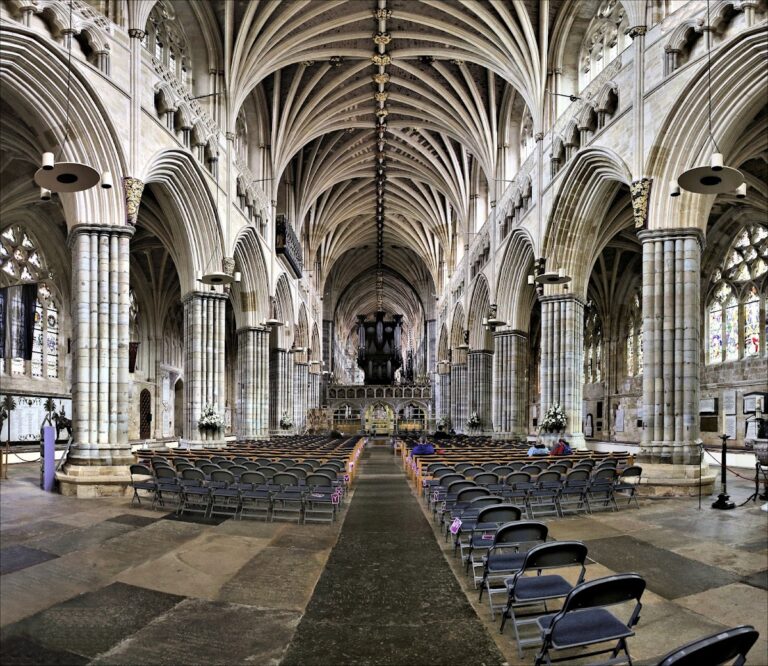
St Mary’s is a cruciform church, meaning that its main length and cross arms form the shape of a cross. The building is 163 feet, or 50 metres, long, and its paired towers rise 71 feet, or 22 metres, above the transepts. It has a five-bay nave, while the unusually long chancel has six bays and is flanked by vestry chapels to the north and south. Like Exeter Cathedral, it has no tower above the crossing, the central space where the nave and transepts meet.
Exterior and principal plan
Chancel and tower-transepts
The outer walls of the chancel and the tower-transepts are considered by Nikolaus Pevsner to belong to the church consecrated in 1260. The paired towers were evidently modelled on those of Exeter Cathedral. Pevsner described the building as lying “large and low like a tired beast.” The fourteenth-century rebuilding nevertheless established the arrangement of the present nave, chancel, aisles, Lady Chapel, and vestry chapels.
Dorset Aisle
The north aisle was enlarged around 1520 through Cecily Bonville’s patronage and is known as the Dorset Aisle. Its elaborate Tudor-Gothic ceiling is a fan vault, a form in which the ribs spread outward in a fan-like pattern. Pendant bosses hang from the vault, giving the aisle a particularly detailed late medieval finish.
Medieval interior features
Carving, tomb, and altar furnishings
Ten misericords date from around 1350. Misericords are small ledges beneath folding choir seats, and five of those at St Mary’s carry the arms of Bishop John de Grandisson. Other medieval survivals include two carved Green Man figures, leafy or foliage-associated heads whose precise meanings can vary, together with the tomb of Otho de Grandisson and his wife.
The medieval altar screen, clergy seats known as sedilia, and a wooden eagle given by Bishop Grandisson also remain inside the church. Sedilia are seats placed near the altar for clergy. In 1934, three sculpted scenes by Herbert Read were installed in vacant niches in the altar screen, adding a twentieth-century layer to the medieval furnishing.
Butterfield’s interior changes
Butterfield’s restoration lowered the floors of the transepts, the crossing, and the western part of the chancel to the level of the nave. It removed the galleries except for the one in the south transept, replaced enclosed pews with open seating, paved the area around the altar with encaustic tiles, and stripped and cleaned the plaster from the walls.
Clock and organ
Astronomical clock
The astronomical clock is housed in the south transept beneath its bell tower. Its mechanism follows Ptolemaic cosmology, the pre-modern model that placed Earth at the centre of the universe. A black central sphere represents Earth, while a golden sphere representing the Sun travels around the outer circle to indicate the time of day. Between them, a half-white and half-black lunar sphere shows the lunar month and rotates to display the Moon’s phases.
Present organ
The present organ has 37 stops and includes 32-foot stops, two 56-note manuals for the Hauptwerk and Swell, and a 30-note pedalboard. It is housed in two mirror-symmetrical cases positioned on either side of the choir, preserving the instrument’s prominent place within the church’s liturgical interior.