Santa Maria Etiopissa: An Early Medieval Church near Vicenza


Site at a Glance
- Rating
- 4.4
- Popularity
- Very Low
- Country
- Italy
- Primary era
- Medieval
- External website
- Open
- Eras represented
- Medieval, Early Modern
- Civilizations
- Holy Roman Empire, Venetian
- Site type
- Religious
- Remains
- Church
On this page13 sections
History
Santa Maria Etiopissa is a Roman Catholic church in Italy, near Vicenza, whose first construction dates to the Early Middle Ages. Its present fabric combines Romanesque and Renaissance elements. The name probably comes from the nearby medieval locality of Teupexe or Teupissae, remembered in the modern Chiuppese road, rather than from a title of the Virgin Mary.
Early foundations and medieval development
Nineteenth-century scholars proposed that the church had a Lombard foundation, perhaps as a guarded strategic position. The Lombards were a Germanic people who established a kingdom in Italy during the early medieval period. This interpretation remains uncertain. Other explanations for the name, including a foundation by eastern missionaries opposing Lombard Arianism and the Three Chapters Schism, a dedication to an African saint, or an association with a Black Madonna, also remain hypotheses.
Before 1000, the surrounding area was largely woodland extending from Vicenza toward Cavazzale. The inhabitants of Cavazzale and Povolaro used the cemetery of Santa Maria of Chiupese. After the Hungarian invasions, the church was probably partly rebuilt on earlier foundations during the tenth or eleventh century. Its rough river-pebble masonry and the possible remains of a Romanesque fresco beside the southern doorway belong to the evidence for this phase.
The first written reference dates to 27 March 1107, when Gumberto, Arprando, Ambrosio, and Uguccione of the da Vivaro family donated a chapel at Teupese dedicated to Saint Mary to the Benedictine Abbey of Santa Maria of Pomposa. Pomposa was a major Benedictine monastic institution in northern Italy. A papal bull confirmed its rights over the church in 1153.
The donation also transferred the churches of Santa Perpetua, Santa Croce, and Santa Fosca of Dueville to Pomposa, separating them from Vicenza’s Benedictine organization at San Felice. By the thirteenth century, the local Benedictine community may have disappeared and possibly been replaced by a lay religious community. Jurisdiction was later disputed between Pomposa, the bishop, and the municipality of Vicenza. The da Vivaro family retained connections with the church until its members were expelled from Vicenza territory in 1290.
Decline and limited revival
In 1297 and 1298, Santa Maria Etiopissa was held in commendam by Cardinal Pietro Colonna and depended on the parish church of Dueville. A commendatory abbot held an abbey’s revenues and administration without necessarily residing as head of an active monastic community. The church was no longer recorded in 1303, and its decline led to near-abandonment around 1370.
In 1377, Bishop Raimondo of Padua, acting as a papal representative, ordered the abbot of Pomposa to intervene in the deteriorating Vicenza monastery. He required the church and cloister to be restored enough to permit religious life. The community experienced a limited revival, and in 1393 Pietro was recorded as abbot and rector of Santa Maria of Thiupexe.
At the beginning of the fifteenth century, the chapter of Vicenza Cathedral assumed jurisdiction. In 1403 it leased the church and its possessions to Pierpaolo, who was required to maintain the church and its annexes and support a resident chaplain at his own expense. During the fifteenth century, the church served scattered families between Vivaro and Cavazzale. Testaments frequently requested burial in its cemetery, and the church served the small settlement of Chiupese along the road toward Marostica.
Renaissance transformation and later administration
In 1405, Pandolfo Malatesta, commendatory abbot of Pomposa, entrusted administration of the abbey to Biagio Vitriani of Vicenza. Biagio’s son Marco continued to administer it until 1484. The Vitriani appear to have treated the abbey as a private rural estate because it no longer housed monks, a circumstance that may explain the lack of an attached cloister. Their administration also involved reclaiming and improving land that had previously been marshy, wooded, and uncultivated.
Around 1480, Marco Vitriani ordered a thorough restoration and interior decoration of the church. In 1484, the former Benedictine abbey was incorporated into the monastery of San Bartolomeo in Vicenza. That monastery was governed by the Canons Regular of Santa Maria of Frigionaia near Lucca, a religious community following the Rule of Saint Augustine. The canons undertook to restore the buildings and maintain a resident secular priest, meaning a priest serving outside a monastic order.
On 22 February 1502, Pope Alexander VI authorized the canons to demolish the nearby church of Santa Croce and reuse its material for a new altar at Santa Maria of Chiupese, also called Etiopissa. The altar was dedicated to the Holy Cross in memory of the demolished church. The abbey remained semi-abandoned, possibly because nearby rice fields and flooded land made habitation unhealthy. The church nevertheless continued to matter to local inhabitants, and the community of Polegge restored it in 1640.
Suppression, restoration, and present use
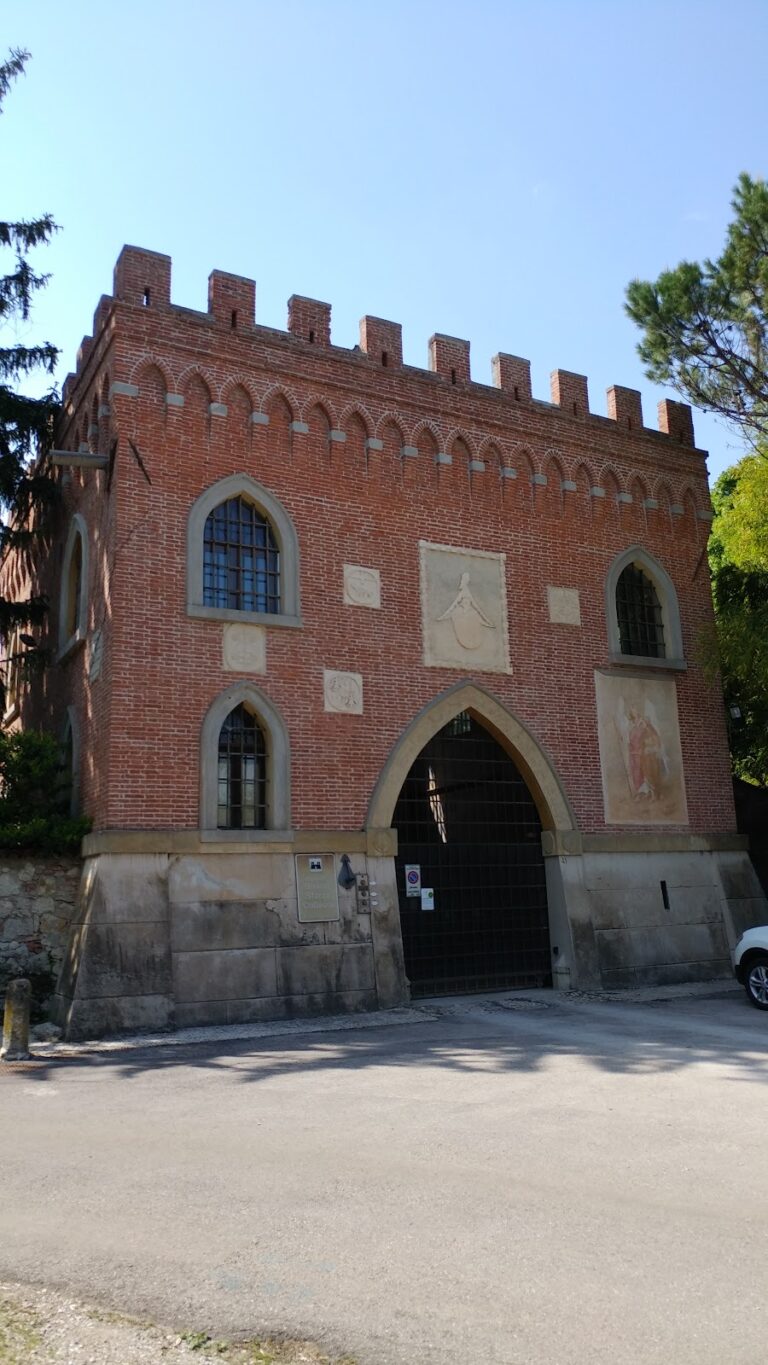
In 1771, the Venetian state suppressed the monastery of San Bartolomeo and sold its possessions. The abbey and its lands passed first to the Cordellina family, then during the Napoleonic period to the Milan family, which built the large agricultural service building. During the Austrian period, the Gonzati family built the main body of the villa.
Santa Maria Etiopissa later fell into disuse, and Bishop Farina permitted secular uses. A restoration campaign began in 1933 through the efforts of Don Federico Maria Mistrorigo, who led a special committee. The work continued for about a decade. The church’s former bells, cast by the Colbachini foundry of Bassano del Grappa in 1933, were later replaced and preserved inside the building.
The parish of Polegge now owns Santa Maria Etiopissa, which remains used for Catholic worship by local residents. The building is described as being in serious deterioration and neglect, making its surviving medieval and Renaissance fabric especially vulnerable.
Remains
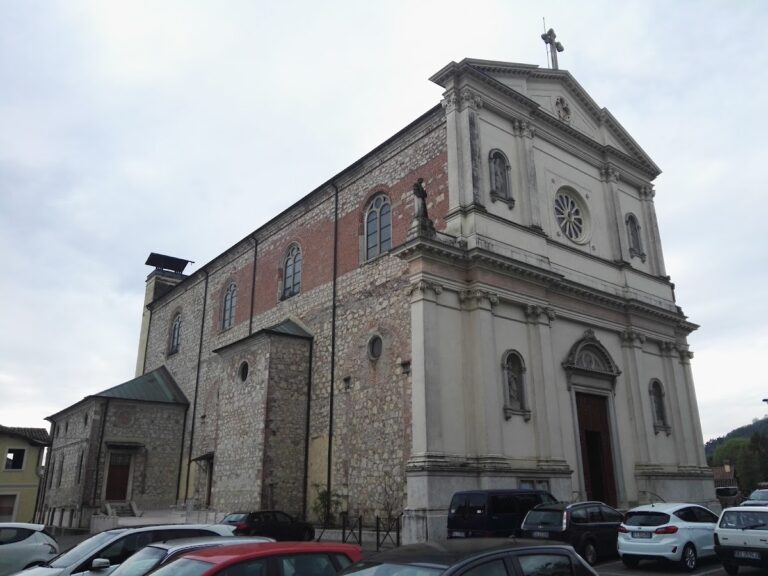
Santa Maria Etiopissa is a compact church with a rectangular plan and a single nave. Its Romanesque and Renaissance fabric is built of stone and brick. The square apse begins immediately beyond the triumphal arch, the arch separating the nave from the sanctuary or apse. A double-ring arch divides the apse from the nave, a form associated with other Veneto-Ravennate buildings. The load-bearing walls use herringbone masonry, in which stones or bricks are set diagonally in alternating directions to create a zigzag pattern.
Church fabric and decoration
Walls, portal, and interior
The historic walls show widespread weathering and leaching. The stone is eroded and weakened, while the old plaster is disintegrating and detaching from its support. The late-fifteenth-century restoration included a Lombard-style portal and a floral frieze running around the church. These features belong to the period when Marco Vitriani ordered the building’s renewal and interior decoration.
Frescoes
The interior preserves frescoes of the enthroned Virgin with Saints Christopher and Lucy, the Virgin beneath a canopy with the infant Jesus on her knees, the monks Marco Vitriani and Barnabas, and the Annunciation. The paintings may be attributable to Taddeo of Ascoli, a painter active in the late fifteenth century and the son of Villano. Possible remains of an earlier Romanesque fresco survive beside the southern doorway.
Water entering through the roof covering is damaging the timber structures and washing out the wall paintings. Rising damp and nearby modern cement plasters also threaten the frescoes, since their salts could cause irreversible damage. The interior therefore preserves several layers of the church’s history while remaining in fragile condition.
Bell tower and bells
Bell tower
The bell tower rises at the right-hand corner of the facade and projects awkwardly from that corner. Inside the building, two arches support it on a pillar fitted with a capital and abacus, the upper slab of a column capital.
2025 bells
Two new bells were cast by the Grassmayr foundry of Innsbruck and blessed on 4 October 2025, replacing the two bells made in 1933. The larger bell, Grazia, is dedicated to the Madonna of Monte Berico, the Marian title associated with Vicenza’s principal Marian shrine. It bears her image, the invocation “Protect us everywhere,” and the inscription “Ave Maria.”
The smaller bell, Preziosa, is dedicated to the Holy Family of Nazareth. It bears their image and the invocation “Holy Family of Nazareth, pray for us.” Its dedication also refers to the family as a community, specifically the community of Polegge. Both bells were made for Santa Maria Etiopissa and carry the date 4 October 2025.
The upper sections are decorated with garlands inspired by the painted garlands along the nave and by the bell-founding tradition of the Triveneto. Each bell has a crown with six angel faces looking in different directions. Small salamanders on the shoulders symbolize endurance through fire and hardship. Two sage leaves below the Grassmayr emblem and casting year refer to the plant’s traditionally associated healing properties and express a wish for good health. Raised signatures of the donors appear below the founder’s emblem. The bells are tuned with those of the parish church of Polegge, forming an intended symbolic choir of distinct but harmonized voices for the community.
Carved liturgical stone
A marble pluteus, a carved stone panel once used for a liturgical screen or enclosure, was associated with the church. Possibly dating from the sixth or seventh century, it depicts two facing peacocks drinking in a symbolic garden of plants and flowers. The original is preserved in the third room of the Diocesan Museum of Vicenza, while a copy is kept inside Santa Maria Etiopissa. The peacock imagery carries strong religious symbolism.