St. Paraskeva Church: An Eastern Orthodox Landmark in Vilnius


Site at a Glance
- Rating
- 4.6
- Popularity
- Low
- Country
- Lithuania
- Primary era
- Modern
- Eras represented
- Medieval, Modern
- Civilizations
- Grand Duchy of Lithuania, Russian
- Site type
- Religious
- Remains
- Church
On this page9 sections
History
St. Paraskeva Church is an Eastern Orthodox church in Vilnius, Lithuania, and is regarded as the country’s oldest Eastern Orthodox church and the city’s first stone Christian church. The first building was erected in 1345 on the initiative of Maria Yaroslavna of Vitebsk, the first wife of Algirdas, the fourteenth-century Grand Duke of Lithuania. The church was modeled on older churches in Kyiv and Novgorod and became an important early centre of Orthodox Christianity in the Lithuanian capital.
Foundation and early Orthodox history
Maria died in 1346 and was buried in the church. Tradition connects the site with the replacement of a shrine to Ragutis, a Lithuanian pagan deity associated with brewing, beer, and mead, although this account is not fully reliable. The church’s early arrangement reportedly included galleries screened by green translucent curtains, behind which women worshippers stood. The seventeenth-century Chronicle of Lodzjata called it “the first stone church of the true God” erected in the Lithuanian capital and in Lithuanian land.
Several events associated with the early church became central to Orthodox memory in Vilnius. Three close associates of Algirdas were baptized there under the Christian names Anthony, John, and Eustathius. They were martyred in 1347 and later canonized as the Vilnius Martyrs. All twelve sons of Algirdas by Maria of Vitebsk and Juliana of Tver were also baptized at the church.
Fires, rebuilding, and changing ownership
A fire completely destroyed the original church in 1557. It was rebuilt in 1560 under a royal order, but another major fire around 1610 or 1611 caused further damage. The building then passed to the Greek Catholics, an Eastern Christian tradition that retained Byzantine worship while recognizing the authority of the pope. A shortage of parishioners and conflicts between Orthodox and Greek Catholic communities contributed to a prolonged decline.
The church returned to Orthodox control in 1655 and was renovated by the end of the seventeenth century, with the rebuilding commonly dated to 1698. A further fire in 1748 nearly destroyed the building, and another rebuilding is dated to 1795. After the church’s return to Orthodox control in the nineteenth century, it remained closed for decades and deteriorated severely.
Imperial reconstruction
The abolition of the Uniate Church in Lithuania in 1839 brought the building back to the Orthodox community. By then it was roofless and being used as a woodshed. At the initiative of Governor-General Mikhail Muravyov, the church was effectively rebuilt on its former site in 1864 and 1865. Surrounding buildings were demolished so that the church would occupy a dominant position, and it was consecrated in 1865 under Governor-General Konstantin von Kaufman.
The present reconstruction is associated with the architect Nikolay Chagin and was carried out from plans attributed to the architect Martsinovsky. In the late nineteenth century, St. Paraskeva had no independent parish. It was affiliated with the nearby Church of St. Nicholas and administered by the military authorities. This subsidiary status continued during the interwar period.
War, museum use, and revival
During the Second World War, fire destroyed the church’s interior and original furnishings. Major repairs followed between 1945 and 1949, and 100 parishioners were registered in 1946. The church closed in 1961. From 1962, the building housed a branch of the Art Museum devoted to small-scale art. A proposed Museum of Atheism was established elsewhere, in St. Casimir’s Church.
St. Paraskeva Church was returned to the Vilnius and Lithuanian Diocese in 1990 and reconsecrated on 31 May 1991 by Metropolitan Chrysostom. It served as an auxiliary church of the cathedral parish until an independent parish was established in 2012. Services have been held in Lithuanian since 2005. The church is entered in the Lithuanian Register of Cultural Values under code 27299 and is protected by the state as an architectural monument.
Peter I and Abram Gannibal
During the Great Northern War, the conflict between Russia and Sweden that occupied much of the early eighteenth century, Tsar Peter I visited the church in 1705. He attended a thanksgiving service for victory over the Swedish forces of King Charles XII and presented the church with a captured Swedish flag or flags. On the orders of Prince Adam Czartoryski, the banner or banners were transferred in 1822 to the Temple of the Sibyl in Puławy, a commemorative structure associated with the Czartoryski family.
Tradition also associates the church with the baptism of Abram Petrovich Gannibal, probably in the second half of July 1705. Peter I acted as his godfather, while Queen Christina Eberhardina, the wife of King Augustus II, was also a sponsor. Gannibal was an African-born military officer and nobleman in Russian service and the maternal great-grandfather of Alexander Pushkin. A memorial plaque on the church recalls these events.
Remains
Church building
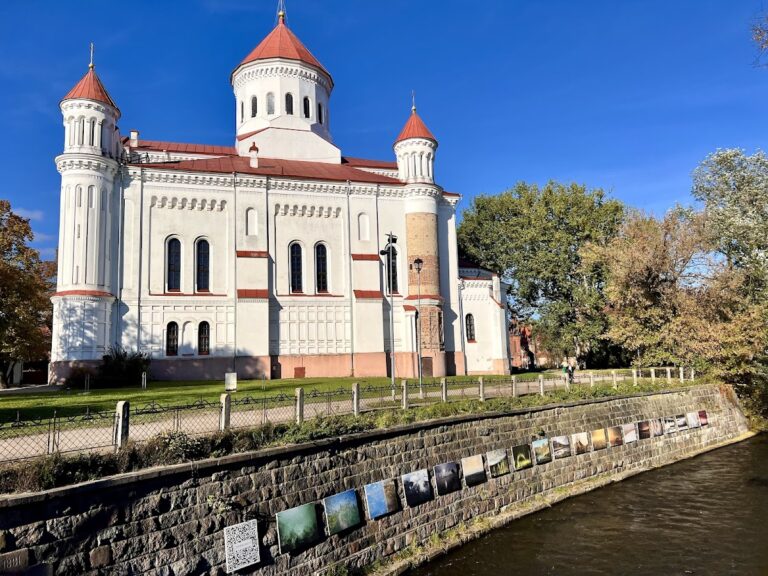
St. Paraskeva Church stands at Didžioji Street 2, at the junction of Piles and Latako streets in Vilnius’s Old Town, with the site also relating to Bokšto Street. The building occupies a slight elevation that separates it clearly from the street. Its present form is a brick church rebuilt and enlarged in 1864 and 1865 in the Neo-Byzantine style, a nineteenth-century revival based on Byzantine Christian forms and decoration.
The church has a square plan, a centralized composition with one dome, and a hall-like interior. Its exterior is modestly decorated with semicircular blind panels and a frieze, while the windows are also semicircular. The brickwork is painted white, pink, and dark red. A central dome rises above the building, and a freestanding bell tower stands separately. Only a small section of the earlier masonry survived the nineteenth-century rebuilding. During restoration, workers found a fragment of wall bearing a date in Slavic script that corresponded to a year in the older creation-of-the-world calendar.
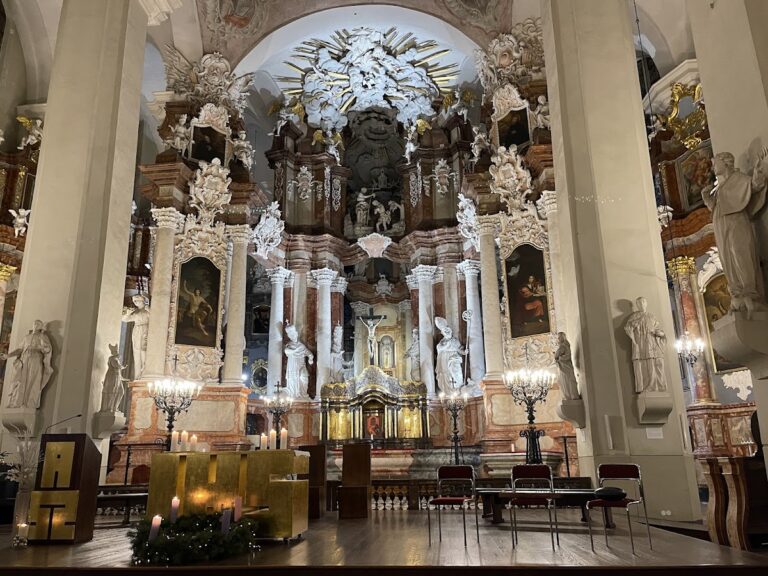
A new iconostasis, the screen of icons separating the sanctuary from the main worship space, was made after the church returned to Orthodox use. The woodcarver Alexander Klyavin produced the woodwork, and the icon painter Vladimir Podgorny created the icons.
Plaques and churchyard monument
An iron fence set on a stone foundation has enclosed the churchyard since 1886. Three memorial plaques on the facade facing the small square at the junction of Piles, Latako, and Bokšto streets describe the church’s history. Three more plaques on the side facing Hodkiewicz Palace commemorate Orthodox churches restored in Vilnius during the second half of the 1860s, identify members of the church-building committee, and show the church in ruins and after its restoration.
The plaque associated with Peter I records his thanksgiving service, his gift of a Swedish banner, and the baptism of Gannibal. Other plaques refer to the church’s origins, early history, and nineteenth-century rebuilding. In the churchyard, a monument to Gannibal and Pushkin was unveiled on 5 May 2011. Conceived by the poet Yury Kobrin and created by the sculptor Vytautas Nalivaika, it consists of joined hands enclosing oval medallions with relief portraits of the two men. The hands are surmounted by an Orthodox cross formed by the extended little fingers. The monument stands on a granite pedestal, with bronze hands and brass medallions, and is 3 metres high and weighs 2 tonnes.