Xiaotang Mountain Han Shrine: An Eastern Han Funerary Stone Shrine
Site at a Glance
- Rating
- 5
- Popularity
- Very Low
- Country
- China
- Primary era
- Classical
- Eras represented
- Classical, Medieval, Modern
- Civilizations
- Chinese, Han
- Site type
- Burial
- Remains
- Tomb
On this page10 sections
History
Xiaotang Mountain Han Shrine is an early Eastern Han funerary stone shrine in Changqing District, Jinan, Shandong, China. Built during the later major period of the Han dynasty (25–220 AD), it is the only known funerary shrine of its period still standing in its original form and is China’s earliest surviving above-ground domestic building.
Eastern Han origins and visits
Stone shrines above the tombs of high-ranking nobles and lords appeared from the Warring States period, before the Han, and became especially common during the Han, particularly in the Eastern Han. The shrine’s exact construction date is unknown. Its carved images resemble Eastern Han work from the Yongping era, suggesting it may have been built around the reign of Emperor Ming (58–75 AD).
A dated inscription from 129 AD shows that the shrine already existed by that year. Another inscription, from 167 AD, dates to the first year of Emperor Huan’s Yongkang era. Together, the inscriptions establish that visitors were leaving marks at the shrine by the middle of the second century.
The Guo Ju tradition and competing identifications
Local tradition identifies the tomb with Guo Ju, the thirteenth figure in the Twenty-Four Filial Exemplars, a collection of stories about devotion to parents. In the story, famine leads Guo Ju to consider burying his infant son so he can preserve food for his elderly mother. While digging, he finds a treasure bearing an inscription that presents it to him, allowing him to save his family.
The association with Guo Ju was widespread by the Northern Qi period, a later dynasty in northern China. The tomb’s occupant, however, remains uncertain. Tradition places Guo Ju in either Longlü in Henei, now Linzhou, or Wen, now Qinyang, both in Henan. The shrine’s images of royal processions and warfare have also been judged difficult to reconcile with his story. Other proposals identify the tomb as that of a King of Jibei or a senior official in the 2,000-shi rank category, a rank associated with a grain stipend. Because the identity is unresolved, architectural historian Luo Zhewen used the name Guo Family Tomb Stone Shrine.
Later records, temples, and protection
The Northern Wei scholar Li Daoyuan described a stone chamber on Wushan known locally as the Filial Son’s Hall. The Song scholar-official and inscription researcher Zhao Mingcheng later included the shrine in his catalogue of inscriptions. From the Tang dynasty onward, temples stood around it, and the complex became known as Xiaotang Mountain Temple. The surrounding buildings were repeatedly repaired during the Ming and Qing dynasties. A major campaign from 1767 to 1769 resulted in a complex with eight halls and two corridors.
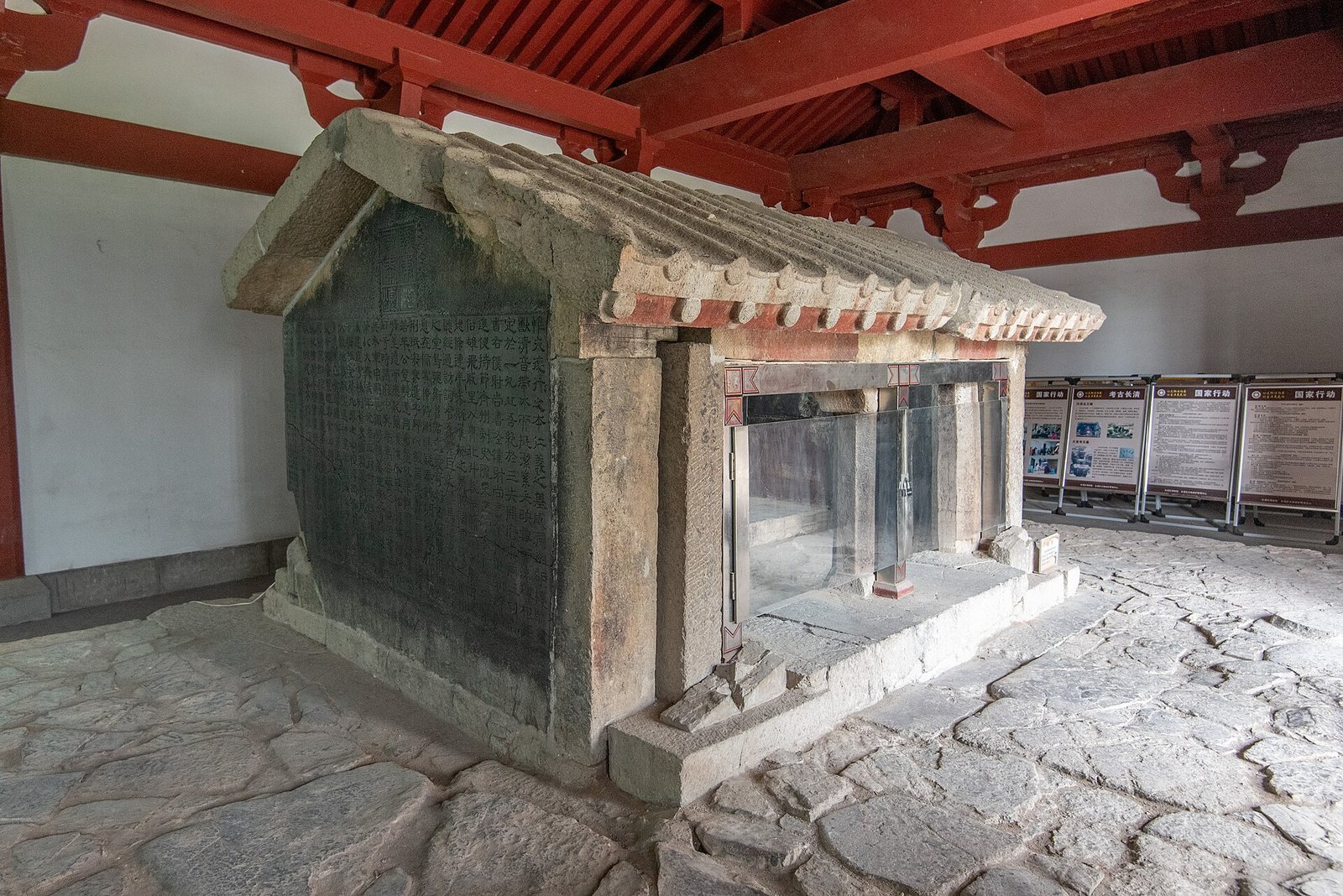
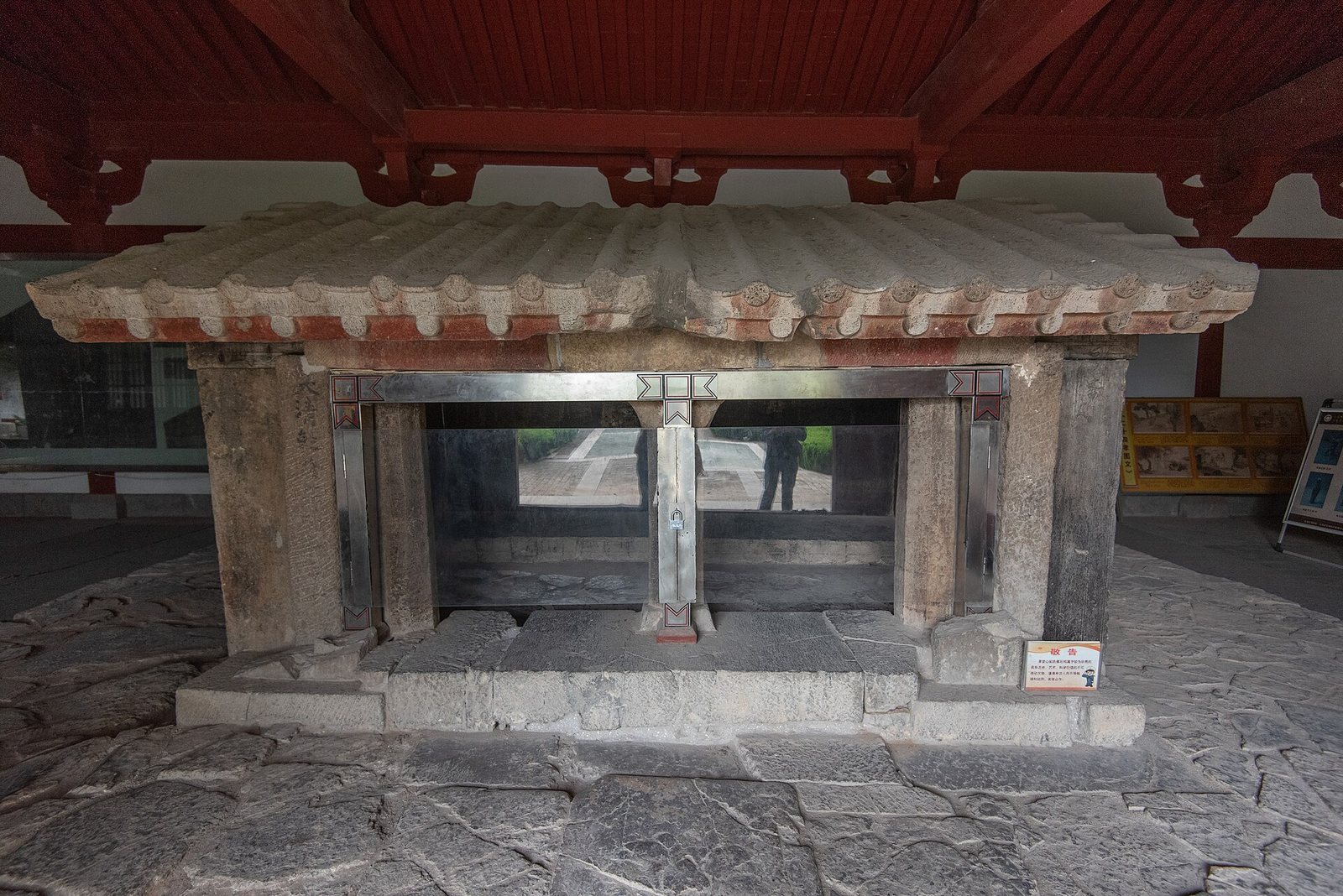
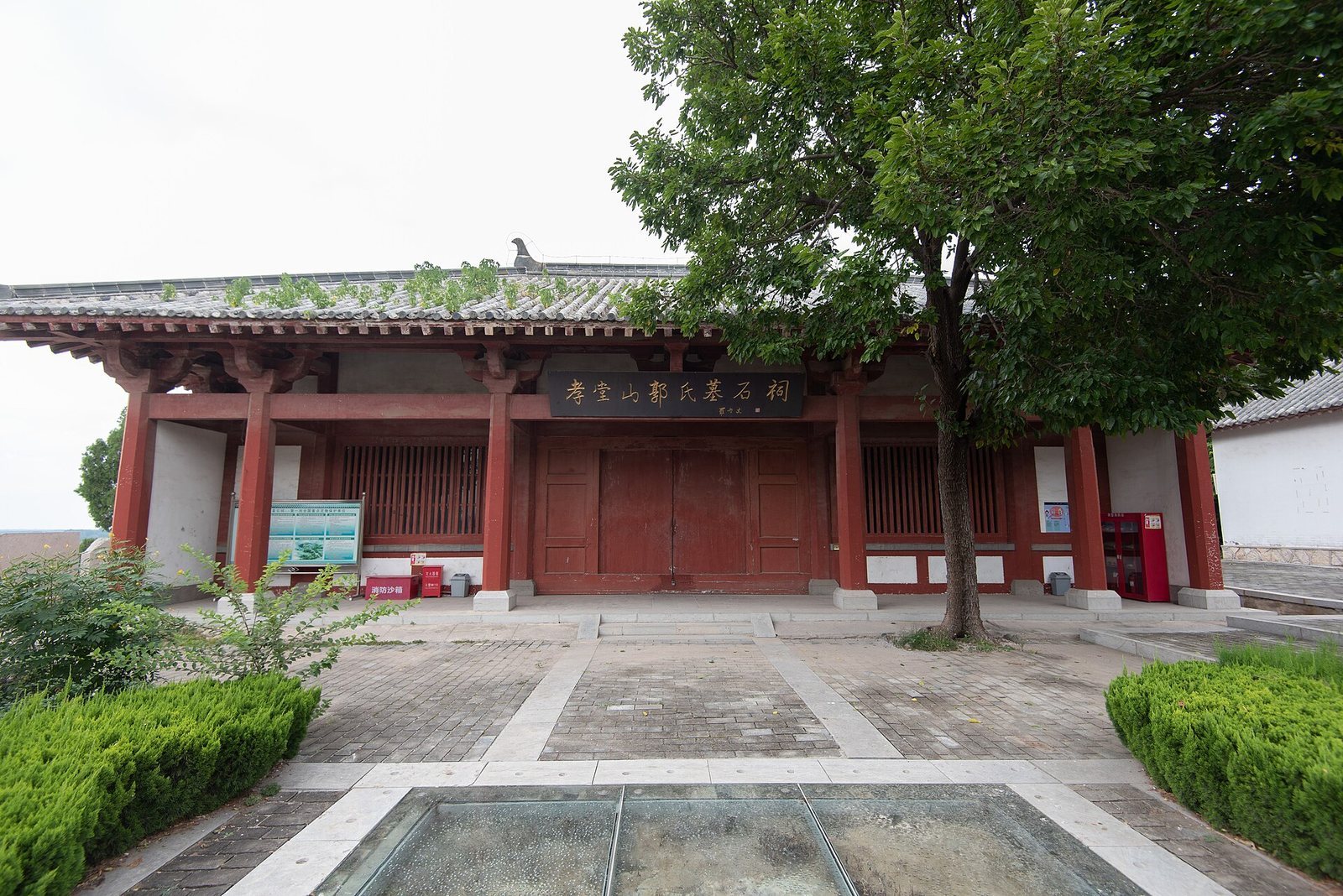
Originally open to the air, the shrine was enclosed for protection on several occasions. Local heritage authorities rebuilt an enclosure and surrounding wall in 1953 and assigned caretakers; the enclosure was rebuilt in a Han-dynasty style in 1999. The first measured drawings were published in 1916. In 1961, while surveying the Qi Great Wall, Luo Zhewen measured the shrine and published a study. That year, the shrine was included in China’s first group of Major National Historical and Cultural Sites.
Remains
Setting and stone structure
The shrine stands on the slopes of the Yellow River valley, on a mountain more than 30 metres high. It lies about 500 metres east of the Yellow River and approximately 20 kilometres southwest of central Jinan. The mountain was formerly called Wushan and is also known as Guishan. The shrine faces south and is a free-standing stone building modelled on Han domestic architecture at a reduced scale. It measures about 4.1 metres from east to west, more than 2 metres from north to south, and about 2.6 metres high. Its walls are made of stone slabs roughly 20 centimetres thick. It is slightly larger than the Wu Family Shrine in Jiaxiang County.
Inside, an octagonal stone pillar, 86 centimetres high, divides the space in two. The interior measures 3.09 metres across and 2.08 metres deep. Stone slabs form the roof, which projects beyond the walls and has a single eave and a gabled profile. Carved ridges, rows of roof tiles, and eaves reproduce details of a tiled roof.
Carved imagery and inscriptions
Interior carvings
Carved images cover the three interior walls and triangular stone beams. The work combines incised designs, shallow carved lines, and raised relief. Its subjects include royal audiences, visits and formal gestures of respect, processions, hunting, acrobatics, warfare, travel, receptions, cooking, recreation, timekeeping, and astrology. Other scenes show the culture-hero deities Fuxi and Nüwa, the Queen Mother of the West, the Duke of Zhou assisting in government, and Confucius meeting Laozi. A procession spreads across the upper parts of the west, north, and east walls, with numerous people, chariots, and horses, and the inscription “King’s carriage.” Other stone components carry simpler motifs, including lowered curtains and water caltrop.
Exterior inscriptions
Numerous visitor inscriptions appear on the exterior. One later text, the Eulogy on Filial Piety by the Prince of Longdong, dates to 570 and was composed by Hu Changren, a Northern Qi official who served as governor of Qizhou and held the title Prince of Longdong. Its heading is in seal script, an older formal style of writing, while its main text uses clerical script, a style widely used during the Han.
Tomb and cemetery
A large tomb lies behind the shrine beneath an earthen mound about 3 metres high. Han tombs around the shrine had been robbed. In 2000, archaeologists cleared tombs in front of and beside the shrine, and historical steles found during the work were gathered within the cemetery. A plaque on the protective enclosure bears the name Guo Family Tomb Stone Shrine in Luo Zhewen’s hand; a plaque at the cemetery entrance reads “Xiaotang Mountain Han Stone Chamber” and was written by painter and calligrapher Liu Haisu.