Turukhansk Holy Trinity Monastery: A Russian Orthodox Monastery on the Yenisei
Site at a Glance
- Popularity
- Medium
- Country
- Russia
- Primary era
- Modern
- Eras represented
- Modern
- Civilizations
- Russian
- Site type
- Religious
- Remains
- Monastery
On this page10 sections
History
Turukhansk Holy Trinity Monastery is a Russian Orthodox men’s monastery on the Yenisei near the mouth of the Lower Tunguska in Russia, established in 1660. Founded by monks, it developed into a religious and missionary institution with extensive landholdings and a major role in the region’s salt economy.
Foundation and expansion
The monk Tikhon settled at the site in 1657, possibly in exile, and the monk Dionysius is also named as a founder of the hermitage that became the monastery. In 1660, at the community’s request, Tikhon travelled to Tobolsk, where he was ordained as a priest-monk. Simeon, Archbishop of Siberia and Tobolsk, instructed him to establish the monastery. Tikhon returned with an antimension, a consecrated cloth used on an Orthodox altar.
Royal decrees granted the monastery land and fishing grounds in 1662, 1664, and 1689. The relics of Basil of Mangazeya, an Orthodox martyr, arrived in 1670, giving the community the additional name Trinity Mangazeya-Turukhansk Monastery. Its northern holdings grew from three settlements on the upper Lower Tunguska in 1668. Between 1669 and 1724, the monastery bought 12 wintering posts, remote seasonal bases, from traders along the lower Yenisei and Arctic coast. By the mid-eighteenth century, it owned 23 such posts in the northern Yenisei region, about half the area’s total.
A bequest in the late seventeenth century brought the monastery salt springs and what was then Siberia’s largest saltworks. Salt remained central to its economy: in the late eighteenth century, it sent up to 2,000 poods, a traditional Russian weight of about 16.4 kilograms each, annually for sale in Tomsk. An eighteenth-century account of the monastery’s origins was written there, along with a text describing a healing attributed to the Trinity icon and a Life of Basil of Mangazeya, possibly written by Tikhon. A fire on 14 November 1726 destroyed many materials about Tikhon’s life that had been gathered in preparation for his canonization.
Reform, exile, and decline
The monastery served as a place of exile from 1730. The 1764 secularization reform transferred church lands to state administration and placed monasteries in classes that determined staffing and state support. The monastery lost its estates and was assigned to the third class, leading to a sharp reduction in its community.
Its institutional work included a school for missionaries and a boarding school where children from Indigenous peoples of Siberia were taught Russian. In 1827, the monastery held Nikolai Bobrishchev-Pushkin, a Decembrist involved in the 1825 uprising against imperial rule. During the 1860s and 1870s, clergy assigned penances for misconduct were also confined there. In the 1860s, missionary Ioann Kozhevnikov served at once as the monastery’s abbot, the sole priest of an itinerant church, and head of the Turukhansk church district.
By the 1890s, the monastery no longer held prisoners, and its abbot reported in 1897 that this function had ended. The community was impoverished and its monks struggled to support themselves. By the late nineteenth century, the annual state allowance was 668 rubles and 88 kopecks. In 1914, just eight people lived there: four from Yenisei Province and one each from Kazan, Kaluga, Tambov, and Penza provinces.
Dissolution and revival
The monastery was dissolved in either 1921 or 1923. Its Trinity church continued as a parish church until 1930, with services led by Martin Rimsha, one of the last priests in the Turukhansk region. Saint Luke (Voyno-Yasenetsky), a Russian Orthodox bishop and surgeon then in his first exile in the region, also served there in 1925-26. A settlement formed around the monastery grew into the town of Turukhansk in the late 1920s. After parish services ended, the church was put to administrative and other practical uses.
An Orthodox parish was established in Turukhansk in 1990, and worship returned to the church on 8 July 1991. The Russian Orthodox Church’s governing Holy Synod decided to revive the monastery, whose charter was registered on 18 July 1996. Bishop Agafangel (Daineko) has served as abbot since the revival, and Igumen Sofroniy (Semenov) was appointed deputy superior in March 2015. The active monastery belongs to the Diocese of Norilsk and Turukhansk, a church district overseen by a bishop. It is designated a cultural heritage site of regional significance in Russia.
Remains
The monastery’s buildings developed from early wooden structures to a surviving stone church. The original chapel and cell marked the site of the later complex, on the Yenisei near the mouth of the Lower Tunguska.
Church buildings
The chapel and cell
Tikhon built a wooden chapel and cell in 1657. These structures marked the location of the monastery that was established there three years later.
The wooden churches
A wooden Trinity church was built on the chapel site in 1663-64 and later dismantled. A wooden Annunciation church took its place, with a side chapel dedicated to the Trinity added in 1682. This church remained until 1809. The monastery church was dedicated to the Life-Giving Trinity and had an Annunciation side chapel; the relics of Basil of Mangazeya were kept beneath its floor.
The stone Trinity church
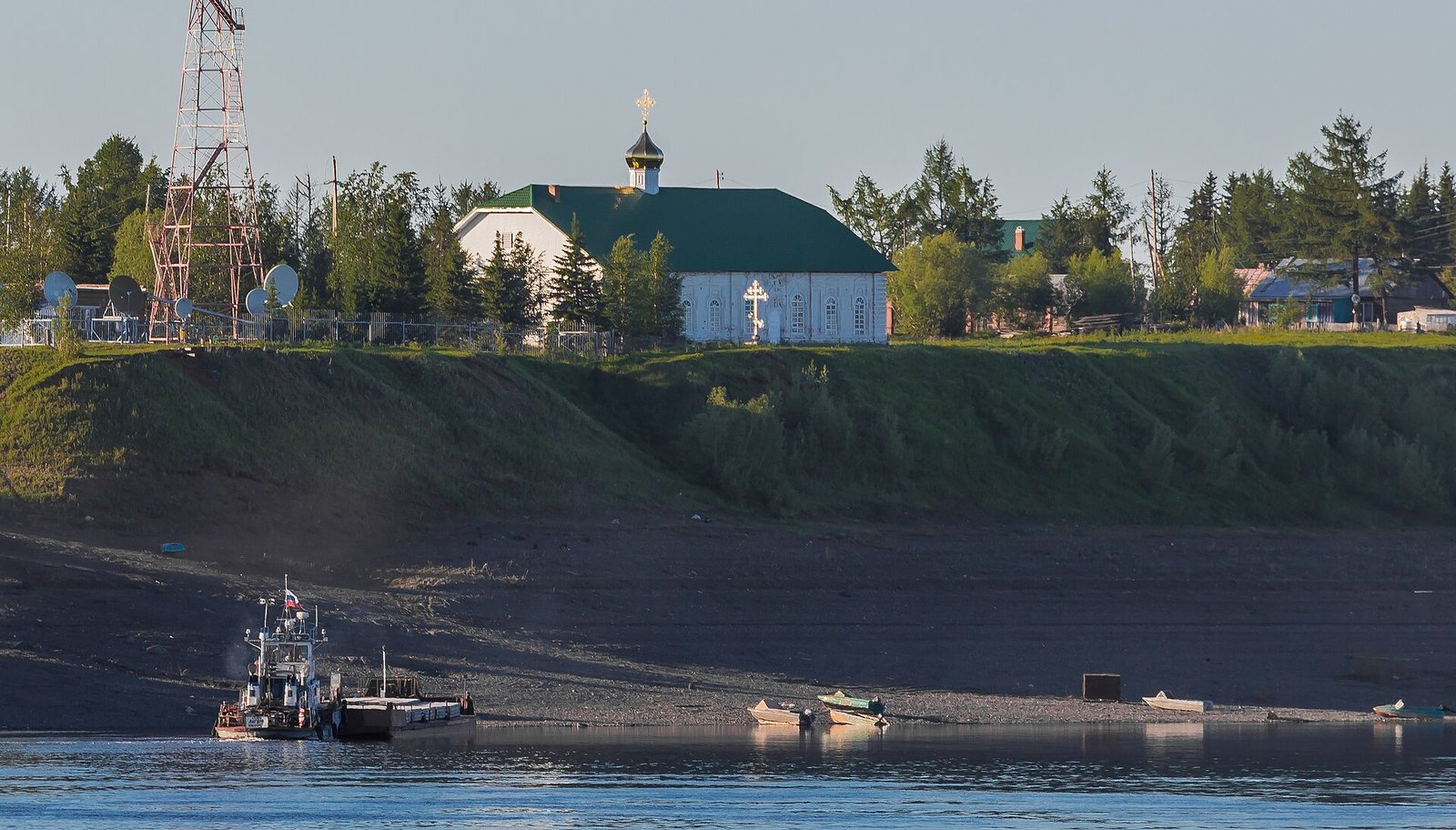
The stone Trinity church was consecrated on 29 November 1801 and survives. After the monastery closed, the building was left without its domes.
The house church
After monastic life resumed, a house church dedicated to Saint Luke was consecrated inside the monks’ residential building.