Tullyhogue Fort: A Gaelic Royal Inauguration Site in Northern Ireland
Site at a Glance
- Rating
- 4.6
- Popularity
- Medium
- Country
- United Kingdom
- Primary era
- Unclassified
- Eras represented
- Unclassified
- Civilizations
- Unclassified
- Site type
- Civic
- Remains
- Monument
On this page8 sections
History
Tullyhogue Fort is a hilltop ceremonial enclosure near Cookstown in Northern Ireland, United Kingdom. Its construction date is unknown, but by the eleventh century it had become a royal centre and inauguration place for the Cenél nEógain and, later, the Uí Néill dynasty. Inaugurations continued there until the late sixteenth century.
Early dynastic control
The site held ritual importance before its association with the O’Neills. It was first linked to the Uí Tuirtri, a people associated with Airgialla, a medieval Irish kingdom or political region. Branches of the Cenél nEógain, a major branch of the Uí Néill dynasty in northern Ireland, displaced them. The Cenél mBinnig entered the area in the tenth century, and a twelfth-century genealogy connected them with Tullyhogue. They later moved north to Glenconkeyne and Loughinsholin and were succeeded by the Cenél Feargusa, which included the O’Hagans, supporters of the O’Neill dynasty.
Before 1056, the Cenél Feargusa took possession of the site as reachtaire, meaning a steward or controller of the royal household. They remained there into the seventeenth century. The O’Hagans lived at Tullyhogue and became its hereditary guardians.
Royal inauguration and succession
Before 1084, branches of the Cenél nEógain brought in Conchobar and his brother Cennétig, grandsons of Donnchadh mac Briain and members of the rival O’Brien royal dynasty of Munster. The Meic Lochlainn, a ruling family within the Cenél nEógain, backed the brothers, who briefly ruled as kings of Telach Óc. Their branch did not secure lasting power there. The upheaval helped Domnall Ua Lochlainn, Cennétig’s son-in-law, become King of Ailech in 1083 and removed the threat of O’Neill rivals for several generations.
In later medieval times, Tullyhogue became the O’Neill inauguration place. The ceremony bestowed the title An Ó Néill, “The O’Neill,” and made the new lord head of the clan. O’Neill territory at times extended well beyond present-day County Tyrone, and some rulers claimed the title High King of Ireland. The O’Cahan, the O’Neill’s principal sub-chief, threw a golden sandal over the new lord’s head as a sign of good fortune. The O’Hagan guardian then placed the shoe on the lord’s foot and presented him with a rod of office. Tradition says the first O’Neill was inaugurated on the Leac na Rí and that St Patrick blessed the stone.
The end of the inaugurations
Hugh O’Neill, Earl of Tyrone, received his inauguration at Tullyhogue in 1595, the last such installation there. During the Nine Years’ War, a conflict in Ireland between Gaelic forces led by Hugh O’Neill and the English crown, Lord Mountjoy ordered the inauguration stone smashed in 1602 as a symbolic end to O’Neill sovereignty. In April 1603, Hugh O’Neill pledged to Mountjoy that he would give up the O’Neill name and title. The site had been abandoned by 1622.
Tullyhogue Fort is held in public care as a State Care Historic Monument, and the inauguration site is protected as a Scheduled Historic Monument.
Remains
Earthworks and layout
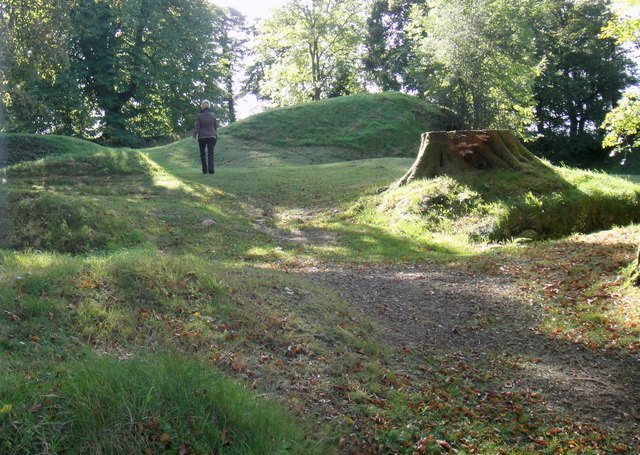
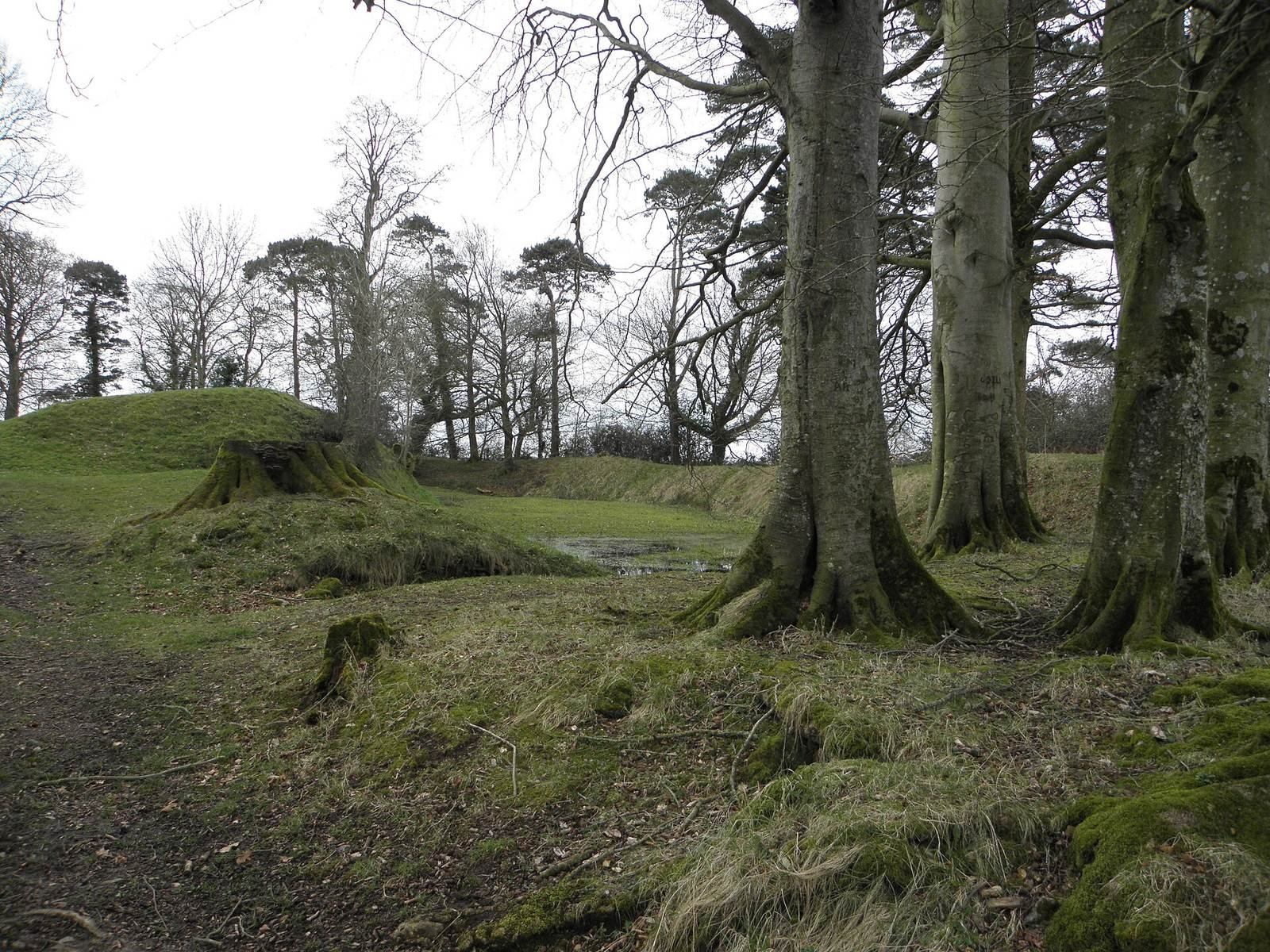
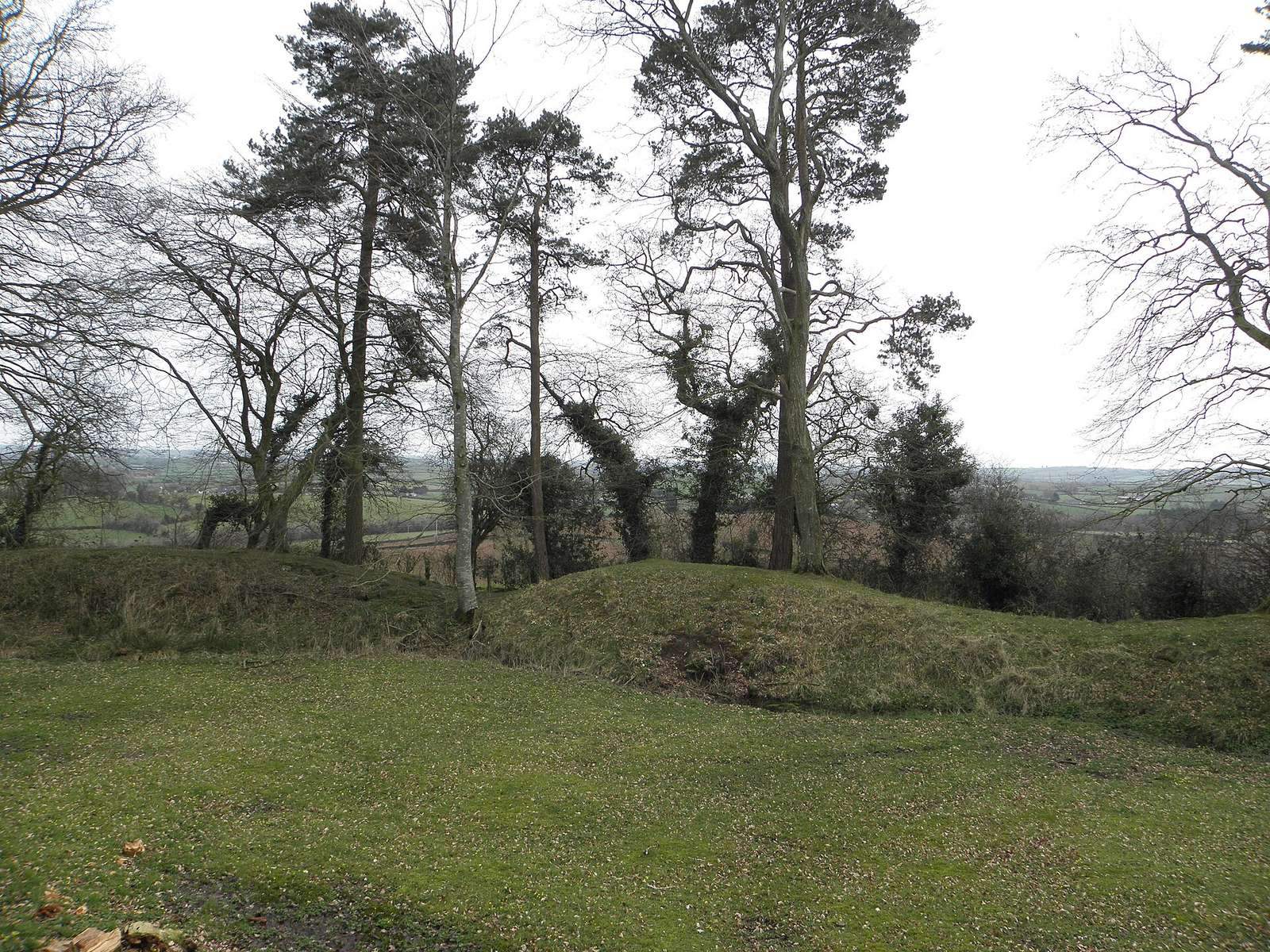
The hilltop enclosure is formed by earthen banks around a central area. A low inner rampart surrounds it, while a larger outer bank is separated from the inner earthwork by a broad, level space. These earthworks define the ceremonial area rather than a defensive stronghold. The site includes a large mound with a depressed centre and is now heavily wooded. The hilltop offers broad views over the surrounding area, and the enclosure can be seen from all around.
Ceremonial stone and burial place
The Leac na Rí, meaning “flagstone of the kings,” was a large boulder outside the enclosure. By the sixteenth century, three large slabs had been set around it to form a ceremonial stone chair. Donaghrisk, the O’Hagans’ burial place, lay at the foot of the hill.
Prehistoric finds
Fragments of flint tools found below the hill in 2014 date to before 5000 BC. They are associated with Mesolithic communities, people of the Middle Stone Age who lived by hunting and gathering.