Toquepala Caves: Pre-Ceramic Archaeological Shelters in Peru
Site at a Glance
- Rating
- 4.2
- Popularity
- Very Low
- Country
- Peru
- Primary era
- Stone Age
- Eras represented
- Stone Age
- Civilizations
- Unclassified
- Site type
- Civic
- Remains
- Rock Art
On this page10 sections
History
Toquepala Caves are archaeological shelters near the Toquepala mine in Ilabaya District, Tacna, Peru. They were used seasonally by small, mobile hunter-gatherer groups during the Paleolithic, or Old Stone Age, and the pre-ceramic period before pottery became established locally. Their occupation is associated with the Collawa, an ethnic group linked to the site’s prehistoric inhabitants, and is generally dated to around 7,600 BC.
Early hunter-gatherer occupation
The shelters lie in the western Andes of southern Peru, near the Quebrada Cimarrona and within the Osmore–Locumba drainage. Their elevation is reported between about 2,200 and 2,800 metres, and they are approximately 154 kilometres from Tacna. Radiocarbon dating from deposits in a pit excavated to a depth of 1.8 metres indicates habitation around 7,600 BC. An earlier date of about 10,000 BC has also been proposed, but that estimate remains uncertain because the dated layers were not directly associated with human occupation remains.
The occupants left food waste inside the shelters, creating archaeological layers over time. When local animals moved away, the caves were abandoned and later used by birds, whose bones accumulated on the floor. Much later, shortly before the Christian era, other occupants returned to use the shelters for basketry and left a basket behind.
Rock art and interpretation
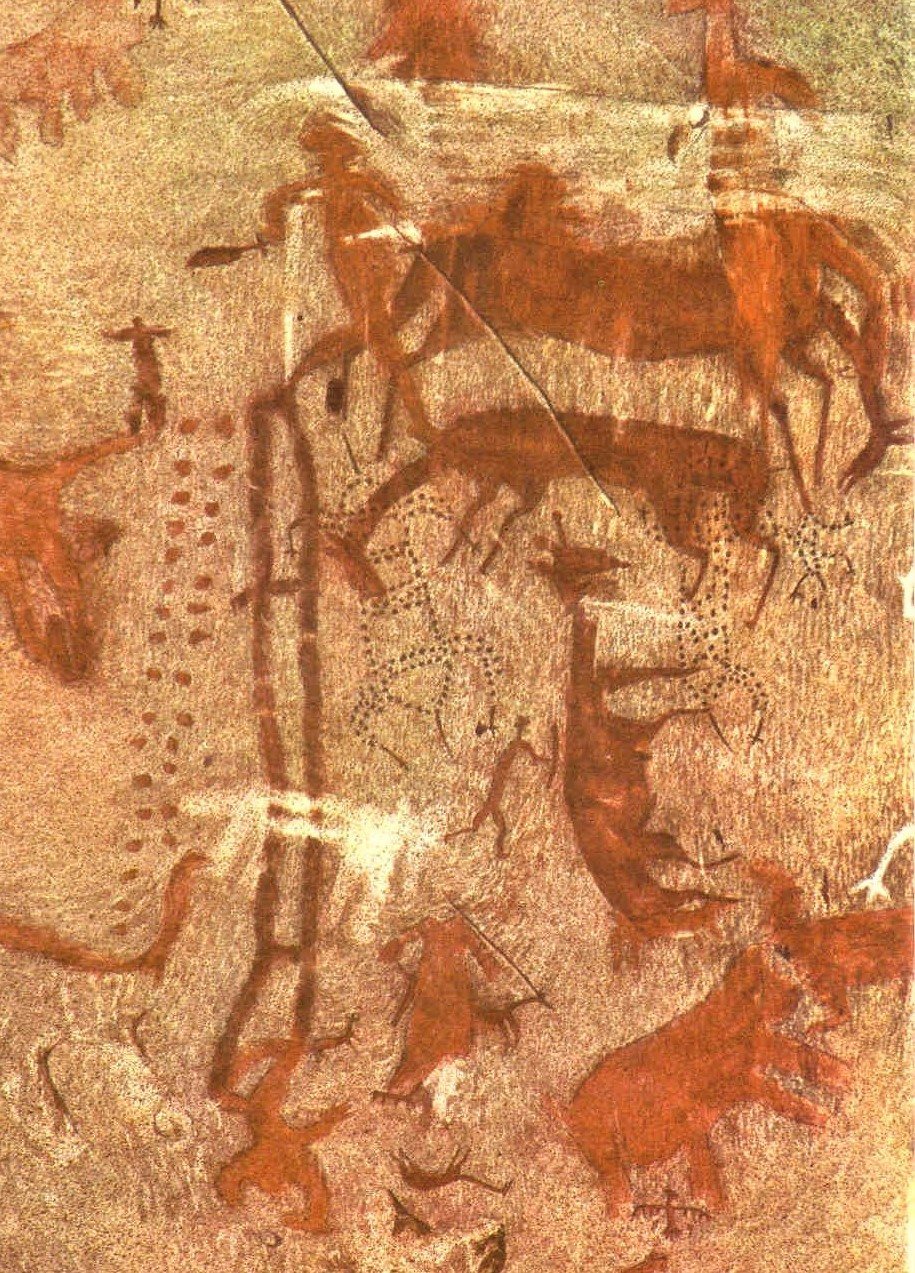
The paintings are associated with hunting and the acquisition of food. They show guanacos being surrounded, pursued, attacked, and killed. Jorge C. Muelle proposed that the images may have served a magical or animistic purpose, with hunters perhaps throwing projectiles at animal figures before an actual hunt. The scenes have also been linked to the Andean chaco, a communal hunting method in which people form a cordon, drive animals together, and then kill or capture them.
Investigation and protection
The caves had been visited by at least 1950 and were identified scientifically in 1963 by Emilio Gonzáles García. From 1963 to 1967, the Museo Nacional de Antropología y Arqueología of Lima investigated the site with support from the Southern Peru Copper Corporation, whose mining operations had brought the caves to wider attention. Jorge C. Muelle, Rogger Ravines, and Miomir Bojovich were among the principal investigators. Ravines carried out detailed exploration in 1965, while Muelle and Ravines published documentation of the paintings in 1966. Pedro Rojas Ponce prepared painted tracings in watercolor.
The investigations established the importance of the pre-ceramic occupation and rock art, while also recovering stone tools, paint remains, food debris, and brush-like implements. A protective fence was installed after the initial work, but clandestine entries damaged some paintings. Stronger fencing was later put in place.
Remains
Toquepala Caves consist of two small sandstone cavities formed by erosion. One is a cave and the other a rock shelter. They face south and southwest, and their exposed bedrock walls carry painted scenes. The cavities are also described more generally as measuring about 15 metres by 5 metres, with an interior length of roughly 10 metres and a depth of about 5 metres.
The two shelters
Cave
The cave measures approximately 4.20 metres in depth, 5.20 metres in width, and 3 metres in height. It was also known as Cueva del Diablo, or “Devil’s Cave.” Its internal walls are divided into six painted sectors. The cave contained stone tools, paint remains, food debris, bird bones, and evidence of later basket-making activity.
Rock shelter
The second cavity is lower and shallower than the cave, but it has a wider entrance and a broader interior. It is known as Abrigo del Diablo, or “Devil’s Rock Shelter.” Paintings cover its external surfaces and are arranged in two sectors. Its sandstone structure retains exposed bedrock walls.
Paintings
More than 50 paintings cover the cave and shelter, of which about 30 were studied. The figures are small, flat-coloured, and schematically naturalistic. Human figures reach about 5 centimetres in height, while animals reach about 10 centimetres. Guanacos predominate, appearing in scenes of pursuit, enclosure, attack, and killing. Some animals are shown dead or struck by projectiles or lances. The human figures carry clubs, axes, lances, and spear-throwers, devices that increase the range and force of a thrown dart or spear. Some may carry bows, although the use of bows and arrows remains unclear.
Red is the dominant colour, accompanied by yellow, green, white, and black. The red pigment was made from hematite, an iron-rich mineral that produces red colour when ground. The principal scenes were applied with liquid pigment and a fine brush. Some isolated figures were made with the fingers, using pigment mixed with a fatty medium. Brush-like implements found at the site may have served as painting tools. Overlapping figures indicate that portions of the paintings were produced at different times.
Associated archaeological remains
The shelters preserve stone tools, pigment remains, food waste, and bird bones alongside the painted surfaces. A later basket relates to basket-making activity shortly before the Christian era. Together, these remains connect the painted hunting scenes with repeated use of the shelters for seasonal occupation, food processing, and later craft activity.