Tomb of the Marquess of Haihun: Burial Place of Liu He
Site at a Glance
- Popularity
- Very High
- Country
- China
- Primary era
- Classical
- Eras represented
- Classical
- Civilizations
- Han
- Site type
- Burial
- Remains
- Tomb
On this page24 sections
History
The Tomb of the Marquess of Haihun, in Xinjian, Jiangxi, China, is the burial place of Liu He, the first holder of the Haihun marquessate. It belongs to the Western Han, the earlier part of the Han dynasty, which ruled from 206 BC to AD 9. A marquess was a hereditary noble, while a king of a Han fief held a distinct, higher title.
Liu He and the Haihun marquessate
Before his burial as a marquess, Liu He had been King of Changyi and briefly the Western Han’s ninth emperor. His reign lasted little more than twenty days. The historical account of his fall links it to an effort to remove Huo Guang, a powerful statesman and regent, who then secured Liu He’s deposition. Liu was the second and last King of Changyi. When he became a marquess, his fief moved from the Juye area of Shandong to Xinjian in Jiangxi. A Han marquessate was a territorial holding within the empire, not an independent state.
The cemetery’s residence-like arrangement reflects the rites associated with a Han marquess’s burial. Liu He and his wife occupied separate tombs in the same cemetery and shared ritual buildings. The wife’s burial came later, and part of her mound was built over the mound of Liu He’s tomb. The deceased’s sleeping chamber was associated with offerings of food four times a day, while ancestral halls housed tablets honoring the dead and served for sacrifices. All nine graves in the cemetery had an associated ancestral hall, forming an unusually complete arrangement of these rites.
Burials, evidence, and changing interpretations
Interpretations of other graves changed as new evidence came to light. A jade sword from Tomb 5 led to speculation that its occupant was a man. The substantial foundations of that tomb’s ancestral hall prompted a different proposal, that the grave belonged to Liu He’s favored concubine. A metal seal with a tortoise-shaped knob, found at the occupant’s waist, identified the person as Liu He’s eldest son.
The burial goods also informed discussion of Liu He’s reputation and political career. The excavation leader interpreted the Confucian writings among the grave goods as evidence that texts had been deliberately placed in the tomb and that Liu He was strongly influenced by Confucian culture, a Chinese ethical and philosophical tradition that shaped education and government. The head of the archaeological expert group questioned the historical charge that Liu He was debauched. In that expert’s view, political overreach and poor judgment at court, which provoked Huo Guang, better explained his downfall.
A bronze lamp from the tomb carries the inscription “Nanchang.” The excavation leader proposed that the place-name grew from the meaning “Southern Changyi,” on the theory that Liu He might have regarded his former fief as Northern Changyi and his new one as Southern Changyi. The proposal remains disputed. Objections include evidence for the name Nanchang in Qin-period bamboo slips found elsewhere, the argument that “yi” formed part of the place-name, and the likelihood that imperial authorities rather than Liu He determined place-names.
Later history and archaeological investigation
After a major earthquake in AD 319, the cemetery grounds sank beneath Poyang Lake. Scholars have considered this one possible reason the tomb escaped looting. A separate tunnel, dug at the cemetery’s northwest corner during the Five Dynasties, a succession of short-lived regimes between the Tang and Song dynasties, also failed to reach the burial chamber.
In March 2011, a local resident alerted police to suspected tomb robbers. Their tunnel reached about 14.8 metres but stopped short of the timber protection around the main burial chamber. The excavation leader estimated that the robbers had come within about five centimetres of the grave goods. They had already robbed the marquess’s wife’s tomb, believing her mound was higher. Once vegetation had been cleared, Liu He’s mound proved larger. The robbers also misjudged the burial hierarchy, in which the right was the more honored position. The main coffin lay east of the mound’s center, in keeping with the tomb’s residence-like arrangement.
Rescue excavation began on April 15, 2011. In 2012 and 2013, archaeologists excavated three attached tombs and a chariot-and-horse pit, examined the eastern and northern gates and building foundations, and located roads and drainage works. The attached tombs had been looted; finds included jade swords, ceramics, and lacquerware. A conical bowl from the Song dynasty, which ruled from AD 960 to 1279, indicated that one tomb had been looted during that period.
Work on the main tomb began in 2014. In early 2015, archaeologists located its timber burial structure and cleared the surrounding galleries before starting on the central chamber on November 14. They opened the outer coffin on December 20. Although the coffins had collapsed, a view through a gap showed that the main coffin’s contents were better preserved than expected, so the team shifted from clearing it in place to excavating it under controlled laboratory conditions. On January 15, 2016, the main coffin was moved on a track to a conservation station about one kilometre away. The coffin from Tomb 5 and coins from the main tomb’s northern gallery were moved at the same time. The inner coffin was opened the next day in a workspace of about 20 square metres, filled mainly with purified nitrogen and kept at adjustable humidity.
On March 2, 2016, archaeologists confirmed Liu He’s identity through three groups of finds: a wooden document recording a memorial to the emperor, dated consistently with Liu He’s time as marquess; gold objects inscribed “Your servant He”; and a jade seal bearing his name. Earlier arguments had also drawn on the tomb’s chariot-and-horse pit and lacquerware associated with the Changyi kingdom. The Chinese Academy of Social Sciences included the tomb among China’s six major archaeological discoveries of 2015. A site management authority, museum, and archaeological institute were established in 2016 to oversee excavation, protection, and research. The tomb forms part of the Purple Gold City site and Tie River ancient tomb complex, designated a National Key Cultural Relic Protection Unit on March 5, 2013.
Remains
The cemetery combines packed-earth walls, gates and buildings with a group of tombs laid out around two principal burials. Liu He’s large, south-facing tomb and his wife’s tomb occupy the center and highest ground. Ritual halls, a sleeping chamber, side rooms, smaller graves, a chariot-and-horse pit, wells, roads, and drainage works complete the cemetery plan.
Cemetery layout and boundaries
Setting and enclosure
The cemetery stands on the summit of the middle hill in a group of five low hills running northeast to southwest, southwest of the Haihun kingdom’s capital settlement. Hills flank its eastern and western sides, streams run to the south and west, and the high ground is described as open to the north, south, and west. Its position was chosen according to geomancy, traditional principles for selecting and arranging places in relation to the terrain.
The trapezoidal enclosure covers about 46,000 square metres. Its east-to-west dimension ranges from roughly 233 to 248 metres, and it measures about 141 to 186 metres from north to south. A largely well-preserved packed-earth wall surrounds it. Formed in a base and an upper body, the wall is about two metres wide and 868 metres long.
Gates and towers
Entrances pierce the eastern and northern walls. Their surviving features include passageways, gate piers, and packed-earth foundations. The eastern opening is about 5.7 metres wide and 1.8 metres deep; the northern one is about 10.6 to 12 metres wide and 5.7 metres deep. Two facing towers stood outside each gate, marking the formal approach to the entrance.
The eastern gate towers have trapezoidal plans, each about 11.9 metres long from north to south and 4.5 to 4.7 metres wide. At the northern gate, the eastern tower is L-shaped and the western tower has a knife-shaped plan.
The principal tomb and ritual buildings
Mound and burial chamber
Liu He’s mound rises about seven metres and has the form of an inverted, truncated pyramid. It stands over two square packed-earth platforms, the lower of which is shared with his wife’s tomb. A passage on the south side leads to the burial chamber. The passage is about 15.65 to 16.17 metres long and 5.92 to 7.22 metres wide. The chamber measures about 17.17 to 17.34 metres from east to west and 17.09 to 17.15 metres from north to south, and is around eight metres deep.
Timber burial structure and coffins
Within the chamber, a timber structure about two metres deep is organized around a central room, surrounding galleries, compartments for vehicles, and a connecting passage. The central room is 3.4 metres high, about 0.4 to 0.5 metres higher than the galleries. A partition and doorway divide it into an eastern sleeping room and a western hall, with the eastern room twice the area of the western one. The western hall has a window on its south side; the eastern room has both a southern door and window. The principal coffin stood in the northeast of the eastern room.
The principal coffin had at least an outer and inner coffin. The outer coffin measured about 3.4 by 1.6 metres. The wooden coffins decayed and collapsed, in places pressing together; some objects became embedded in the outer coffin’s base. Several protective layers of timber surrounded the coffin.
Sleeping chamber and ancestral hall
The separate sleeping chamber lies about 0.8 metres south of the main tomb passage. Its square plan measures about ten metres on each side, with four L-shaped packed-earth foundations. In front of the tomb, the main ancestral hall has a corridor-style plan. Its U-shaped packed-earth foundation sits within a rectangular outer foundation about 17.7 by 13 metres.
Side rooms and service buildings
Two sets of side rooms flank the sleeping chamber and ancestral hall. Each is a connected, three-bay structure measuring about 27 metres long and ten metres wide. Their purpose is uncertain. They may have been auxiliary halls for daily rites and the storage of clothing and vessels, or offices and service quarters for cemetery staff. Other buildings within the cemetery have also been identified as quarters for its officials.
Attached tombs and cemetery infrastructure
Attached tombs
Seven attached tombs have packed-earth platforms beneath their mounds and drainage ditches around them; the ditches mark the extent of the burial mounds. Each tomb had an ancestral hall. The excavated halls in front of Tombs 4, 5, and 6 measure about 7 by 5 metres, 13.3 by 9 metres, and 10 by 7.8 metres, respectively.
Tombs 4 and 5 have sloping passages and each contained one coffin within an outer coffin. Tomb 4’s passage is about 5.35 metres long, and its chamber measures about 4.83 metres long by 3.97 metres wide and five metres deep. Tomb 5’s passage is about 12.67 metres long and 2.96 to 4.7 metres wide; its chamber measures about 6.16 by 5.54 metres and is six metres deep. Tomb 4 yielded 30 objects, including bronze and pottery items. More than 100 objects, among them bronze, jade, and pottery finds, came from Tomb 5.
Chariot-and-horse pit
West of the main tomb, a rectangular pit forms part of its burial complex. The main mound covers the pit’s eastern end. It measures 17.7 metres from north to south and 4.24 metres from east to west, at a depth of about 2.5 metres. A northern sloping ramp, about 2.08 metres long and 2.18 metres wide, stops short of the pit floor. Traces of a timber roof and earthen platforms indicate that the wooden outer chamber was about half a metre high. Its wood and reinforcing posts have decayed.
The pit contained five painted wooden vehicles, including seated and light carriages, along with traces of 20 horses. The horses’ bones had decayed. Vehicle fittings had been removed and placed in a painted, lacquered wooden box on the floor of the wooden enclosure. More than 3,000 objects came from the pit, including canopy-bow tips, shaft collars, dragon- and tiger-head yoke ornaments, pole and crossbar fittings, axle fittings, bridle ornaments, bits, and forehead guards. Some fittings were gilded or inlaid with silver. A hemp canopy was also recovered. Scholars have compared the equipment with descriptions of royal vehicles in Han texts.
Wells, roads, and drainage
Three wells lie approximately in a straight line: west of the sleeping chamber, west of Tomb 5’s ancestral hall, and west of the ritual buildings inside the northern gate. Each is about 1.8 metres across and 24 to 27 metres deep. The cemetery also contains numerous roads with trampled surfaces and drainage channels. More than 100 objects came from the wells, including water jars, roof and eaves tiles, a well windlass, wooden parts, clay sealings, and lacquer ear cups inscribed with terms translated as “Food Office,” “office,” and “meat offering.”
Objects from the main tomb
The main tomb’s surrounding galleries yielded more than 6,000 objects, including sets. Finds from the tomb as a whole exceed 20,000. They include more than 2,300 lacquered wooden objects, over 3,000 bamboo and wooden slips, more than 500 metal objects, over 30 jade and gemstone items, more than 100 ceramic objects, and five textiles. The metal objects include gold, silver, bronze, and iron; the stones and gemstones include jade, agate, and turquoise.
Writing and texts
More than 5,200 slips and wooden tablets carried writing, mainly Confucian texts and commentaries. They include the Book of Songs, Book of Rites, Analects, and Spring and Autumn Annals, as well as several versions of Confucian works otherwise lost. A bamboo text titled “Knowing the Way” belongs to the Qi version of the Analects, a textual form considered lost for about 1,800 years; its opening chapter has been published. Wooden tablets also preserve copies of official memorials, including one from Liu He to the emperor, and dispatch inventories.
Northern gallery
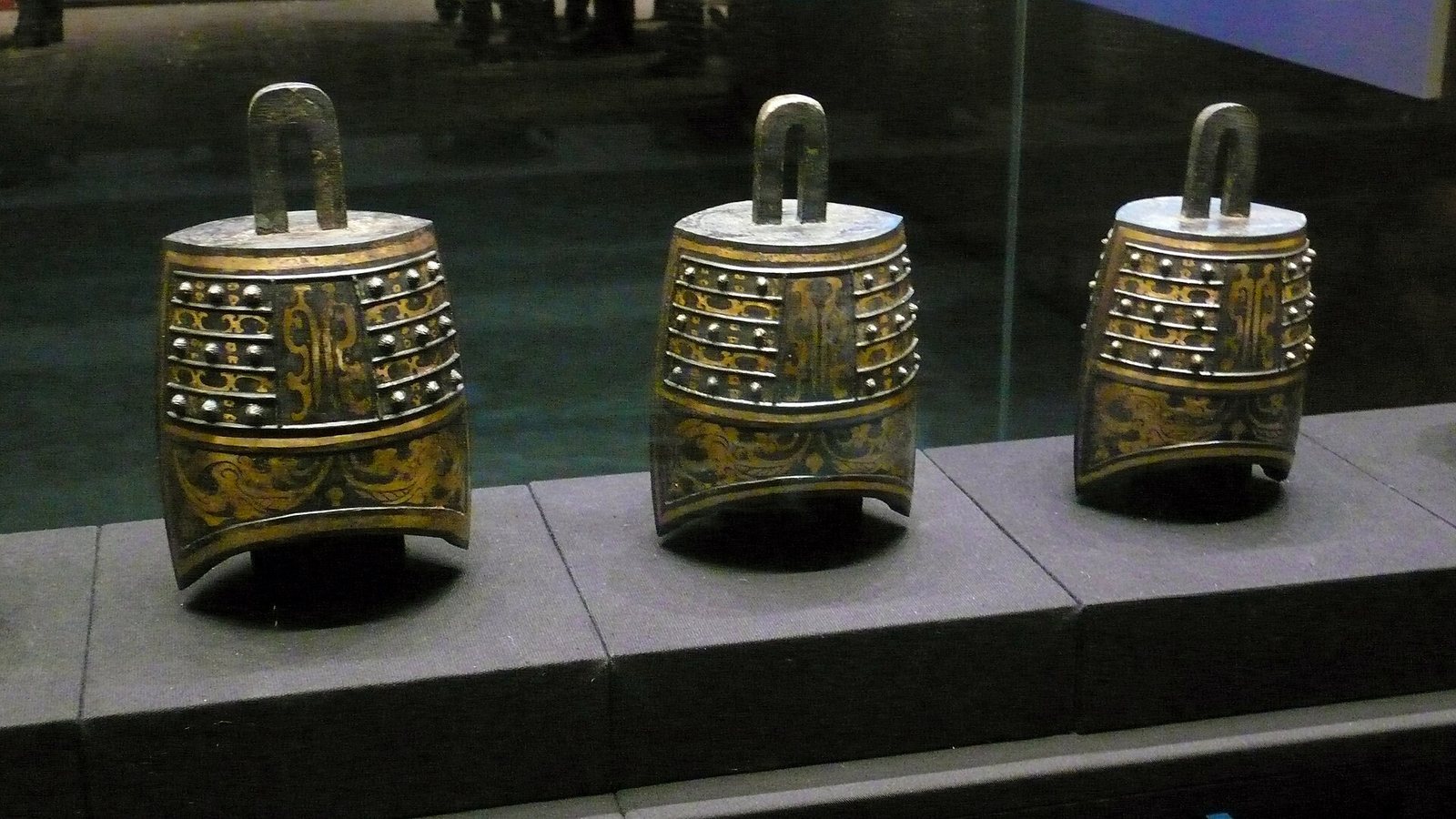
The northern gallery held two sets of bells, a set of stone chimes, nearly 200 musician figurines, and complete instruments including zithers and panpipes. Their arrangement and positions were preserved clearly. A coin store held two million Wu Zhu, standard Han bronze cash coins, weighing more than ten tonnes.
Other finds in the gallery include a large bronze distillation vessel packed with chestnuts, water chestnuts, and water caltrops, possibly used to make fruit wine, and a bronze cooking pot with chestnut residue. Dozens of ceramic vessels and lacquer-bodied pottery wine containers were found, as were two bronze lamps shaped as a goose and a fish. Textiles in the clothing store had decayed. Rounded-top, square-bottom tags in Han clerical script, a writing style used in the Han period, listed garment quantities and colors and were thought to have been attached to lacquer clothing boxes.
Eastern gallery
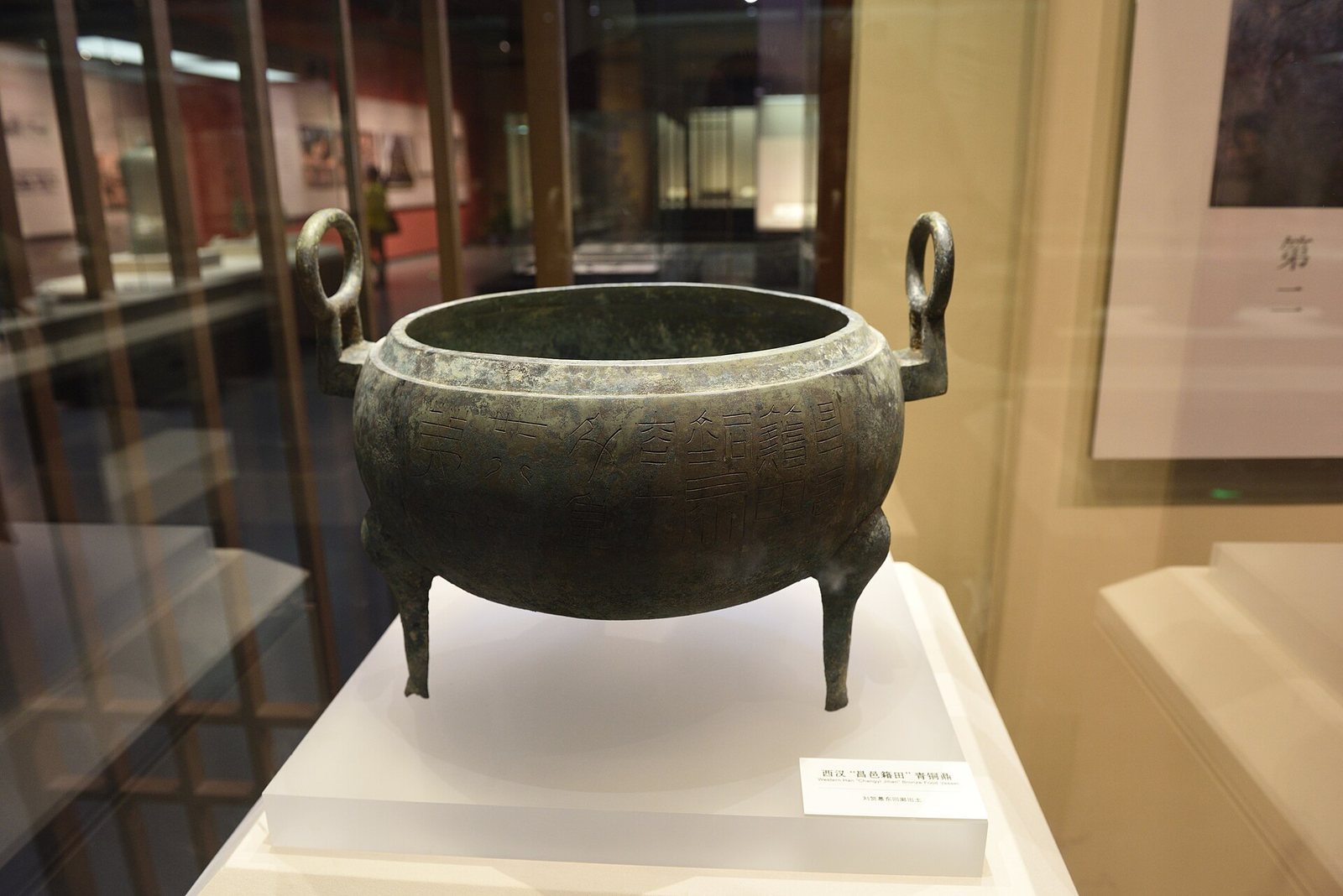
The eastern gallery contained bronze and lacquered wooden objects marked with inscriptions translated as “Food Office” and “ritual ploughing fields.” Its lacquerware includes serving and low tables, boxes, storage chests, ear cups, plates, cosmetic boxes, and spoons. Bronze finds include basins, pots, wine vessels, cauldrons, cooking vessels, mortars, pestles, ladles, a water clock, and weights. Some bear inscriptions including “Food Office of Changyi” and “ritual ploughing fields.” A bronze lamp shaped like a stemmed ritual vessel carries the inscription “Nanchang.”
Western gallery
Armor and many bronze weapons were found in the western gallery, alongside lacquerware such as a go board, a zither, boxes, storage chests, ear cups, plates, and cosmetic boxes. Other finds include a gold vessel inlaid with jade and a lacquer box containing cordyceps, a costly medicinal substance. Bronze objects include a mountain-shaped incense burner, lamps, and weights shaped as deer, tortoises, and geese. One bronze seal bears the character “Han”; some bronze weights and mirrors are inlaid with agate and turquoise.
Thousands of slips and wooden tablets were also recovered from the gallery, along with inscribed lacquer containers and cups. Some lacquerware carries dates corresponding to the ninth and eleventh years of the Changyi kingdom.
Southern passage and vehicle compartments
The southern passage and adjoining vehicle compartments held model carts and other travel-related objects, including attendant figurines. Among them was a painted carriage drawn by three horses and fitted with two shafts. A model music cart, the first Han-period example identified archaeologically, carried usable bronze percussion instruments: a bronze percussion vessel, a large drum mounted on a stand, and four bronze bells.
Central chamber and coffins
The central chamber yielded a screen painted with episodes from the life of Confucius, gold ingots, a mountain-shaped incense burner, bronze lamps, and a jade pendant shaped like an archer’s thumb ring and decorated with dragons and phoenixes. Before the inner coffin was opened, archaeologists had recovered 285 gold ingots. Each weighed about 230 to 260 grams, close to the Han catty, a unit of weight of about 250 grams.
Between the inner and outer coffins lay horse-hoof-shaped and qilin-hoof-shaped gold objects, jade and lacquered wooden items, and 20 gold plates. The qilin is a mythical auspicious creature often shown as a hoofed beast. The finds also included gold pieces inlaid with glass and a broken, translucent white jade disc about 20 centimetres across. Inside the inner coffin were numerous jade objects, a mat of glass threads wrapped in gold beneath the remains, and neatly arranged groups of gold ingots. A tortoise-knob jade seal near the main coffin measured 1.7 centimetres square and bore an inscription translated as “Seal of Great Liu.” Another jade seal, found at the occupant’s waist, bore Liu He’s name.