Toling Monastery: A Center of Buddhist Revival in Western Tibet
Site at a Glance
- Rating
- 4.7
- Popularity
- Very Low
- Country
- China
- Primary era
- Medieval
- Eras represented
- Medieval
- Civilizations
- Unclassified
- Site type
- Religious
- Remains
- Monastery
On this page16 sections
History
Toling Monastery is a Tibetan Buddhist monastery in Zanda County, Ngari Prefecture, Tibet, China, founded by the Guge Kingdom in the late tenth century during the revival known as the later dissemination of Buddhism in Tibet. It stands on the south bank of the Xiangquan River, more than 10 kilometers east of the ruins of the Guge Kingdom, and was the first historically established Buddhist monastery in the Ngari region. Founded when Guge’s capital was at Toling, it became a major center for Buddhist learning and the transmission of Indian religious knowledge into western Tibet.
Foundation and the Translation Movement
The monastery was established around 996 or 997 by Yeshe-O, a Guge king who renounced the throne and became a monk. Its name is traditionally explained as meaning “a monastery hovering in the sky.” Yeshe-O supported 27 local children, sending them to Kashmir and India to study Buddhist doctrine, translation, writing, and related subjects. Disease, difficult climatic conditions, and other hardships prevented most of the group from completing their studies, but Rinchen Zangpo, Lekpai Sherap, and an Indian master eventually returned to Toling.
Under Yeshe-O’s direction, Rinchen Zangpo and his collaborators translated and edited Buddhist scriptures at the monastery. Rinchen Zangpo translated 17 exoteric Buddhist works, including medical and craft-related texts, the Essence of the Eight Branches, and its extensive commentary. He also revised translations made during the reign of Trisong Detsen. This work helped distinguish older and newer translations of tantric scriptures and created an intellectual foundation for the later expansion of Buddhism in western Tibet.
Yeshe-O gathered gold to invite the Indian Buddhist master Atisha to Toling, but died in the Garlog region during the effort. In the early eleventh century, his successor as abbot, Lhatsun Jangchub O, continued the plan. He collected further gold in Ngari and sent the translators Gyatsön Truseng and Naktsö Tsultrim Gyelwa to India. Atisha came to Toling in 1042, where he taught, translated scriptures, and composed more than 20 works, including the Lamp for the Path to Enlightenment.
Atisha also taught the Eight Branches of medicine, influencing the development of Tibetan medical traditions. He spent three years at Toling and is associated with a retreat building where he lived and practiced for six years. His teaching at the monastery helped revive Buddhism in Tibet during the later dissemination and contributed to the emergence of the Kadampa tradition, which emphasized disciplined monastic practice and a graded path to enlightenment. Toling became a gateway for Indian scholars and Buddhist ideas entering Tibet, with connections extending from Kashmir to Assam. It later became associated with the Kagyu and Gelug traditions as well.
Religious Assemblies and Guge Patronage
In 1076, King Tsede of Guge sponsored a major gathering at Toling to commemorate the twenty-second anniversary of Atisha’s death. Known as the Fire Dragon Year Religious Assembly, it brought Buddhist devotees from different parts of Tibet together and was described as the first large-scale gathering of its kind after the revival of Buddhism. The assembly directly influenced the later formation of Tibetan Buddhist schools and reinforced Toling’s position as a religious center of the western Tibetan kingdom.
War, Reorganization, and Monastic Administration
During the 1630s, Ladakh conquered the Guge Kingdom and ruled the region for approximately 50 years. Toling suffered extensive damage during the conflict. Images, offerings, scriptures, and food supplies were seized, while stupas and temple murals were damaged. The struggle was connected with tensions between the Gelug tradition and Bhutanese Drukpa Kagyu forces. Toling monks sent news of Ladakhi military movements to Lhasa, after which a Mongol-Tibetan force defeated the Ladakhi army and drove it back to Leh. Many objects taken from Toling were reportedly returned, although the monastery remained heavily damaged.
In 1683, Toling changed its affiliation from the Nyingma tradition to the Gelug tradition and became a subsidiary monastery of Sera Monastery in Lhasa. Sera’s Jé College thereafter appointed Toling’s abbots. The first Gelug abbot was the scholar Guge Ngawang Drakpa, whose extensive reorganization played a decisive part in the monastery’s revival.
Under Ngawang Drakpa, Toling established the office of the abbot, or tripa. Each holder had to possess the Geshe Tsorampa degree and was selected from five respected Tsorampa scholars of Sera’s Jé College after interviews by the Dalai Lama. The chosen abbot received a ceremonial blessing, a gold horse-head headdress, and five high-quality robes. Abbots normally served for three years and traveled from Lhasa with about 25 officials and assistants, including treasurers and disciplinary and administrative officers.
The transfer of authority lasted more than two months, during which the incoming and outgoing abbots shared responsibilities. The outgoing abbot then handed over the Dalai Lama’s seal, which represented authority over Toling. The abbots administered affiliated monasteries and collected taxes and offerings in Ngari. They taught at Toling on designated lunar days, conferred titles and degrees during major assemblies, distributed food to monks, and presided over religious activities at Tashi Gang Monastery and the annual Gar Chachen assembly.
Toling had 25 affiliated monasteries across the three districts of Ngari. Five followed the Sakya tradition, three followed Drukpa Kagyu, and 17 followed Gelug. The network included Pelwang, Ribuje Ling, Dingkar, Zhisher, Gangse Jowo, Gungpur, Sertik, Somoru, Yeru, Daba Tashi Lhunpo, Tongpo Tashi Choling, Khyunglung, Dunkyu, Manang, Lokang, Doshang, Raltikang, Rigong, Chuksep, Sgaril, Sarang, Pekar, Nu, Puri, and Lo.
Nineteenth- and Twentieth-Century Damage
During the Sikh, or “Senpa,” war in the mid-nineteenth century, the abbot Pacho Chokyi Yangpel remained at Toling while invading troops occupied the monastery. The soldiers looted its property, used the temples as quarters, and confined more than 100 camels within the walls. Sera Monastery later commended Pacho Chokyi Yangpel for protecting Toling, and he also helped stabilize the populations of the Zhabrang and Daba districts.
Giuseppe Tucci visited Toling in 1933 and recorded damage caused by years of leaking roofs. His photographs preserved views of the murals before further deterioration. Anagarika Govinda and Li Gotami Govinda photographed the monastery in 1947 and 1948, providing another record of its condition before the Cultural Revolution of 1966 to 1976. During that period, buildings, images, ritual objects, and other contents were severely damaged or destroyed. The fifteenth- and sixteenth-century White Chapel and Red Chapel survived comparatively well because they had been converted into grain stores.
Toling was designated a National Key Cultural Relic Protection Site in 1996. Its surviving historic complex includes the Langba Langze Lhakhang, the Dukhang, and the Lhakhang Karpo, together with a stupa and numerous surviving murals.
Remains
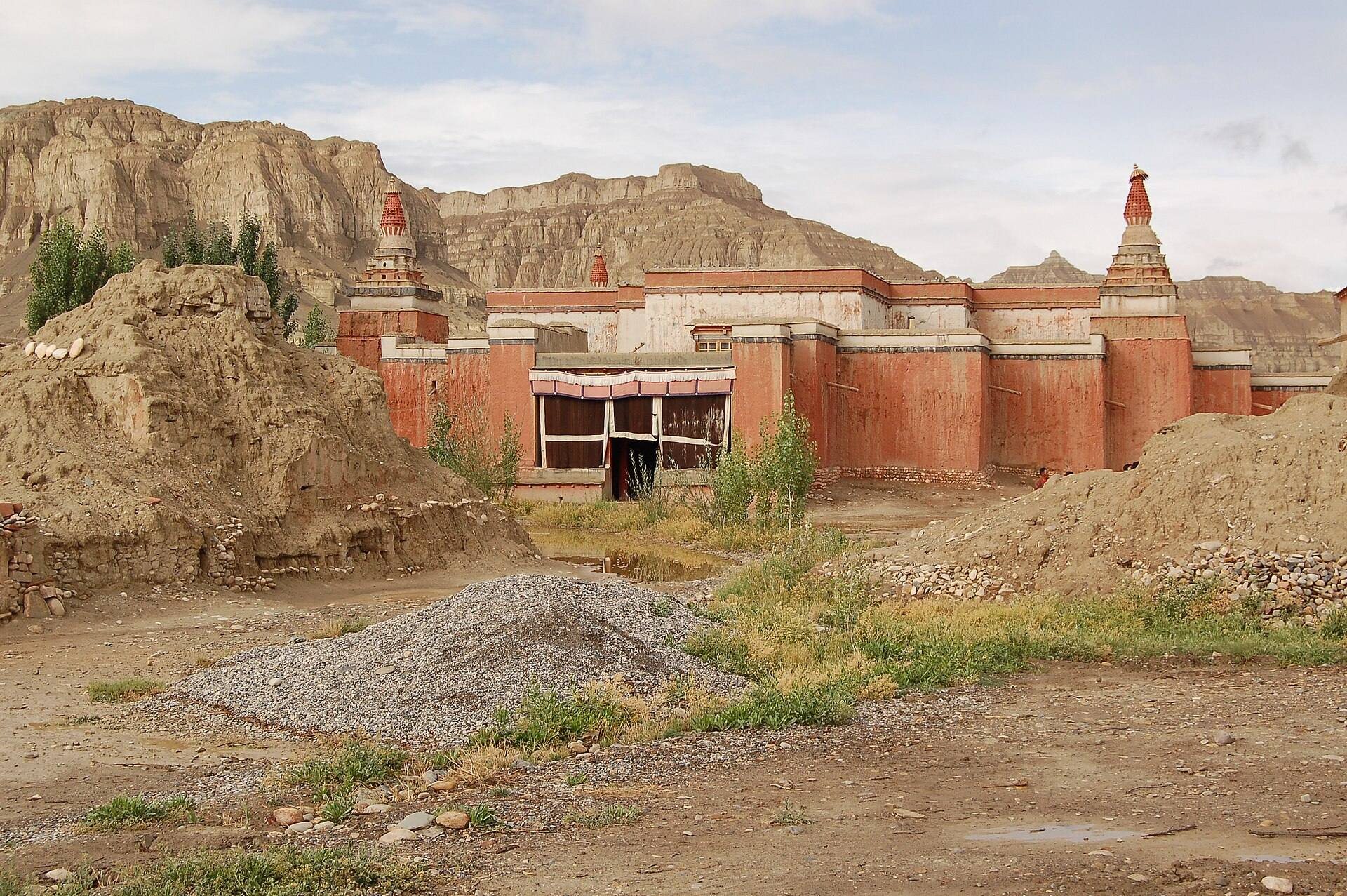
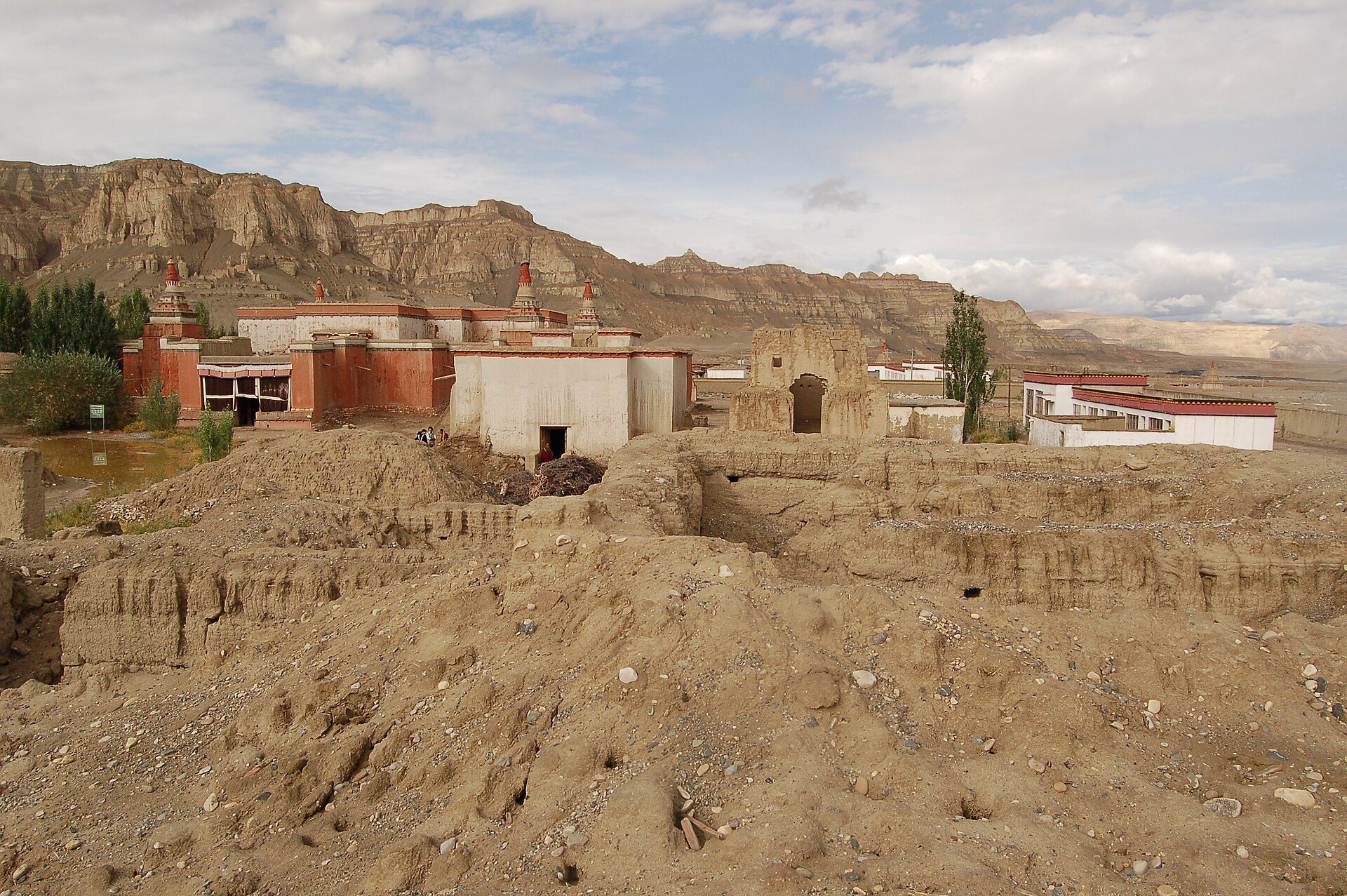
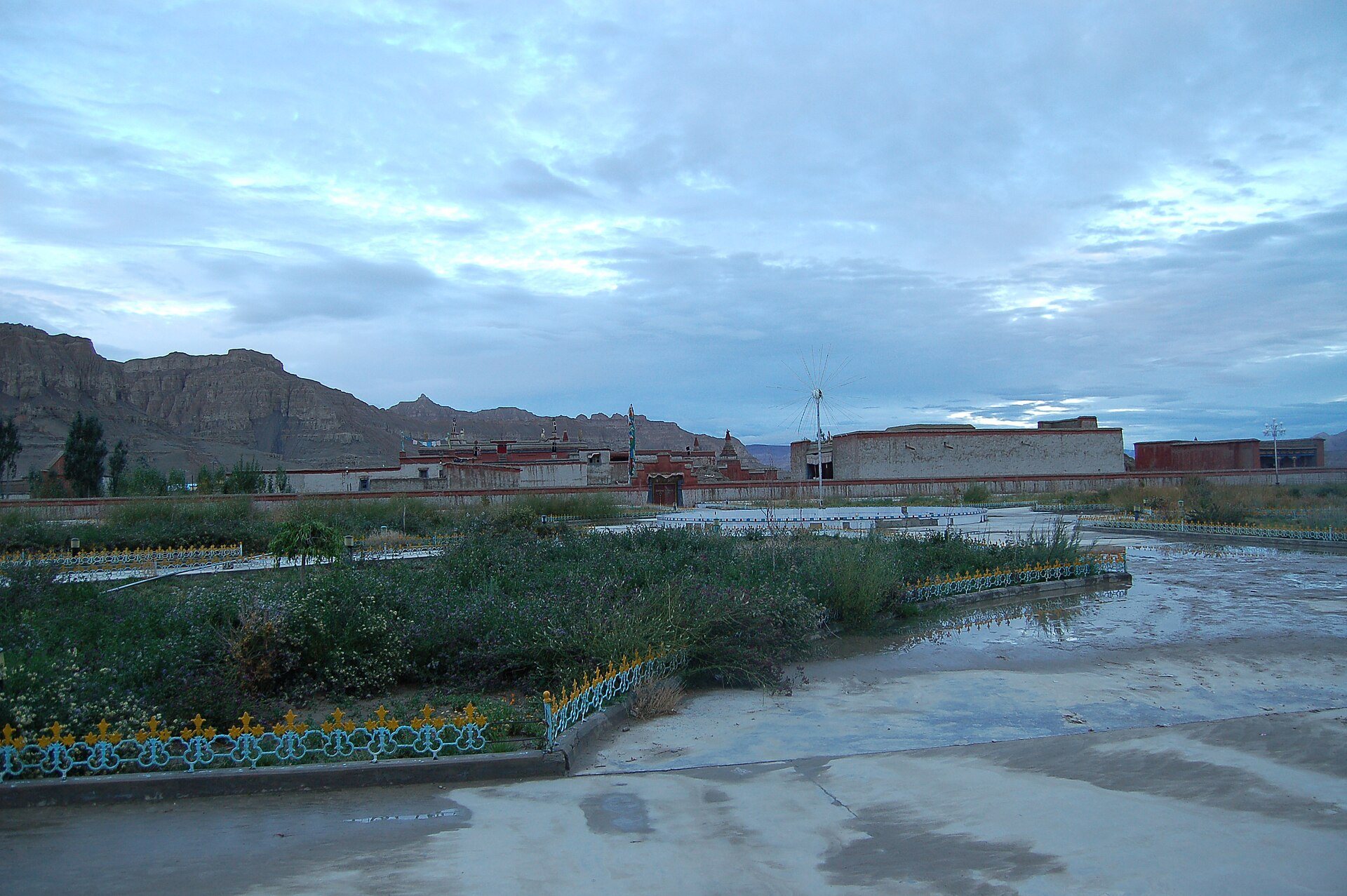
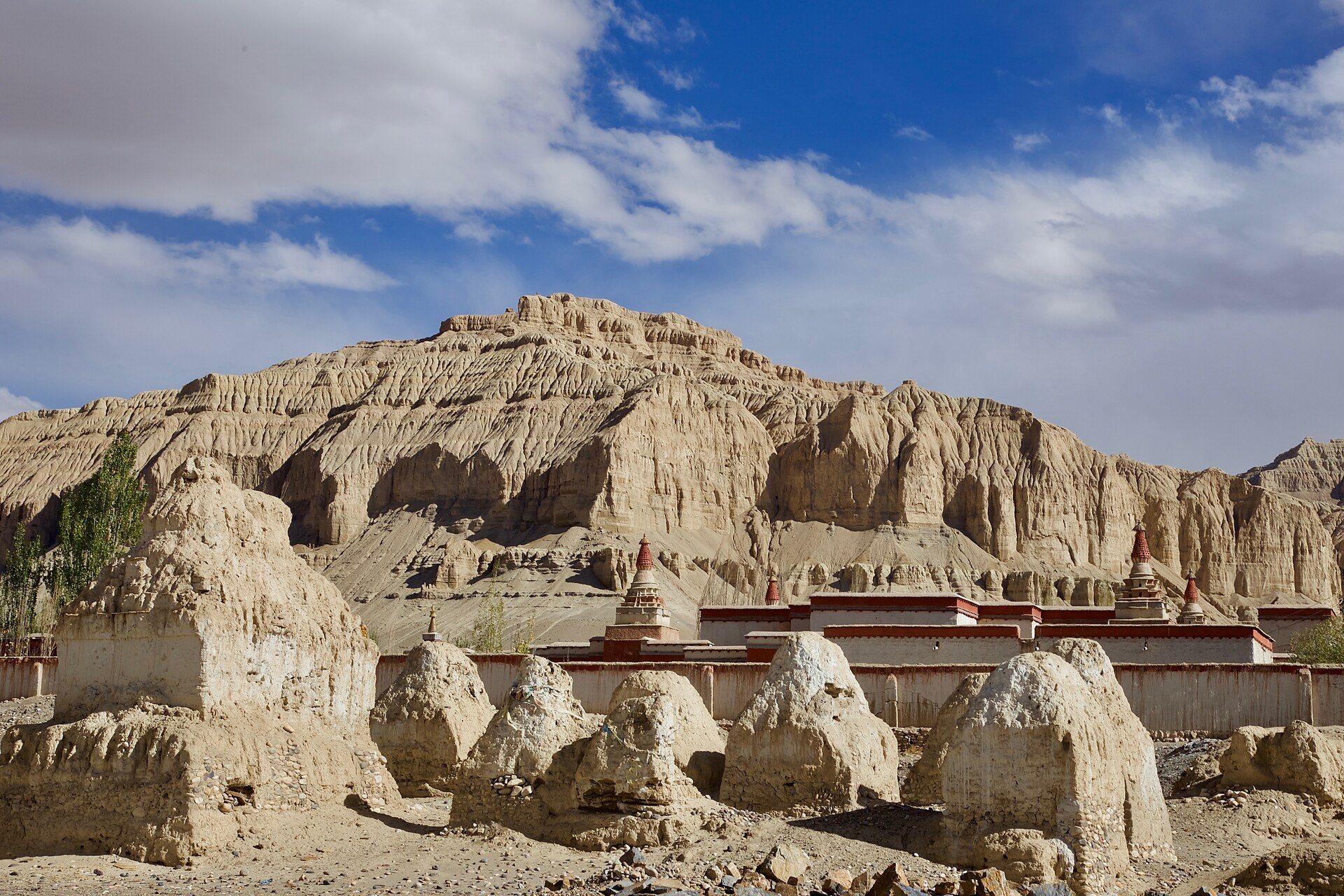
Toling occupies a walled complex of mainly rectangular mud-brick buildings arranged on an east-west axis. The monastery is narrow from north to south and elongated from east to west, with major buildings placed along both sides of the central alignment. Its eastward orientation, red-painted towers, corner stupas, mandala planning, painted chapels, and earthen construction became a model for later temples in the Guge Kingdom. The principal group includes the Gyatsa Temple, White Chapel, Great Bodhi Stupa, Arhat Chapel, Maitreya Chapel, Protector Chapel, Assembly Hall, Golden Chapel, Atisha Scripture Chapel, prayer-wheel room, abbatial residences, monks’ quarters, stupas, and reliquary monuments.
The Gyatsa Temple and Mandala Plan
Chapels and Inner Arrangement
The Gyatsa Temple, also called the Langba Langze Lhakhang, stands at the western end of the temple district and faces east. It contains more than 20 chapels and is traditionally called “the hundred places,” referring to its many sacred spaces. Its plan consists of inner and outer rings arranged as a mandala, a sacred geometric design representing Buddhist cosmological and ritual order, modeled on Samye Monastery. The central square chapel represents Mount Sumeru, groups of chapels represent the four continents, and four stupas outside the corners represent the Four Heavenly Kings.
The easternmost chapel is the Heavenly Kings Chapel, which forms the entrance. Immediately to its west, the Sakyamuni Chapel projects toward the entrance in a T-shaped plan. It has 12 columns, an interior area of 181 square meters, linear altars along its north and south walls, and 22 images, including 18 arhats. A T-shaped earthen platform at the west supports a mandala and an image of Sakyamuni beneath a roof opening. Its floor is substantially lower than those of the other chapels, and the chapel was rebuilt in a later period.
The four inner-ring chapels are dedicated to Akshobhya in the east, Ratnasambhava in the south, Amitabha in the west, and Amoghasiddhi in the north. At the center stands the square Vairocana Chapel, measuring 14 by 14 meters. It contains a mandala and an image of Vairocana and is surrounded by a corridor. The inner ring and central chapel form a cross-shaped arrangement.
Outer Chapels and Corner Towers
The outer ring contains 18 chapels dedicated to subjects including protector deities, Acharya, auspicious light, medicine, Avalokiteshvara, Tara, the five Buddhas, Palden Lhamo, Maitreya, Vajradhara, the Buddha Mother, Tsongkhapa, Amitayus, the Tengyur, the Kangyur, and Manjushri. The Kangyur is the collection of teachings attributed to the Buddha, while the Tengyur contains later Indian commentaries and treatises. The Medicine Chapel stands at the southern end, the Maitreya Chapel at the western end, and the Amitayus Chapel at the northern end.
Four small towers stand at the corners of the Gyatsa Temple’s outer ring. Each is about 13 meters high and built of red brick, with its base, shaft, and finial occupying roughly one-third of the total height. Four larger stupas stand on the ground outside the four corners and align with the towers. The Gyatsa Temple was reconstructed after damage during the Cultural Revolution in a mandala form. Its red doors and elaborate towers survive alongside images that suffered substantial damage.
Assembly Hall and White Chapel
Assembly Hall
The Assembly Hall, also called the Dukhang or Red Chapel, stands at the southeastern end of the monastery on the same axis as the Gyatsa Temple and faces east. A Dukhang is an assembly hall for communal monastic activities. The building contains a scripture hall, protector chapels, monks’ quarters, storerooms, and a kitchen. Its T-shaped plan is narrower in the west and broader in the east. The protector chapel measures five bays by four bays, while the scripture hall measures seven bays by four bays.
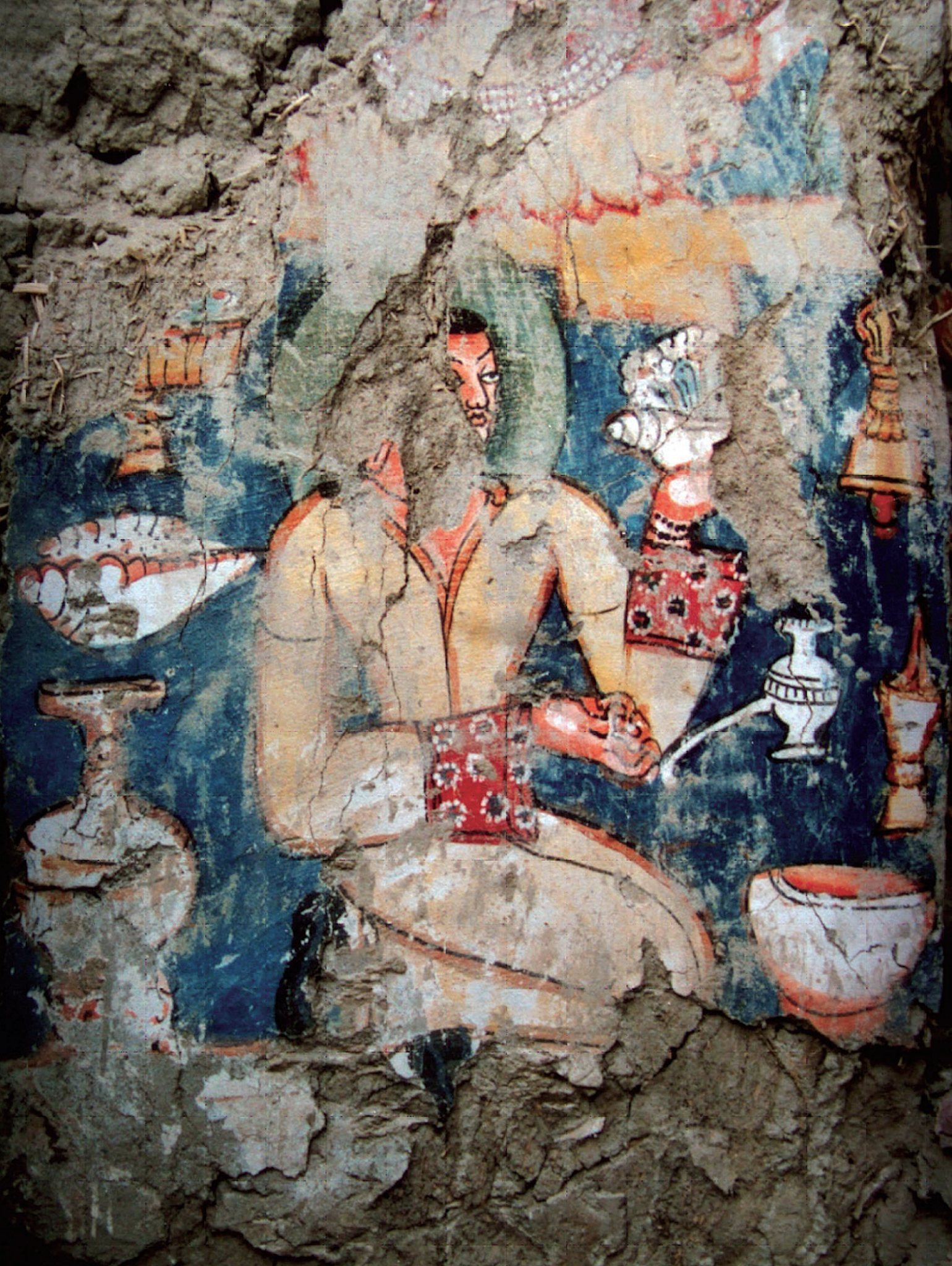
Murals and wall inscriptions in the Assembly Hall are comparatively well preserved. Portraits of Yeshe-O, Rinchen Zangpo, and Lhatsun Jangchub O appear among inscriptions describing Toling’s history. The single-story hall also contains fifteenth- and sixteenth-century paintings of important figures, deities, monks, and lamas, with clothing, textiles, and jewelry rendered in detail. Their styles combine Tibetan, Kashmiri, and Newari influences. Images of Dipankara, Sakyamuni, and Maitreya were rebuilt in the rear chamber.
White Chapel
The White Chapel, or Lhakhang Karpo, also called the Nuns’ Chapel, stands northeast of the Assembly Hall and faces south. A square main plan is extended by a small chapel projecting from the north side, producing an overall T-shaped form. The building contains 42 columns, a high ceiling supported by slender deodar-wood pillars, a cobblestone floor, and geometric ceiling decoration.
Fifteenth- and sixteenth-century murals remain inside the White Chapel, with male figures arranged on the right and female figures on the left. The paintings survived the Cultural Revolution comparatively well because the building was used as a grain store. It later served as a storage place for wood and stones.
Other Buildings and Sacred Monuments
Golden Chapel and Atisha Retreat Chapel
The Golden Chapel, or Serkhang, lies southeast behind the White Chapel. Its yellow walls identify it as the place where Rinchen Zangpo traditionally translated scriptures and practiced. To its right stands the Atisha Retreat Chapel, associated with the six years during which Atisha is said to have lived and practiced at Toling.
Stupas and Enclosing Wall
The Great Bodhi Stupa stands directly in front of the Gyatsa Temple. Its large stone-built base is coated externally with red clay, and tradition holds that it contains the ashes of Rinchen Zangpo. A strong enclosing wall surrounds the monastery. Eight stupas stand inside and outside its four corners, including the inner-corner Lhabap, Sangwa, Sengge, and Chabu stupas. Their bases and shafts are made of stone and brick.
A stupa field extends north of the monastery along the southern bank of the Xiangquan River. Tradition says that it once contained 108 stupas, while repeated flooding washed many away. Numerous stupas remain in the field. Together with the corner monuments, these structures form part of the monastery’s wider sacred landscape.
Chapels and Residential Buildings
Other named components include the Nyima Lhakhang, or Prayer-Wheel Chapel, the Acharya Chapel, the Neten Lhakhang, or Arhat Chapel, and the Protector Chapel. Abbatial residences and monks’ quarters, mostly built of earth and timber, extend in rows along the northern and southern sides of the temple group. Six chapels were said to stand at the monastery before the Cultural Revolution. The Neten Lhakhang and Tongy Chapel were destroyed, while the surviving complex retains many images and murals within a largely ruined setting.
Toling’s paintings and architectural decoration draw on Tibetan, Kashmiri, Newari, and Inner Asian artistic traditions. Western Tibetan murals, portraits, painted chapels, red-brick towers, mud-brick walls, corner stupas, and the mandala arrangement of the Gyatsa Temple preserve the monastery’s distinctive architectural and religious character.