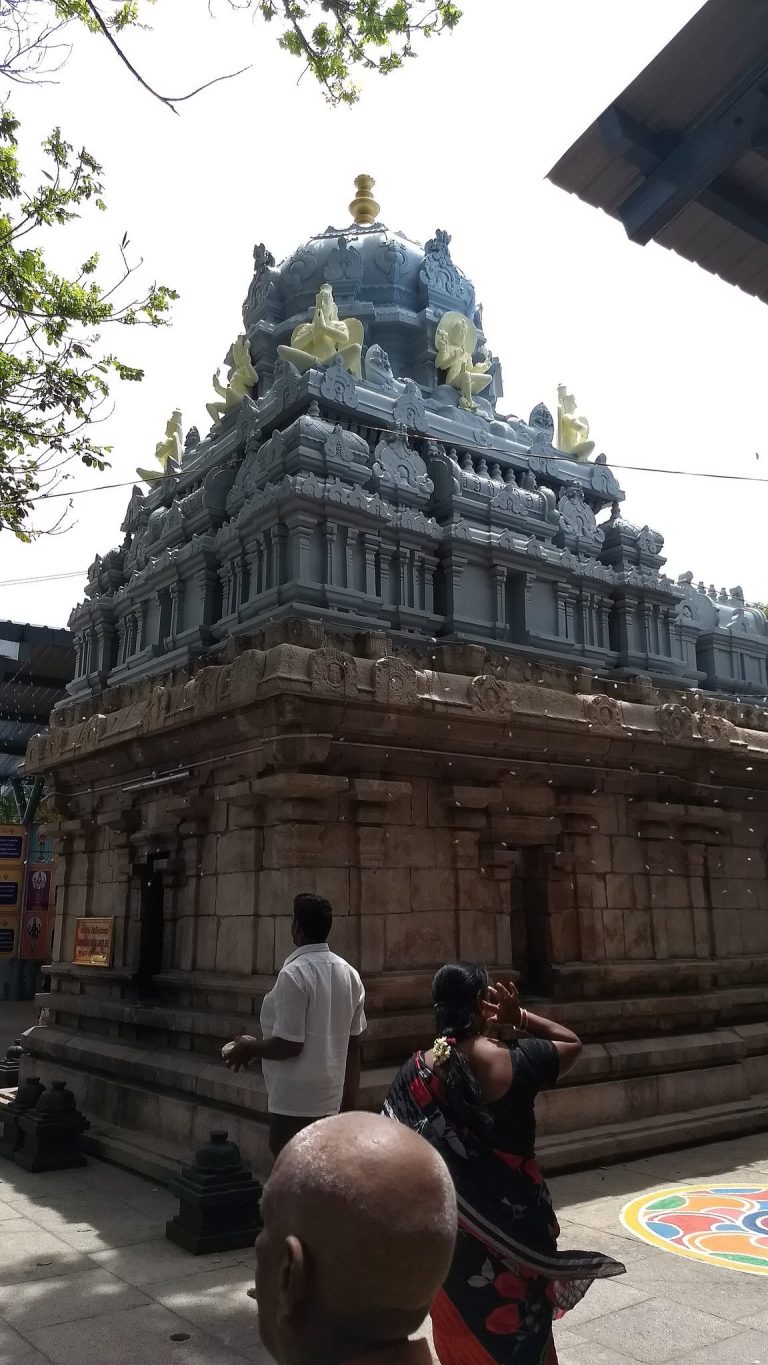
Tirumala Venkateswara Temple: A Dravidian Hindu Temple in India
Site at a Glance
- Rating
- 4.7
- Popularity
- Low
- Country
- India
- Primary era
- Medieval
- Eras represented
- Medieval, Early Modern, Modern
- Civilizations
- Unclassified
- Site type
- Religious
- Remains
- Temple
On this page19 sections
History
Tirumala Venkateswara Temple is a Hindu temple dedicated to Venkateswara, a form of Vishnu, at Tirumala in Andhra Pradesh, India. The shrine developed in the Dravidian tradition from around 300 CE and stands on Venkatadri, the seventh peak of the Seshachalam range. Hindu tradition holds that Vishnu manifested here to protect humanity during the Kali Yuga, the present age of spiritual decline, giving the site the names Kaliyuga Vaikuntha and Kaliyuga Pratyaksha Daivam.
Origins and sacred traditions
The temple is traditionally associated with the Tondaiman rulers. Tradition attributes an early gateway tower and enclosure to Tondaman in the eighth century, along with the inner enclosure and the Ananda Nilayam, the tower above the central sanctum. Another temple tradition says that Gopinatha Dikshita, a priest of the Vaikhanasa Agama tradition, found the image of Venkateswara in an anthill beneath a tamarind tree near Swami Pushkarini. He installed the image at the present location, and his descendants are traditionally said to have continued the shrine’s ritual service.
Tirumala is regarded as one of Vishnu’s eight Swayambhu Kshetras, meaning sacred places where the principal deity is believed to have appeared independently. It is also identified as the 106th and last terrestrial Divya Desam, one of the 108 Vishnu temples praised in the devotional hymns of the Alvars. Worship follows the Vaikhanasa Agama, a Vaishnava system governing temple ritual, services, and priestly duties.
Ramanujacharya, the eleventh- and twelfth-century theologian associated with Sri Vaishnavism, is traditionally said to have visited Tirupati three times. He is connected with the organization of worship according to Vaikhanasa practice, the introduction of recitations from the Naalayira Divya Prabandham, the establishment of the Tirupati Jeeyar institution in 1119, and the institutional supervision of temple service. Daily, weekly, and periodic observances include Suprabhata Seva, Thomala Seva, Archana, Kalyanotsavam, Dolotsavam, Brahmotsavam, Vasanthotsavam, Sahasra Deepalankarana, and Ekanta Seva.
Royal patronage and medieval expansion
The earliest recorded endowment identified in the temple’s history was made in 966 CE by the Pallava queen Samavai, the wife of King Shakti Vitankan. She gave jewels and two parcels of land measuring approximately 10 and 13 acres. Their revenue was assigned to the temple’s major festivals. Pallava, Chola, Pandya, Reddi, Yadava, and Vijayanagara rulers and officials later supported the shrine. Inscriptions from the ninth through fifteenth centuries record gifts and festival arrangements, while the temple’s wealth and large-scale expansion grew particularly under the Vijayanagara Empire.
Saluva Narasimha Raya built four mandapas, or pillared halls, at the corners of the Sampangi Pradakshina in 1470 and provided the platform of the Tirumalaraya, also called the Anna Unjal Mandapa, in 1473. Later Vijayanagara rulers enlarged the hall and conducted festivals there. Venkatapati Raya protected the temple during his rule from Chandragiri. Between 1320 and 1369, images from the Ranganathaswamy Temple at Srirangam were kept at Tirumala for safekeeping.
Krishnadevaraya, the major sixteenth-century emperor of the Vijayanagara Empire, visited the temple seven times between 1513 and 1521. His gifts of gold and jewels enabled the gilding of the Ananda Nilayam roof in 1517. On 2 January 1517, he installed his own image in the temple, and images of the emperor and his consorts remain within the complex.
After the decline of Vijayanagara, rulers of Mysore and Gadwal continued to visit and donate ornaments and valuables. The Maratha commander Raghoji I Bhonsle visited the shrine and established a permanent administrative arrangement for worship. Valuable jewels associated with his patronage were kept in a container named after him.
Colonial-era administration and modern management
Golconda took control of the temple in July 1656. A short period of French administration followed, and the Nawab of Carnatic then governed the shrine until 1801. Under Nawab Daud Khan, taxes were imposed on the temple to raise revenue for payments to the Nizam. This contributed to conflict involving Muslim and Maratha forces.
In the early nineteenth century, the East India Company assumed administrative control while granting the temple special status and avoiding interference in religious activities. Regulation VII of 1817 placed oversight under the Board of Revenue through the Collector of North Arcot. Rules drafted in 1821 became known as Bruce’s Code. In 1843, the Company transferred control of the temple and other Tirupati shrines to the mahants of Hathiramji Math. Six generations of mahants administered the temple before the establishment of Tirumala Tirupati Devasthanams under the TTD Act of 1933.
Later administration came under the Madras Hindu Religious and Charitable Endowment Act of 1951, the Andhra Pradesh Endowments Department in 1966, and the Tirumala Tirupati Devasthanams Act of 1979. Tirumala Tirupati Devasthanams continues to administer the temple under the control of the Andhra Pradesh government, with an executive officer appointed by that government. Its governing board grew from five members in 1951 to eighteen in 2015. Temple revenue and donations, much of it collected through the Srivari Hundi, support temple operations and charitable institutions.
Inscriptions, devotees, and festivals
Approximately 640 inscriptions in Kannada, Sanskrit, Tamil, and Telugu preserve information about the temple’s history. About 3,000 copper plates contain Telugu devotional compositions by Tallapaka Annamacharya and his descendants. Annamacharya, a fifteenth-century Telugu poet and composer, served as the temple’s official songmaster and is associated with approximately 32,000 devotional compositions. Ramanuja, Annamacharya, Hathiram Bhavaji, and Tarigonda Vengamamba are among the prominent devotees connected with the shrine. Hathiram Bhavaji is traditionally identified as an Ayodhya saint who came to Tirumala around 1500, while Vengamamba was an eighteenth-century poet and devotee associated with temple worship.
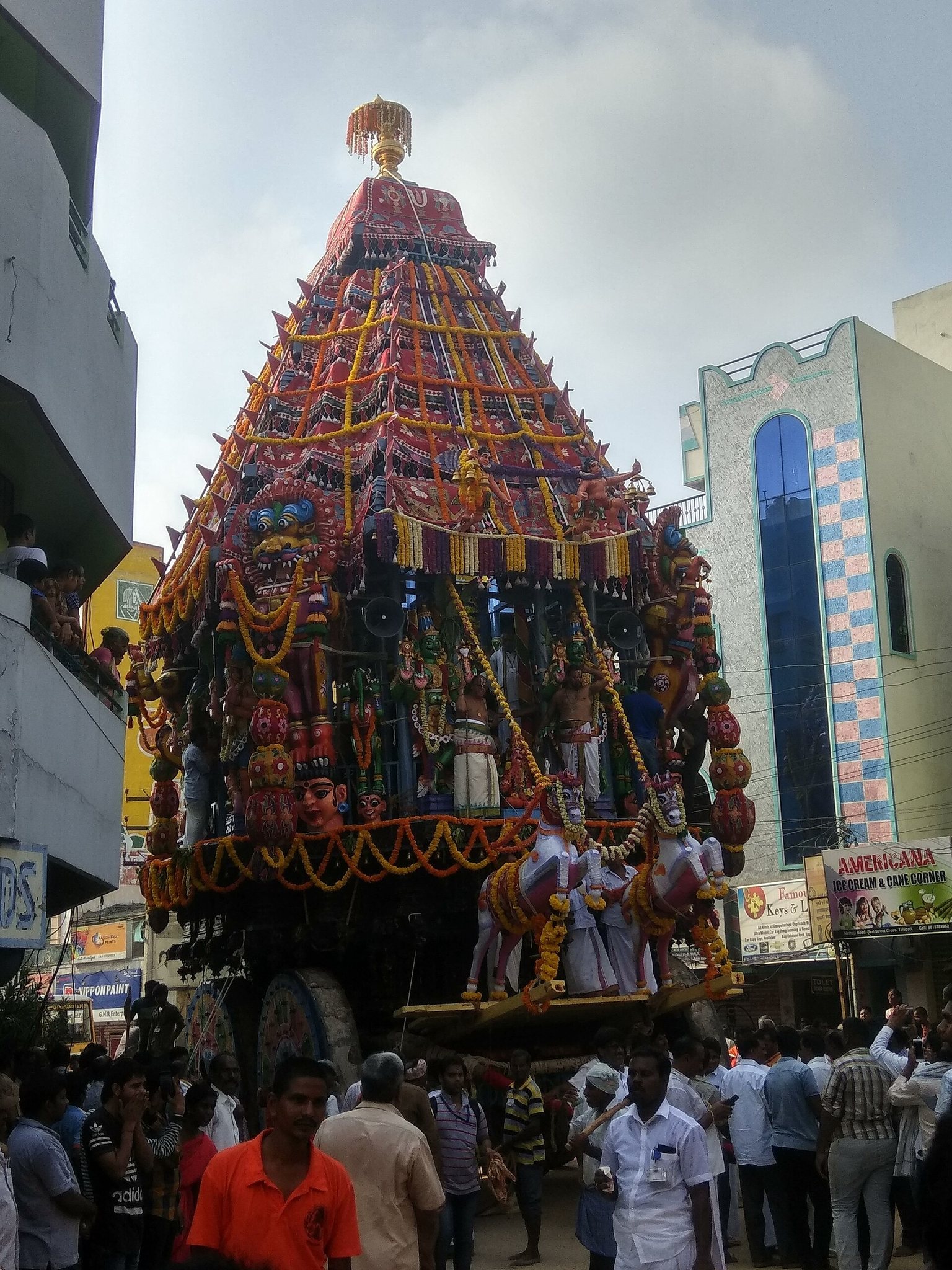
The nine-day Sri Venkateswara Brahmotsavam is the principal annual festival and is held in October. During it, the processional deity Malayappa Swami is carried with Sridevi and Bhudevi through the four Mada Streets on a succession of ritual vehicles. Other observances include Vaikunta Ekadashi, Ratha Saptami, Rama Navami, Janmashtami, Ugadi, Teppotsavam, Sri Padmavati Parinayotsavam, Pushpa Yagam, Pushpa Pallaki, and Vasanthotsavam. Temple tradition describes more than 433 festivals during the 365 days of the year.
Large numbers of pilgrims attend the temple each day, with especially large crowds during Brahmotsavam, Vaikunta Ekadashi, and other festivals. Queue complexes were constructed in 1983 and 2000. Religious practice includes hair tonsure, donations through the Hundi, and Thulabaram, in which offerings such as sugar, jaggery, tulsi leaves, bananas, gold, or coins are weighed against a devotee or child. The Tirupati Laddu is distributed as temple prasadam, food first offered to the deity and then given to worshippers. It has a geographical indication, and TTD alone is authorized to produce or sell it. The temple also provides free daily meals to pilgrims.
Puranic narratives
The temple is linked with several Puranic narratives. One tradition places Varaha, Vishnu’s boar incarnation, on the hill and explains the seven hills as the transformed body of Shesha, the cosmic serpent associated with Vishnu. Another story tells that Lakshmi left Vaikuntha after the sage Bhrigu struck Vishnu’s chest, after which Vishnu appeared as Srinivasa or Venkateswara.
In the principal Srinivasa legend, Vishnu comes to Tirumala in human form while seeking Lakshmi. A cow gives milk to him, and a cowherd injures him. The Chola ruler is cursed because of his servant’s action and is later reborn as Akasharaja, whose daughter Padmavati marries Srinivasa. Kubera is said to lend money for the wedding, providing the mythological basis for continuing Hundi donations. Other traditions identify Padmavati as a manifestation or rebirth of Lakshmi, while variant accounts call her Vedavati. In the legend, Srinivasa becomes a stone image when Lakshmi and Padmavati confront him, and both women remain with him eternally as divine images.
Remains
Mountain setting and enclosures
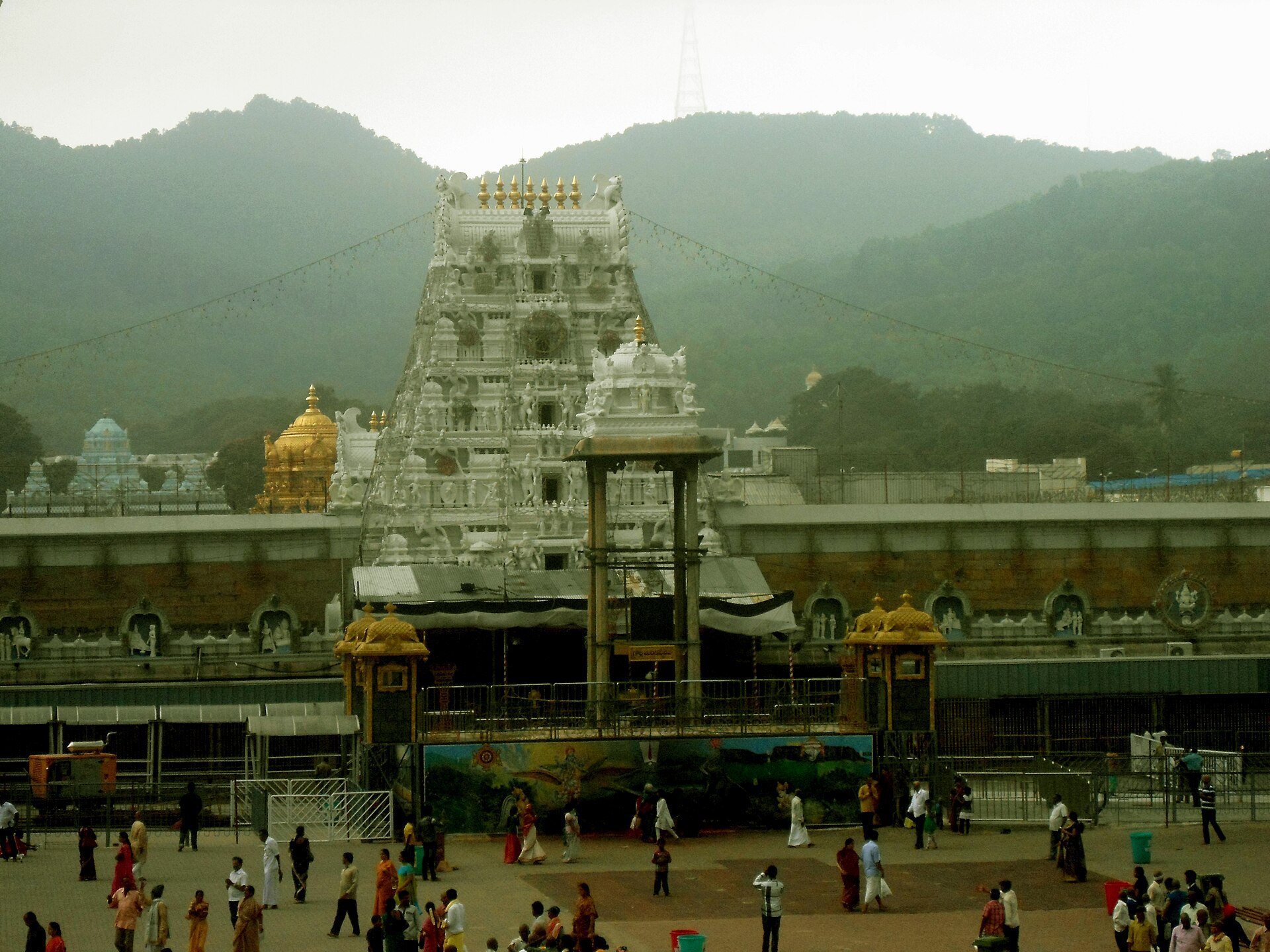
The temple stands on Venkatadri, about 853 metres above sea level, on the southern bank of Swami Pushkarini. Venkatadri is the seventh of the seven hills traditionally understood as the heads of Adisesha. The hills are named Vrishabhadri, Anjanadri, Neeladri, Garudadri or Garudachalam, Seshadri or Seshachalam, Narayanadri, and Venkatadri. Srivari Padalu, identified as the footprints of Venkateswara, are associated with Narayanadri.
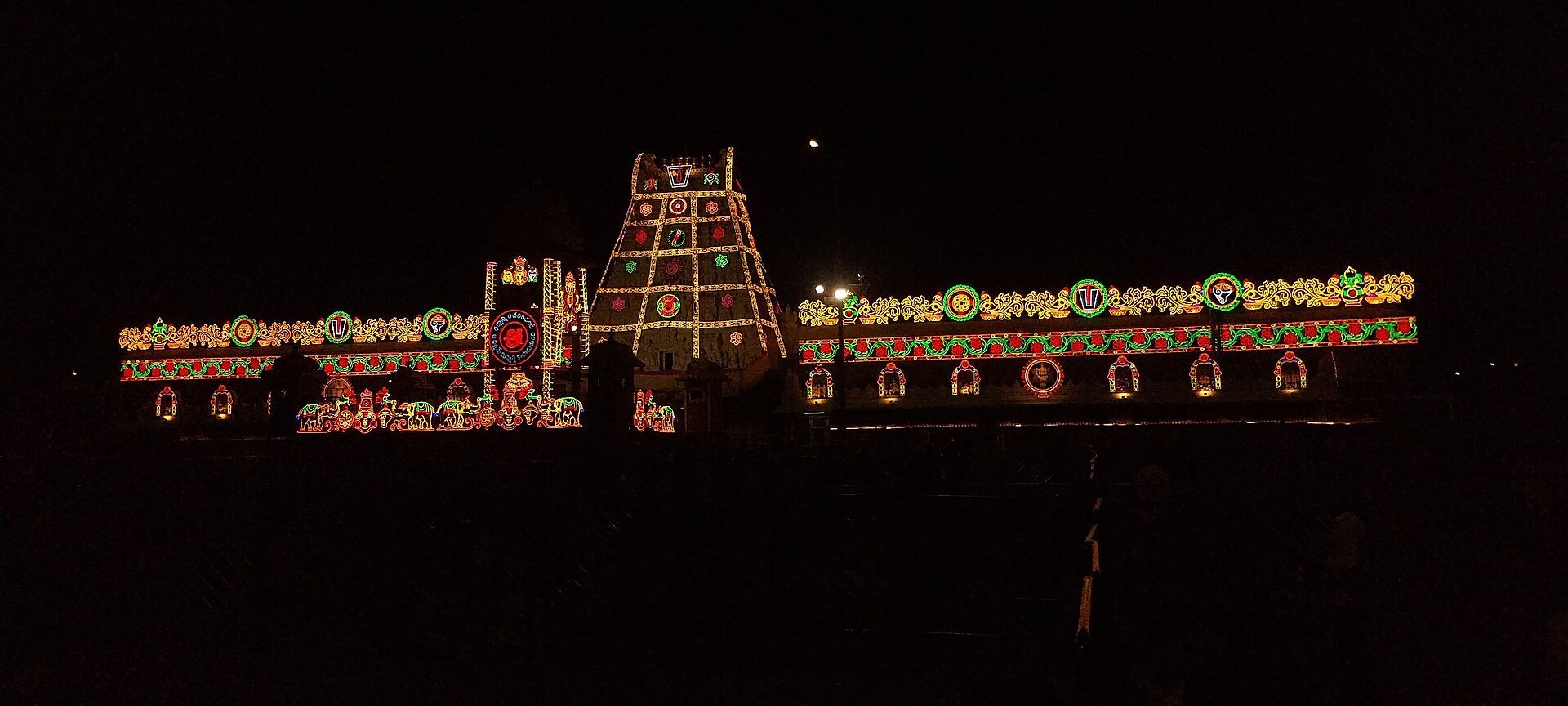
The complex follows the Dravidian architectural tradition and is organized through concentric enclosure walls and two principal circumambulatory routes. The Sampangi Pradakshina lies between the Maha Prakaram and the Sampangi Prakaram, while the Vimana Pradakshina circles the Ananda Nilayam Vimana. These enclosed areas contain halls, a flagstaff, a ritual offering platform, the Kshetrapalika stone, the main kitchen called the Potu, the Bangaru Bavi or Golden Well, the Yagashala, rooms associated with Parkamani, the Chandanapu Ara, the records repository, the Ramanuja shrine, storage rooms for processional vehicles, the Lord’s Hundi, and the seat of Vishvaksena.
Outer gateway
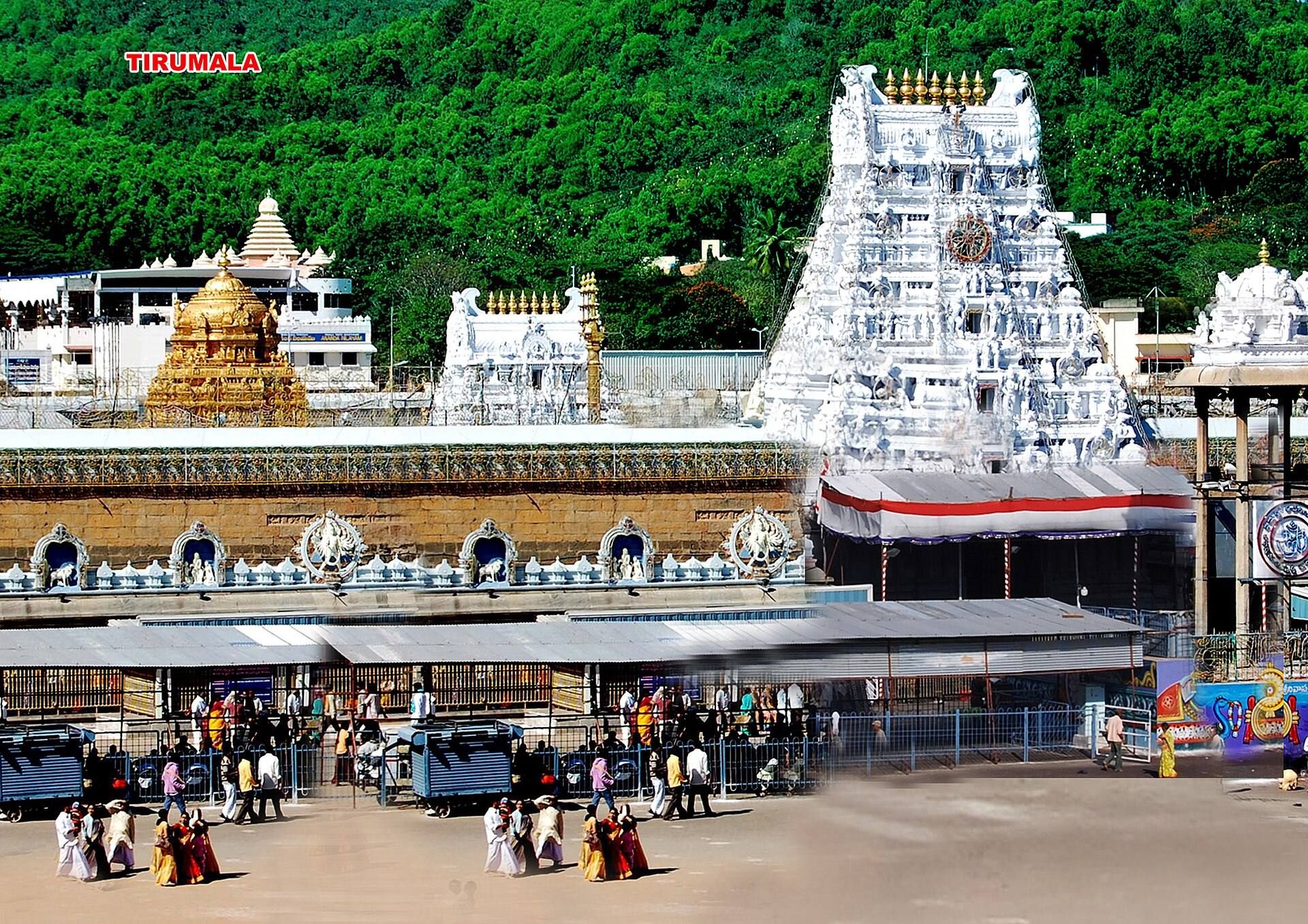
The Maha Dwaram, also called Padikavali, is the first entrance through the outer Maha Prakaram. Its five-storey gopuram, a monumental South Indian gateway tower, rises approximately 50 feet and is crowned by seven kalashas, or finials.
Silver and Golden Entrances
The second entrance is the Vendi Vakili, or Nadimipadikavali, a silver-plated gateway in the Sampangi Prakaram. Its three-storey gopuram has seven kalashas. Farther inward, the Bangaru Vakili or Golden Entrance leads toward the sanctum. Copper images of Jaya and Vijaya stand beside it, and gilt plates on the door depict the ten avatars of Vishnu.
Pillared halls
Named halls within the circumambulatory areas include the Pratima Mandapa, Ranga Mandapa, Tirumalaraya or Anna Unjal Mandapa, Saluva Narasimha Mandapas, Aina Mahal, and Dhvajasthamba Mandapa. The Tirumamani Mandapa is an open hall supported by sixteen pillars. Two large inscribed temple bells stand in its southwestern corner. Mallanna, also known as Madhavadasa and a chief of Chandragiri, built the hall in 1417. It is used for the daily audience of Koluvu Srinivasa. A Garuda shrine stands behind it facing the Bangaru Vakili.
Sanctum and ritual images
Ananda Nilayam and the central image
The central sanctum, or Garbhagriha, is called Ananda Nilayam. It contains the east-facing principal image of Venkateswara and is approximately square, with double walls. Its cut-stone walls may belong to the eighth or ninth century CE, while inscriptions on the outer wall date from approximately 966 to 1013 CE.
The Ananda Nilayam Vimana, the superstructure above the sanctum, is a gold-covered, three-storey tower crowned by a single kalasha and decorated with images of deities. Its gilding is associated with renovations around the thirteenth century. The Pandya ruler Jatavarman Sundara I installed a gold-plated kalasha around 1262. The tower was renovated again during the 1950s and 1960s, and Vimana Venkateswara is carved on the northwest corner of its second tier.
The principal image is a standing, four-armed figure on a lotus base. Two hands hold the conch and discus, one forms the Varada gesture, and the other rests on the thigh or is held in the Kati position. Lakshmi appears on the chest as Vyuha Lakshmi. Temple descriptions place Lakshmi on the right side of the chest and Padmavati on the left.
Pancha Berams
The temple represents Venkateswara through five ritual forms known as the Pancha Berams. They are the Dhruva Beram or Mula Beram, the permanent principal image; Kautuka Beram or Bhoga Srinivasa, the service image; Snapana Beram or Ugra Srinivasa, the bathing image; Utsava Beram or Malayappa Swami, the processional image; and Bali Beram or Koluvu Srinivasa, the image associated with offerings and temple administration.
Bhoga Srinivasa is a silver image approximately one foot high and is attributed to a donation by Pallava queen Samavai in 614 CE. Ugra Srinivasa is taken out only once a year before sunrise on Kaishika Dvadasi. Malayappa Swami is accompanied by Sridevi and Bhudevi. Koluvu Srinivasa oversees ritual and financial reporting. The sanctum also contains panchaloha images, cast from five metals, of Sita, Rama, Lakshmana, Rukmini, Krishna, and Chakrathalvar. Other images and shrines honor Garuda, Narasimha, Varadaraja, Kubera, Hanuman, Shesha, Vishvaksena, Sugriva, and Ramanuja.
Swami Pushkarini and surrounding shrines
Swami Pushkarini
Swami Pushkarini is the sacred temple tank on the northern side of the main shrine. It covers more than 1.5 acres and is traditionally believed to have been brought from Vaikuntha by Garuda. Saluva Narasimha Raya built a mandapa at its center in 1468. The annual Teppotsavam is held on the tank, and it is used for the ceremonial Chakrasnanam at the conclusion of Srivari Brahmotsavam.
Associated shrines
The Bhuvaraha Swamy shrine stands on the northern bank of Swami Pushkarini and is traditionally considered older than the Venkateswara Temple. Ritual practice places offerings and darshan there before worship at the main shrine. The Varadaraja, Yoga Narasimha, Garuthmantha, Bedi-Anjaneya, Vakulamatha, Kubera, and Ramanuja shrines occupy other positions around the main temple.
Akhilandam
Akhilandam lies in front of the main temple. It contains large lamps, a continuously maintained camphor flame, and metal stands where devotees break coconuts as offerings.
Processional and service facilities
The complex includes the four Mada Streets used for processions, the two modern Vaikuntam Queue Complexes built in 1983 and 2000, the Tarigonda Vengamamba Annaprasadam Complex, hair-tonsure facilities, and multiple pilgrim lodging facilities. These structures form part of the wider temple organization surrounding the historic shrine and its ritual spaces.