Thirlwall Castle: A Twelfth-Century Castle in Northumberland


Site at a Glance
- Rating
- 4.3
- Popularity
- Low
- Country
- United Kingdom
- Primary era
- Medieval
- External website
- Open
- Eras represented
- Medieval
- Civilizations
- English
- Site type
- Military
- Remains
- Castle
On this page5 sections
History
Thirlwall Castle is a twelfth-century medieval castle in the United Kingdom, near Greenhead in Northumberland. It became the home of the Thirlwall family and was later strengthened with stone taken from nearby Hadrian’s Wall, the Roman frontier barrier built across northern Britain. The name combines the Middle English word thirl, meaning a perforation or passage, with “wall,” reflecting the castle’s connection with the Roman structure and its reused stone.
Medieval Thirlwall
John Thirlwall fortified the castle around 1330. The family’s association with the site continued into the late fifteenth century, when Sir Percival Thirlwall served as a Yorkist standard-bearer. At the Battle of Bosworth on 22 August 1485, the decisive engagement of the Wars of the Roses between Richard III and Henry Tudor, he was killed while carrying Richard’s standard during the final charge.
Later ownership and decline
A survey made in 1542 listed the castle as belonging to Robert Thirlwall and described it as being in a “measurable good” state of repair. It began to fall into disrepair during the seventeenth century. Eleanor Thirlwall, the last member of the family line, abandoned the castle as a residence after marrying Matthew Swinburne of Capheaton Hall in 1738. The estate consequently passed to the Swinburne family, which sold it to the Earl of Carlisle for £4,000 in 1748.
Major masonry collapses took place in 1832 and again in 1982. In 1999, the Northumberland National Park Authority took over management of the castle to protect it from further dereliction. Thirlwall Castle is protected as a Grade I listed building, the highest category of listed-building protection in England, and as a Scheduled Monument, a nationally protected archaeological or historic site.
Remains
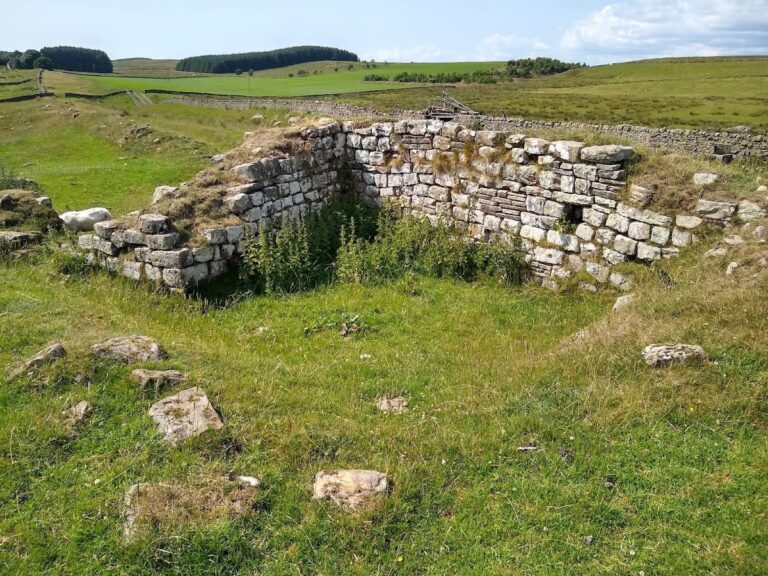
Thirlwall Castle stands on the bank of the River Tipalt in an east-west valley, at an elevation of about 142 metres. It lies approximately 20 miles (32 kilometres) west of Hexham. The surrounding landscape is chiefly grassland, with relatively flat ground to the northwest and hillier terrain to the southeast. The highest nearby ground reaches about 244 metres and is approximately 1.3 kilometres east of the castle.
Castle fabric and survival
The castle is a twelfth-century stone structure that was later reinforced with building material taken from nearby Hadrian’s Wall. Its surviving fabric is ruinous, reflecting the masonry collapses recorded in 1832 and 1982. The reused Roman stone forms part of the physical relationship between the medieval castle and the earlier frontier barrier.
Nearby sites