Thāj: A Fortified Caravan City in Saudi Arabia
Site at a Glance
- Popularity
- High
- Country
- Saudi Arabia
- Primary era
- Classical
- Eras represented
- Classical, Medieval
- Civilizations
- Unclassified
- Site type
- Settlement
- Remains
- City
On this page12 sections
History
Thāj is an ancient urban settlement in Saudi Arabia, generally dated to the third century BCE and flourishing around 215-208 BCE during the Hellenistic period, the centuries after Alexander the Great’s campaigns when Greek cultural influence spread across the Near East. It became an important caravan stop, where travellers could obtain water.
Early settlement and trade
Evidence from Thāj has been interpreted as indicating settlement before 600 BCE. A 1983 excavation proposed a settlement span of about 300 BCE to 300 CE. The surrounding region was connected to trade during the Hellenistic, Parthian, and Sasanian periods, the latter two ruled by successive Iranian empires. Thāj stood on a caravan route running south through al-Yamāmah, al-Aflāj, Wādī al-Dawāsir, al-Fāw, and Najrān. Investigations of nearby marshes between 2000 and 2006 identified them as a source of salt for export.
Thāj’s identification as Gerrha, an ancient trading city whose precise location in northeastern Arabia remains uncertain, is a notable but unconfirmed proposal. Its scale, position on a trade route, archaeological remains, Hasaitic inscriptions, and coins minted by local rulers have been cited in support. Hasaitic refers to an ancient writing culture associated with al-Aḥsā and eastern Arabia. Another proposal identifies Thāj with Phigeia, a place-name on the second-century CE map of the Greek-Roman geographer Ptolemy. This suggestion rests on the proposed location and similarities in local speech.
Late antiquity and the early Islamic period
A castle was built at Thāj in the late sixth century CE by Rāshid ibn Shihāb al-Yashkurī. Before 600, the settlement was an influential centre for the Bakr ibn Wā’il, an Arab tribal confederation. Thāj continued to function as a recognized city under the Umayyads, the dynasty that ruled the early Islamic caliphate. The poets Dhū al-Rummah and al-Farazdaq referred to it. In 691, Mālik ibn Misma took refuge there after fighting against the Umayyad caliph ʿAbd al-Malik ibn Marwān.
Some inhabitants who remained at Thāj accepted Islam during the seventh century. Broken figurines found at the settlement have also been interpreted as evidence of its importance in the early Islamic period and of its inhabitants’ adoption of Islam.
Medieval settlement and later records
Geographers of the tenth and eleventh centuries described Thāj as a watering place and village in al-Baḥrayn, the historic region of eastern Arabia. In the thirteenth century, Yāqūt al-Ḥamawī described it as a spring and village several days’ journey from al-Baḥrayn. The settlement continued to serve caravan traffic.
European records mention Thāj in the eighteenth century in connection with a military confrontation between Saudi forces and Ali Pasha of Baghdad, the Ottoman governor. In 1823, Mengin described it as a village in Najd; in 1865, British official Lewis Pelly regarded it as a major town of al-Aḥsā.
Exploration and archaeological work
Captain W. H. Shakespeare was the first European visitor identified at Thāj. He found two South Arabian funerary inscriptions, then the first examples of their kind known from northern Arabia. A further visit in 1942 produced a description and notes, and another inscription was recorded. An inscription identified in 1958 used a form also found on al-Aḥsā funerary markers.
Archaeological investigations began in the mid-twentieth century. A Danish mission led by Geoffrey Bibby excavated a small area in 1968, followed by a Saudi government survey in 1976, a Harvard-Saudi team in 1977, and an inspection by Daniel Potts’s team in 1982. In 1983, a Saudi-British team led by Mohammed Saleh Qazdar excavated for 85 days and proposed cultural links with South Arabia and the Hellenistic world. Department excavations in 1984 distinguished five settlement phases. Work led by Abdulhameed al-Hashash from 2000 to 2006 examined the surrounding marshes; radiocarbon results suggested settlement before 600 BCE. The antiquities authorities later fenced the site and placed it under guard.
Remains
Thāj occupies a shallow valley that slopes gently north. The ancient settlement comprised a walled city, suburbs, and an extensive cemetery. Within the city, residential mounds are separated by passages about five to six metres wide.
City enclosure and oasis
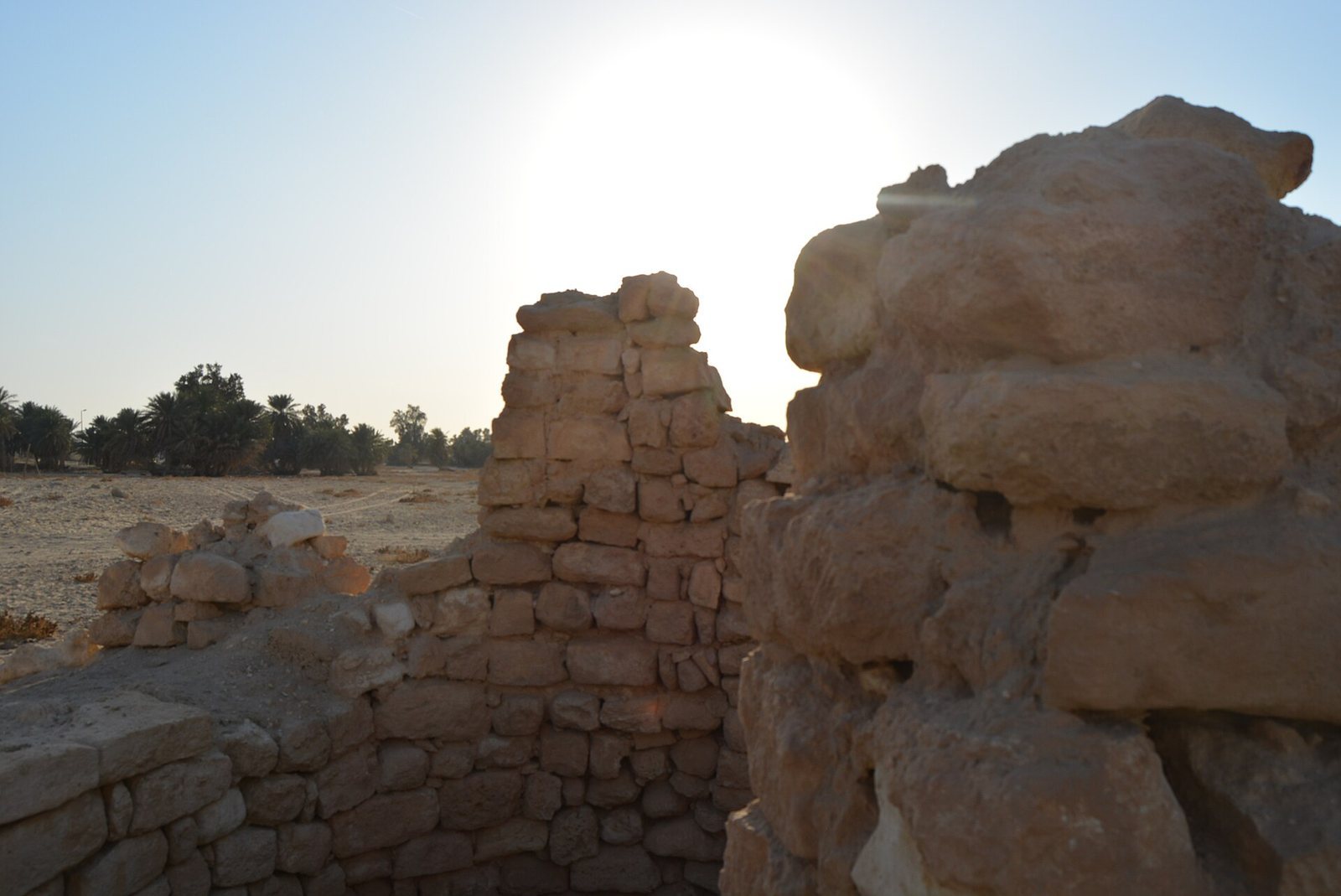
A stone wall enclosed the city. It is described as 2,535 metres long, with surviving sections up to 2.3 metres wide. Buildings of black mud brick also survive. In 1865, Lewis Pelly described the town as reportedly built of white stone and gave its extent as about one mile by half a mile. The oasis contains ancient palm groves and more than twenty old wells, twelve of them still active. A pottery kiln at Thāj has been described as the oldest discovered in Saudi Arabia’s Eastern Province.
Cemetery and burials
Burial mounds and stone graves
More than a thousand tombs lie west, south, and east of the city. Some burial mounds are ring-shaped, reaching up to 50 metres across and enclosing a hollow centre. Other graves have protruding capstones or small stone-lined chambers, some plastered inside. Erosion and grave robbing have exposed examples of these structures.
The richly furnished child’s grave
A grave tentatively dated to the first or second century CE contained the remains of a young girl and a rich group of burial goods. These included a gold funerary mask and glove, jewellery, and a statuette in the Greco-Roman style. The quantity of gold has prompted the suggestion that the child may have been a princess, though that identification is uncertain. The objects were exhibited at the Louvre in 2010.
Inscriptions and burial vessels
Two large transport jars found with burials outside the city carry inscriptions in different scripts. One uses Aramaic, widely used in the ancient Near East; the other bears South Arabian cursive writing, called zabūr. Together, they support the view that the two writing systems were used concurrently in eastern Arabia. The cursive inscription is the earliest known example of its script in the heartland of Hasaitic writing culture. Hasaitic-inscribed tombstones have also been found at Thāj.
Other archaeological finds
Finds from the settlement include bronze coins, pottery, Bronze Age arrowheads, and two pieces of pottery from the Seleucid period, when the Seleucid dynasty ruled much of the Near East after the division of Alexander’s empire. Animal and human figurines have also been recovered; many were found near the surface, and some are broken. Carvings, wall reliefs, and jewellery are among the other finds. Some objects from Thāj are held by the British Museum.