Sviatohirsk Lavra: An Orthodox Monastery in Ukraine
Site at a Glance
- Popularity
- Very High
- Country
- Ukraine
- Primary era
- Modern
- Eras represented
- Medieval, Modern
- Civilizations
- Russian
- Site type
- Religious
- Remains
- Monastery
On this page18 sections
History
The Sviatohirsk Lavra is an Orthodox monastery in Sviatohirsk, Ukraine, beside the Siverskyi Donets River. Tradition places its first monastic community in the 14th or 15th century, though claims of a monastery before the Mongol invasion remain uncertain. The complex later became a frontier outpost, a large pilgrimage center, and the focus of a distinctive community of churches and cave sanctuaries.
Early traditions and a frontier monastery
The Holy Mountains were mentioned in 1526, and written references to the monastery appear in the 1620s, including a land charter from 1624. Earlier origins are linked to several traditions. One places Christian communities in the area before the Mongol invasion; another says that Christians fleeing the forces of Batu Khan, the Mongol ruler whose campaigns reached the medieval Rus principalities, took refuge in the caves. The Ipatiev Chronicle relates that local Christians met Vladimir Monomakh, Grand Prince of Kyiv, there in 1111. A separate tradition says that Byzantine missionaries Cyril and Methodius preached to the Khazars, a Turkic people with a medieval polity north of the Caucasus and Caspian Sea, in the mid-9th century.
In 1578, the Italian traveler Alessandro Guagnini recounted a claim that the Holy Mountains contained ancient pagan images and pillars. During the 16th and 17th centuries, the monastery served as a frontier outpost near the Tatar steppe and Catholic Poland. Monks came from the Pochaiv Lavra after some communities there entered the Union with Rome, an ecclesiastical union with the Roman Catholic Church. Moscow, which became the Tsardom of Russia in 1547, stationed guards at the monastery. Cossack colonel Ivan Bohun tried several times to drive them out and refused to swear allegiance to the Moscow tsar after the Pereiaslav Council of 1654.
The monastery lay within the Izium Regiment, a Cossack military and territorial unit, until 1764. Its setting among river, forest, and steep hills helped it withstand Crimean Tatar attacks in 1664, 1679, 1680, 1691, and 1737; it was repaired after each assault. By the second half of the 18th century, the community had become chiefly agricultural. The Russian Empire’s annexation of Crimea in 1788 further reduced the monastery’s military importance.
Closure and revival
Catherine II ordered the monastery closed in 1787, and its land and property were confiscated. Grigory Potemkin became owner of the Holy Mountains in 1790. The Dormition and St Nicholas churches became parish churches, while the other monastic churches were dismantled and removed. The monastery remained closed for almost 57 years.
It reopened in 1844 after landowner Tatiana Potemkina petitioned Emperor Nicholas I. The renewed community followed the shared communal rule of the Glinsk Hermitage in the Kursk region. Alexandr Mikhailovich Potemkin and his wife Tatiana also financed restoration. The monastery developed brickmaking, mills, workshops, and shops, and attracted many pilgrims. Before the First World War it housed about 600 monks. Amid persecution and plundering in 1918, the monastic population fell from 700 to 200.
Until 1918, the community was known as the Sviatohirsk Dormition Monastery. It was a communal monastery in the Kharkiv Diocese, an ecclesiastical territory administered by a bishop. Its affiliated small monastic settlements, or sketes, included the Spasov Skete at Borki, the cave retreat of Arseniev, and the Akhtyrka hospital skete. Several churches later formed part of the monastery’s extensive building history, including its principal Dormition church.
Soviet rule and the return of monastic life
Plundering and desecration began after Bolshevik rule took hold in 1917. The monastery closed in 1922, and its grounds became the Artem sanatorium and a workers’ rest home; the Dormition Cathedral was used as a cinema. The Transfiguration, All Saints, and Peter and Paul churches were demolished during the Soviet period. The area was renamed the Red Mountains, and the town became Slavianskogorsk. From 1926 to 1931, Abbot Ioann (Streltsov) led the remaining brotherhood at the All Saints cemetery church.
The ensemble was declared a State Historical and Architectural Reserve in 1980. The first service after Ukrainian independence took place at the former sanatorium on 27 September 1991, in Ukrainian, through the initiative of the Andrew the First-Called brotherhoods of Kharkiv and Sloviansk. The monastery reopened in 1992, with the priest-monk Serafim Lavrik and four novices from Donetsk as its first residents. Restoration and rebuilding of churches and monastic buildings began in 1995. The Holy Mountains National Nature Park, with the monastery as its centerpiece, was established in 1997.
In 2003, residential and service buildings previously administered by the Slovianskogorsk Historical and Architectural Reserve and the Holy Mountains sanatorium were transferred to the monastery. In 2004, a council of church leaders granted it the title of lavra, an honorific for a prominent Orthodox monastery. The complex is also designated an immovable monument of national significance in Ukraine. Since the 2007 division of the Donetsk Diocese, it has been assigned to that diocese despite lying within the Horlivka Diocese’s territory. In 2023, the church council placed it directly under Metropolitan Onufriy as a stavropegial monastery, meaning it answers to a senior church authority rather than a local diocese.
Seventeen monks associated with the monastery were later glorified as saints. John the Recluse of Sviatohirsk was glorified in 1995. In 2008, a service in the Dormition Cathedral proclaimed a group of Sviatohirsk saints after church leaders approved the canonization of 16 more monks. In 2009, the brotherhood discovered the relics of Arseniy Mitrofanov, the first abbot after the 1844 reopening, and the monk Isaac Golovin.
War and cultural memory
The monastery sheltered 800 people evacuated from the conflict zone in 2014, including 300 children, and civilians during Russia’s 2022 invasion of Ukraine. An explosion near the complex on 12 March 2022 damaged buildings and injured people while hundreds of refugees were present. Shelling on 4 May injured seven people. Attacks in May and June damaged or destroyed affiliated churches and sketes. On 30 May, three members of the monastic community, a dean, a monk, and a nun, were killed, and three monks were injured. Cell buildings were shelled on 30 May and 1 June. The main church of the All Saints Skete burned on 4 June, while responsibility for the fire was disputed. The bridge across the river leading to the monastery was destroyed on 6 June.
Russian forces occupied Sviatohirsk from June to September 2022. The monastery, on the opposite riverbank, remained under Ukrainian control and continued to be shelled. The Lavra also entered Ukrainian and Russian literary culture: Anton Chekhov set “The Tumbleweed” there, and Ivan Bunin described it in “Holy Mountains.” Fyodor Tyutchev wrote a poem of the same title, while Vasily Nemirovich-Danchenko and Oleksandr Bilyk also wrote works about the monastery.
Remains
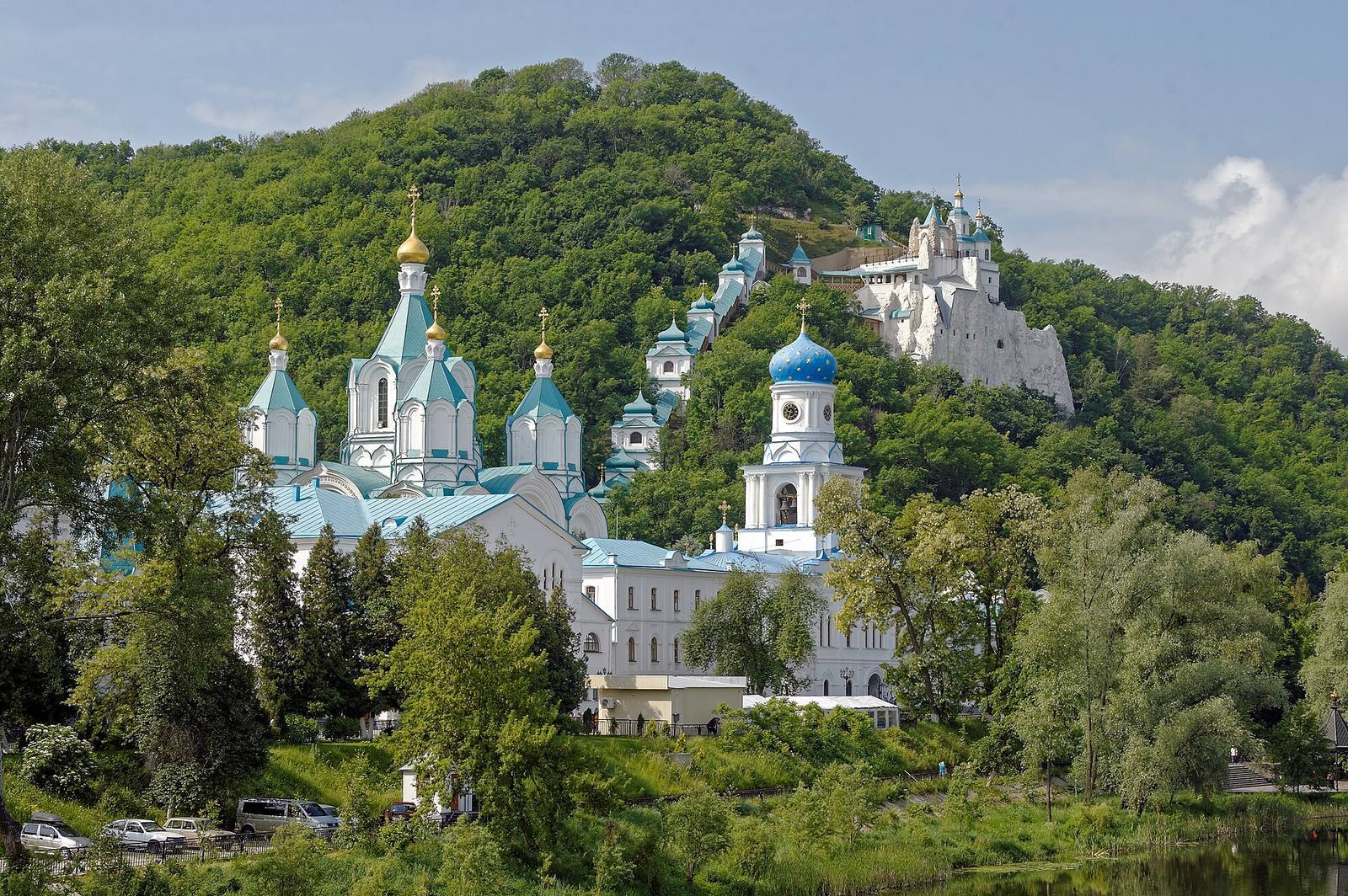
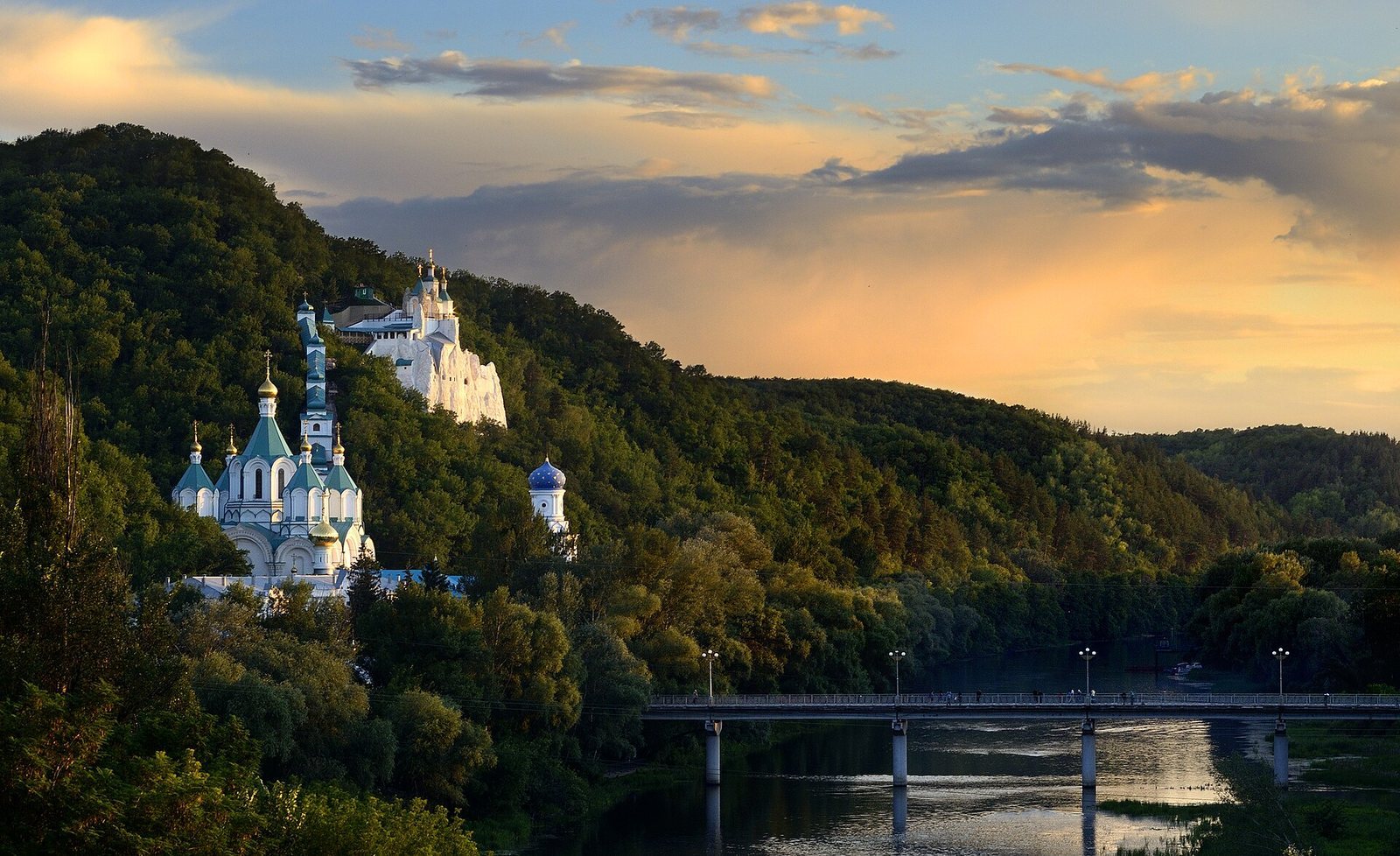
The monastery occupies a high, steep chalk bank on the right side of the Siverskyi Donets River, amid the wooded Holy Mountains. Its ensemble combines buildings above ground with a multilevel network of caves cut into the chalk. The surviving group includes cliffside churches, the Dormition Cathedral and Pokrov Church, chapels, and affiliated sketes.
Caves in the chalk cliffs
Cave cells and underground churches
The cave passages extend through several levels, and the route through them to the cliff top runs for more than a kilometer. Early monks carved cells and churches into the upper level. Small openings brought light to niches for icons, while rock-cut ledges, steps, and doorways remain in the chambers. The cells connect to a square vaulted hall supported by a massive central pillar. Traces of an icon screen, called an iconostasis, survive on the east wall of the first underground church. That church was known at different times as the Dormition church, St Nicholas church, and, by the 19th century, the Church of John the Baptist.
A short passage from the first church leads to a square communal dining room, or refectory. A passage north of it connects with the upper, third level, where another Dormition church was located; a different passage descends to the lower level and the cave church of St Alexis.
St Alexis Cave Church
The cave church of St Alexis reaches up to four meters in height. Its altar area contains a curved niche separated from the main space by flattened, column-like supports called pilasters. These support an arch that holds the icon screen. A tradition identifies one room in the church as a place where monks were tortured.
Church of Anthony and Theodosius of the Caves
The hidden cave church of Anthony and Theodosius of the Caves lies within the chalk hill. A short rock-cut corridor divides into three passages that lead to the church’s central space. Pottery found nearby dates to the 8th–10th centuries.
Cliffside and principal monastery churches
St Nicholas Church
St Nicholas Church stands on a platform on the chalk cliff. A drawing of the monastery from 1679 shows three large chalk cones with cut windows at the site. The cave Dormition church had partly collapsed, through natural or human causes, exposing part of its interior; St Nicholas Church supplemented the lost rock face. The church is dated to 1851 and is built in Sloboda Baroque, a regional form of Ukrainian Baroque architecture. Its domes follow an east–west axis. Smaller octagonal sections rise above larger ones, while a pyramidal tower above the altar carries a small drum, the structure supporting a dome, and a pear-shaped roof. A similar dome tops the west altar, and decorative brickwork surrounds a tower.
Dormition Cathedral and Pokrov Church
The Dormition Cathedral was built from 1859 to 1868. It is 53 meters high and 42 meters long. The Pokrov Church, dated to 1850 or 1851, stands opposite it and is joined to a bell tower containing eight bells. The largest bell weighs 6,354 kilograms. A lower church within Pokrov is dedicated to St Philaret the Merciful. The church also housed the monastery’s sacristy, library, and archive.
Other churches and chapels
The grounds include the cave church of John the Baptist, dated to before the 16th century, and the cave church of St Alexis, dated to 1861. The cave church of Anthony and Theodosius is dated to before the 18th century. The Chapel of Andrew the First-Called dates to the mid-1850s, and another Andrew Chapel dates to the 19th century. Later buildings include churches dedicated to the Nativity of the Virgin, the Prophet King David, and all the venerable fathers, each dated to 2011. Chapels include the water-blessing chapel from 2004, the chapel of Saints Arseniy and German of Sviatohirsk from 2009, and the chapel of the venerable fathers of the Kyiv Caves from 2013.
Monastic grounds and affiliated sketes
Main grounds
The restored complex includes the Dormition Cathedral, the bell tower and Pokrov Church, the cave church of Anthony and Theodosius, St Alexis Cave Church, and St Nicholas Church on the cliff. The ancient cave walls have also been repaired and restored. The Cyril and Methodius Staircase was restored in 2013. At the entrance stands a sculpture of the Virgin Mary as Abbess, made by sculptor Mykola Shmatko. A monument to the revolutionary Artem, the Soviet name of Fyodor Sergeyev, was installed on the summit during the Soviet period.
Affiliated settlements and churches
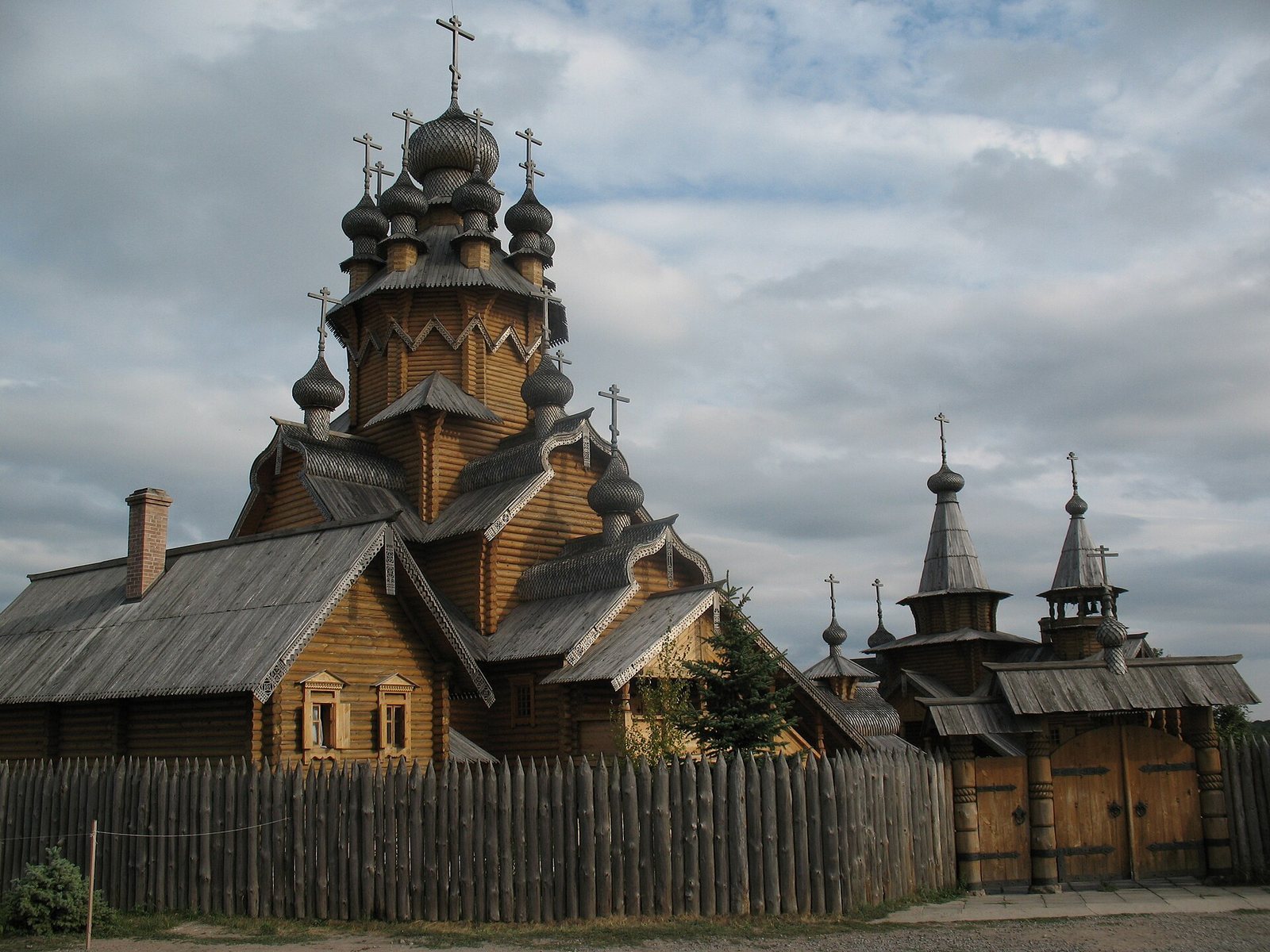
The All Saints Skete was revived with a wooden church, described as a notable example of wooden architecture; its main church burned during the 2022 shelling. Other affiliated settlements include the women’s Bogorodichne Skete in Bogorodichne, the St George Skete in Dolyna, and the St John of Shanghai Skete in Adamivka, at the site of the Maximovich family home where the saint was born. The St Nicholas–Theodosius Skete has a church dating to 1870, with a side altar to St Theodosius, Archbishop of Chernihiv. The Karmazinovsky Skete is in Karmazinivka, in the Luhansk region. The church of the icon Joy of All Who Sorrow at Bogorodichne was destroyed in 2022; the St George Skete at Dolyna was destroyed, and the St John of Shanghai Skete at Adamivka was damaged.
Former monastery churches included the Peter and Paul Church; the Transfiguration Church, whose lower church was dedicated to the Kazan Icon; and the Nativity of the Virgin Church at the refectory. The Akhtyrka Church served the hospital skete, while the Arseniev Skete had a church dedicated to St Arseniy the Great and the Spasov Skete had the Church of Christ the Savior.
Sacred objects and commemorative features
The monastery’s associated sacred objects include the Sviatohirsk Icon of the Virgin and the relics of John the Recluse of Sviatohirsk. The complex also includes a canopy over an altar, known as a ciborium, and other monastic buildings such as a poultry house. Commemorative coins issued by the National Bank of Ukraine in 2005 depict the monastery beside the river and wooded chalk hills; their reverse shows the Sviatohirsk Icon with two angels holding gifts.