Strzelce Dolne Stronghold: An Early Medieval Piast Settlement in Poland
Site at a Glance
- Rating
- 4.6
- Popularity
- Very Low
- Country
- Poland
- Primary era
- Medieval
- Eras represented
- Medieval
- Civilizations
- Unclassified
- Site type
- Military
- Remains
- Fort
On this page8 sections
History
Piast expansion and settlement
Strzelce Dolne is an early medieval fortified settlement in Poland, near Bydgoszcz, built by the Piasts after 950. The Piasts were the ruling dynasty that established and governed the early Polish state. Occupation probably began between the second half of the tenth century and the first half of the eleventh century, during the expansion of the Polans toward Eastern Pomerania.
The stronghold belonged to a larger settlement complex that included several nearby open rural settlements, including one at Gądecz, as well as a cemetery. During the tenth century, this was the largest settlement complex in the area of present-day Bydgoszcz. Its economy was based mainly on agriculture, with cereal seeds and domestic-animal remains indicating the importance of cultivation and animal husbandry. Hunting and fishing contributed less to subsistence. Iron, bone, antler, clay, and stone tools and ornaments point to several crafts and to exchange beyond the immediate settlement.
Destruction and archaeological investigation
The stronghold was probably destroyed and abandoned during Bolesław III Wrymouth’s Pomeranian campaign of 1113 to 1116. Bolesław III was a Piast ruler of Poland whose reign included military campaigns in Pomerania. Strzelce Dolne was not rebuilt after its destruction.
Excavations carried out from 1964 to 1970 produced complete cross-sections along the site’s east-west and north-south axes, together with a trench in the southern part. The investigations identified permanent fortifications and other cultural remains, and they allowed the construction of the rampart to be reconstructed despite severe agricultural damage to the upper cultural layers and surviving rampart material.
Remains
Setting and defenses
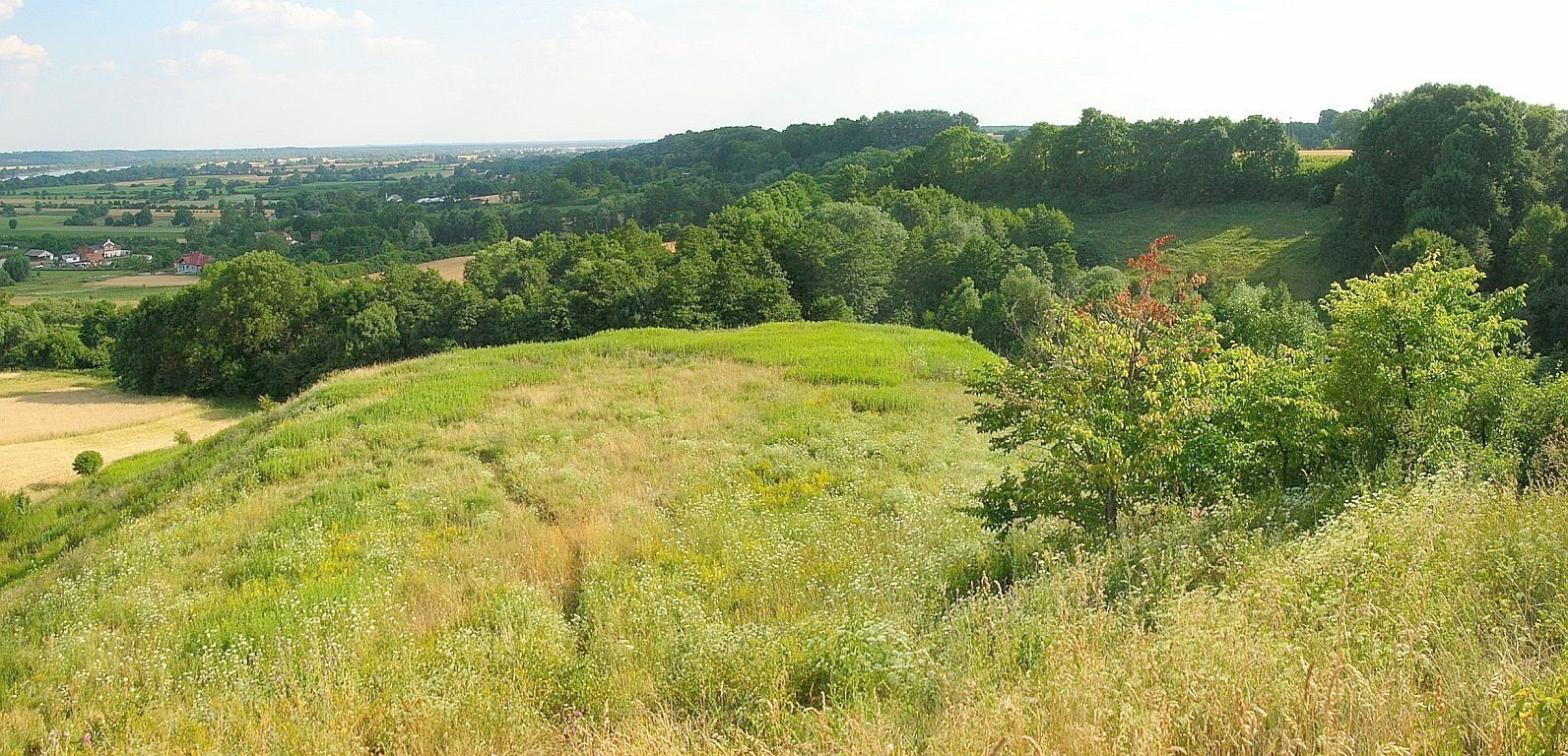
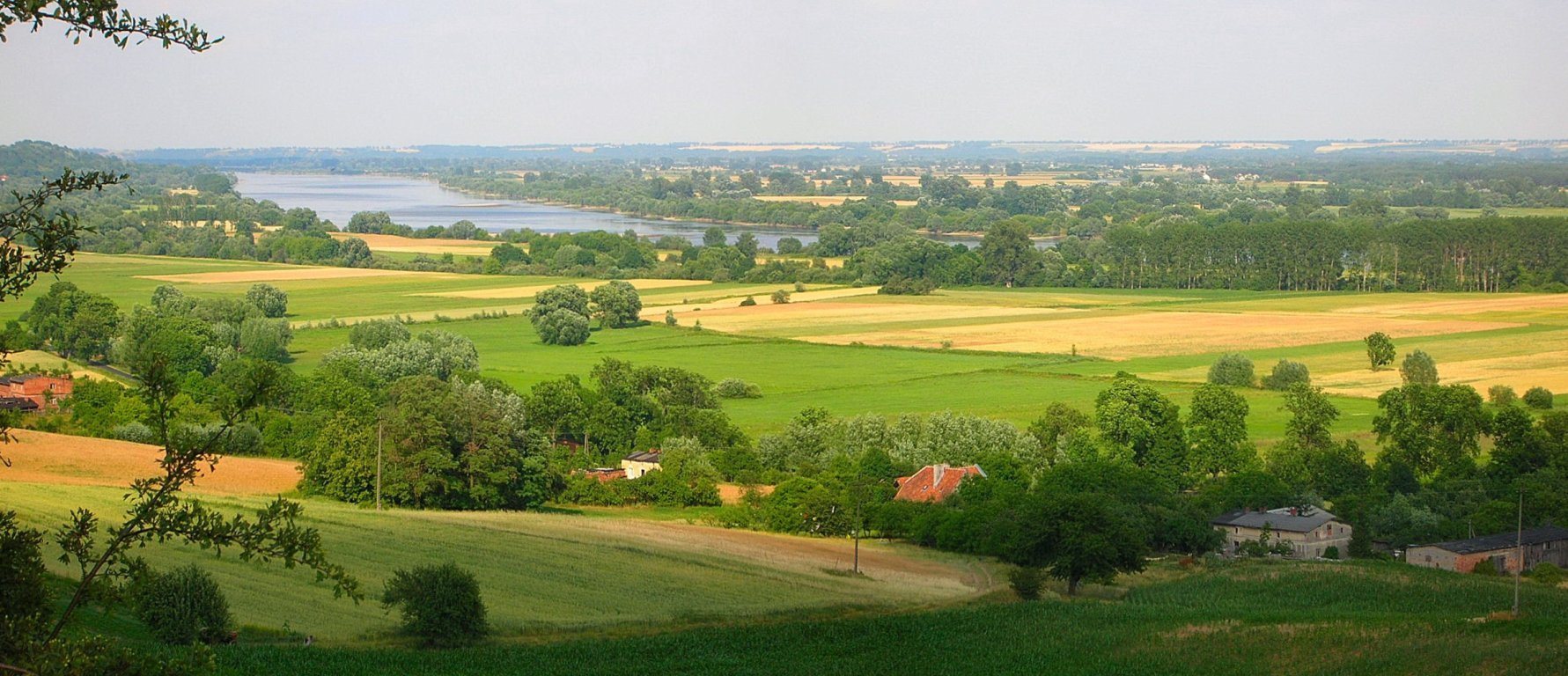
Strzelce Dolne occupies an exposed moraine promontory on the western slope of the Lower Vistula Valley, 96 metres above sea level. The Strzelce ravine borders the southern side, while the Vistula Valley extends to the east. At this point the valley is approximately 3 kilometres wide. A hill with steep slopes rises 8 metres above the level of the inner courtyard and is probably a later feature. A flat terrace extends at the foot of the site on the southern side.
Moat and ramparts
A dry moat surrounds the stronghold. Near the upper edge of the hill, it is cut into the slope in terraces. On the southern side, the moat formed an almost vertical clay face about 3.5 metres high in front of the above-ground rampart structures.
Two phases of rampart rebuilding were identified. In the earlier settlement phase, the rampart occupied a strip about 6 metres wide. Its earthen core was strengthened by a loose internal structure. A partly disturbed group of beams found in 1967 indicates a box-frame rampart, a defensive embankment reinforced with timber compartments filled with earth or other material.
Dwelling against the rampart
A semi-subterranean dwelling stood against the inner side of the rampart. Comparisons with other strongholds suggest that similar houses may have formed a continuous row around the rampart, with their fronts facing the open inner courtyard.
Objects and evidence of exchange
Excavations recovered several thousand clay vessels and 157 objects made from iron, bone, antler, and stone. The objects include eleventh- or twelfth-century arrowheads, knives, a whetstone, antler combs, bone awls and needles, and parts of horse harnesses. Together, these finds reflect domestic activity, craftwork, equipment, and the use of animals within the settlement.
The cultural layers also contained a silver Arab dirham and a group of cut silver coins and silver ornaments. A dirham is a silver coin of Islamic origin that circulated through eastern and northern Europe in early medieval long-distance trade. Arab coins dating from the first half of the tenth century form one of the largest collections of such finds discovered in Eastern Pomerania.