Spiro Mounds: A Caddoan Mississippian Political and Ceremonial Center
Site at a Glance
- Rating
- 4.2
- Popularity
- Medium
- Country
- United States
- Primary era
- Medieval
- External website
- Open
- Eras represented
- Medieval
- Civilizations
- Mississippian
- Site type
- City
On this page10 sections
History
Spiro Mounds is an archaeological site in Oklahoma, United States, where an Arkansas Valley Caddoan settlement became a major political and religious center around AD 800. Its builders belonged to the Mississippian tradition, a pre-contact Indigenous cultural development associated with maize farming, regional centers, earthen mounds, and long-distance exchange. Human activity at the site extends back at least 8,000 years, while its main settlement remained in use until about 1450.
A regional center and exchange network
Spiro served as a regional political headquarters and was one of four major centers of the Caddoan Mississippian world, alongside Cahokia, Moundville, and Etowah. It was the westernmost major outpost of Mississippian culture and took part in the Southeastern Ceremonial Complex, a network of centers connected by shared ritual imagery, beliefs, objects, and practices. Spiro’s cultural influence reached its height during the thirteenth and fourteenth centuries.
Maize cultivation supported food surpluses and larger, more settled populations. Spiro also connected western regions with Mississippian centers farther east. Exchange brought colored flint from New Mexico, copper from the Great Lakes, shells from the Gulf Coast, and mica from the Carolinas. Spiro apparently was the only center in this network to acquire obsidian from Mexico.
The main settlement belonged to a wider network of communities. More than twenty associated village sites lay within five miles, while linked villages extended as far as about 100 miles from Spiro. The Choates-Holt site, north of Spiro, was among the nearby settlements to which residents moved.
Community, ceremony, and population change
Most of Spiro’s mounds were built during the Harlan Phase. The plaza served religious rites and communal gatherings, including chunkey, a game in which players rolled a stone disk and threw spears toward the place where it stopped. The game carried cultural and political importance. Ceremonies on the mounds focused especially on the deaths and burials of powerful rulers.
Residential construction declined sharply around 1250, as most of the population moved to nearby settlements. Spiro continued to function as a regional ceremonial and burial center until about 1450, and those roles may have become more important after the main settlement dispersed. The mound area was abandoned by about 1450, although nearby communities continued until around 1600.
The reasons for this change remain uncertain. One proposed explanation links less predictable seasonal rainfall during the Little Ice Age, a period of climatic cooling, with a ritual effort to restore the rains. In this interpretation, priests placed valuable objects such as capes, axes, and rare minerals in burial mounds. Other possible causes include pressure on local resources, changes in population or trade routes, and greater reliance on bison that may have favored a more mobile way of life.
Looting, archaeology, and preservation
Commercial looting of Craig Mound began in the 1930s. In 1936, five prospectors formed the Pocola Mining Company and leased the site. They tunneled into the mound and removed thousands of pounds of artifacts. Human remains and fragile materials were discarded, and some delicate objects disintegrated before scholars could study them. Other finds were sold to collectors in the United States and overseas. Some objects later returned to regional museums and the Caddo Nation, but many have not been accounted for.
The looting led the Oklahoma Legislature to pass a law protecting the site and stopping the company’s work. University of Oklahoma archaeologists then excavated parts of Spiro between 1936 and 1941 with support from the Works Progress Administration, a federal work-relief agency established during the Great Depression. Since the late twentieth century, the Oklahoma Historical Society has protected the site. It established the Spiro Mounds Archaeological Center in 1978. Spiro is listed on the National Register of Historic Places and is preserved as Oklahoma’s only Archaeological State Park.
The Caddo Nation of Oklahoma and the Wichita and Affiliated Tribes, including the Wichita, Keechi, Waco, and Tawakonie, are recognized as cultural descendants of the builders under the Native American Graves Protection and Repatriation Act, a federal law addressing Native American ancestral remains and cultural items, including their return.
Remains
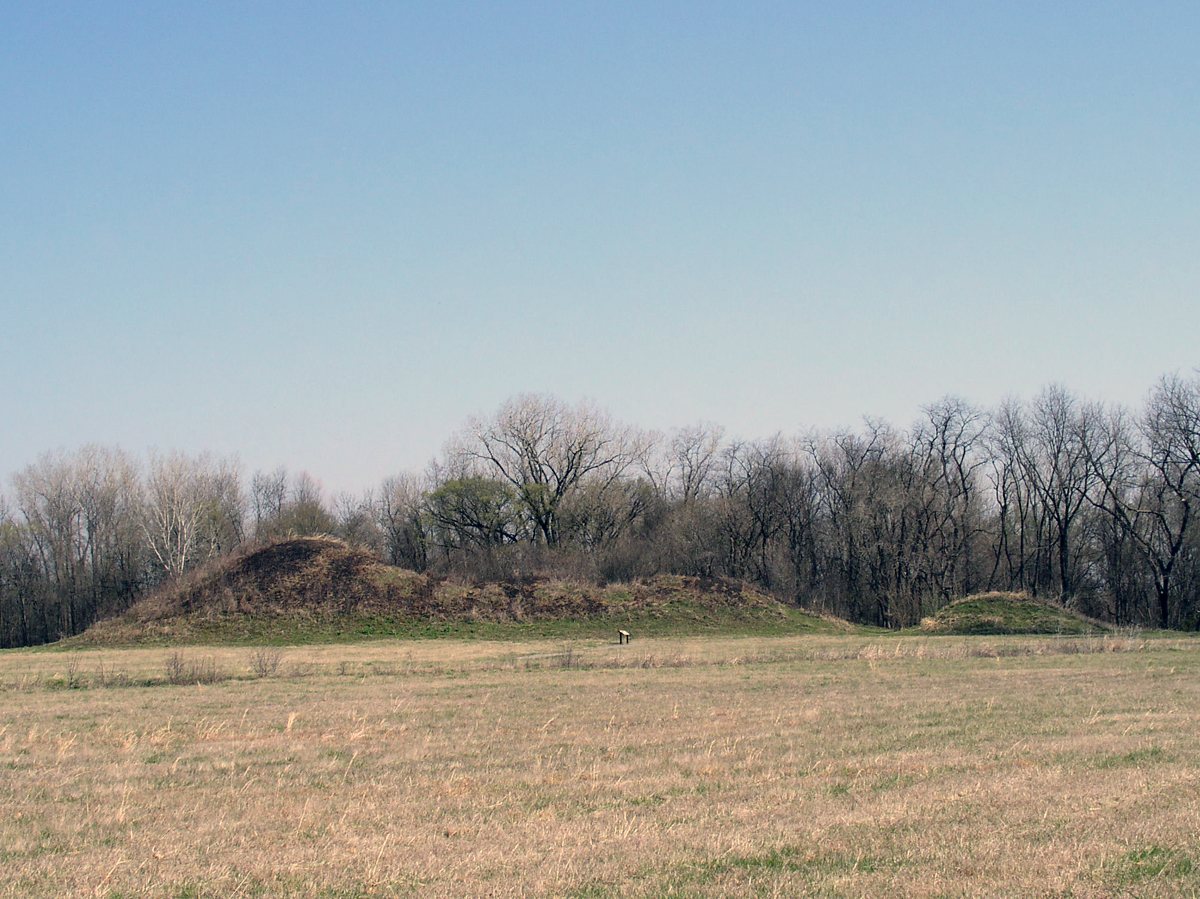
The site covers about 150 acres on the floodplain along the south bank of the Arkansas River in Le Flore County, roughly seven miles north of the town of Spiro. Its mound group occupies about 80 acres. The twelve earthen mounds were formed by laying down successive basketloads of soil. Eleven are platform mounds, earthen structures with flattened tops for buildings or other activities, and one is a burial mound. The platform group includes nine house mounds and two temple mounds.
Platform mounds and plaza
A central group of nine mounds surrounds a leveled oval plaza, with a village bordering the open space. The arrangement brings the settlement’s principal earthen structures and communal area together within the mound group.
Brown Mound
Brown Mound, the largest platform mound, stands on the eastern side of the plaza. An earthen ramp on its north side led to the summit.
Craig Mound
Craig Mound, also known as Spiro Mound, is the second-largest mound and the site’s burial mound. It lies about 1,500 feet (460 metres) southeast of the plaza. Elite burials were placed there between about 950 and 1450.
Timber burial chamber
A hollow chamber within the mound measured about 10 feet (3 metres) high and 15 feet (4.6 metres) wide. It appears to have begun as a burial structure for Spiro’s rulers. A circle of cedar or cedar-elm posts, set into the ground and angled together at the top, formed a cone-shaped space that was covered with layers of earth. Minerals moving through the mound may have hardened the wooden walls, helping to protect the chamber’s contents from decay and direct contact with soil. Looters broke into the chamber, and it was later dynamited.
Burial objects and ceremonial art
The chamber’s conditions preserved objects made from wood, conch shell, copper, basketry, plant and animal fibers, lace, fur, and feathers, along with human remains and burial goods. Finds included stone effigy pipes, shaped as figures or images; polished stone maces and chunkey stones; flint knives and arrow points; copper axes and plates; mica cutouts; pearl-bead necklaces; and copper and stone ear ornaments. Other objects included shell-inlaid wood carvings, burial pottery, urns, cups, ceremonial swords, armor, and a copper box containing surgical instruments.
Named pipe finds include the Resting Warrior, the Lucifer pipe, and the Grizzly Man, also called the Kneeling Rattler. Some pipes were made from Missouri flint clay, and material analysis indicates that some came from Cahokia. Other stone objects included two ceremonial jasper forms worked on both faces, one similar object made of Mill Creek chert, and a ceremonial mace carved from a single piece of flint. A green obsidian scraper came from Pachuca, Mexico.
Engraved conch-shell ornaments and drinking cups bear figures of costumed people, real and mythical animals, and geometric patterns. Some show ceremonies, and one cup carries images of raptor heads. A conch-shell cup with black residue may have been used in a form of the Black Drink Ceremony, a purification rite involving a drink made from yaupon holly among Southeastern Indigenous peoples in historic times. The residue suggests this possibility but does not establish the cup’s use.
Spiro’s ceremonial imagery includes the Birdman, a winged human figure interpreted as a warrior or chunkey player, and the Great Serpent, shown with a serpent’s body and wings or horns. The Great Serpent was associated with the Under World. Cedar-tree and striped central-pole designs have been interpreted as links among the Upper World, the human realm, and the Under World. The chamber’s cedar posts may have carried related spiritual meaning, though that interpretation is uncertain.
Four styles have been distinguished among Spiro’s artifacts: the Braden Style, associated with objects brought from Cahokia, and the locally derived Craig A, Craig B, and Craig C styles.