Shrine of Bahauddin Zakariya: A 13th-Century Sufi Mausoleum in Multan
Site at a Glance
- Rating
- 4.7
- Popularity
- Low
- Country
- Pakistan
- Primary era
- Medieval
- Eras represented
- Medieval, Early Modern, Modern
- Civilizations
- Delhi Sultanate, Durrani
- Site type
- Religious
- Remains
- Tomb
On this page11 sections
History
The Shrine of Bahauddin Zakariya is a 13th-century Sufi shrine in Multan, Pakistan, dedicated to Bahauddin Zakariya, a Muslim mystic of the Suhrawardiyya order. Built in 1262 during his lifetime, it became an important center of religious life in the Punjab and a model for Multan’s classical architectural tradition.
Foundation and spiritual territory
Bahauddin Zakariya was associated with the Suhrawardiyya, an organized Sufi tradition emphasizing disciplined spiritual training and guidance through a religious lineage. He personally financed the shrine’s construction, an unusual display of financial independence for a dervish. He died in 1268 and was buried at the site.
By the 13th century, many Muslims believed that the spiritual power of major Sufi saints remained connected to their burial places. In Punjab, smaller shrines linked to a principal shrine formed a wilayat, or spiritual territory. Multan served as the center of Bahauddin Zakariya’s wilayat, which was regarded as bordering the spiritual territory associated with Baba Farid, the Punjabi Sufi saint of Pakpattan.
Political and military history
After Dara Shikoh, a Mughal prince who contested power with his brother Aurangzeb, was defeated at the Battle of Samugarh in 1658, he gave 25,000 rupees to the shrine. The donation was an unsuccessful attempt to secure the loyalty of Multan’s inhabitants.
The shrine was also drawn into the Siege of Multan in 1848, a conflict in which British forces fought Sikh forces for control of the city. Makhdoom Mahmud, the shrine’s hereditary caretaker, assisted the British. Cannon fire damaged the dome and part of the upper tier, although both were repaired soon afterward.
Religious and hereditary custodianship
The shrine remains an important center for followers of the Barelvi tradition, a Sunni movement that supports forms of devotion associated with Sufi shrines. Deobandi Muslims, another Sunni movement with different views of shrine devotion and related rituals, have strongly criticized or avoided the site.
Its hereditary caretakers are known as sajjada nashin, a term for the hereditary custodian of a Sufi shrine. They claim descent from Bahauddin Zakariya and have sometimes exercised political influence. Shah Mehmood Qureshi, a member of the Pakistan Tehreek-e-Insaf party and a prominent figure in Pakistan’s Saraiki region, served as sajjada nashin before being removed in 2014 after devotees objected to the alleged use of the shrine to consolidate political power.
Nighttime worship includes qawwali, a devotional musical tradition associated particularly with South Asian Sufism, and trance-like dancing after the evening prayer. Devotees also practice mannat, a devotional vow or prayer in which a symbolic act or promised offering accompanies a request for divine or saintly intercession. Threads tied throughout the shrine serve as tokens of these prayers. A popular belief holds that the shrine protects boatmen on the Indus and Chenab rivers.
Remains
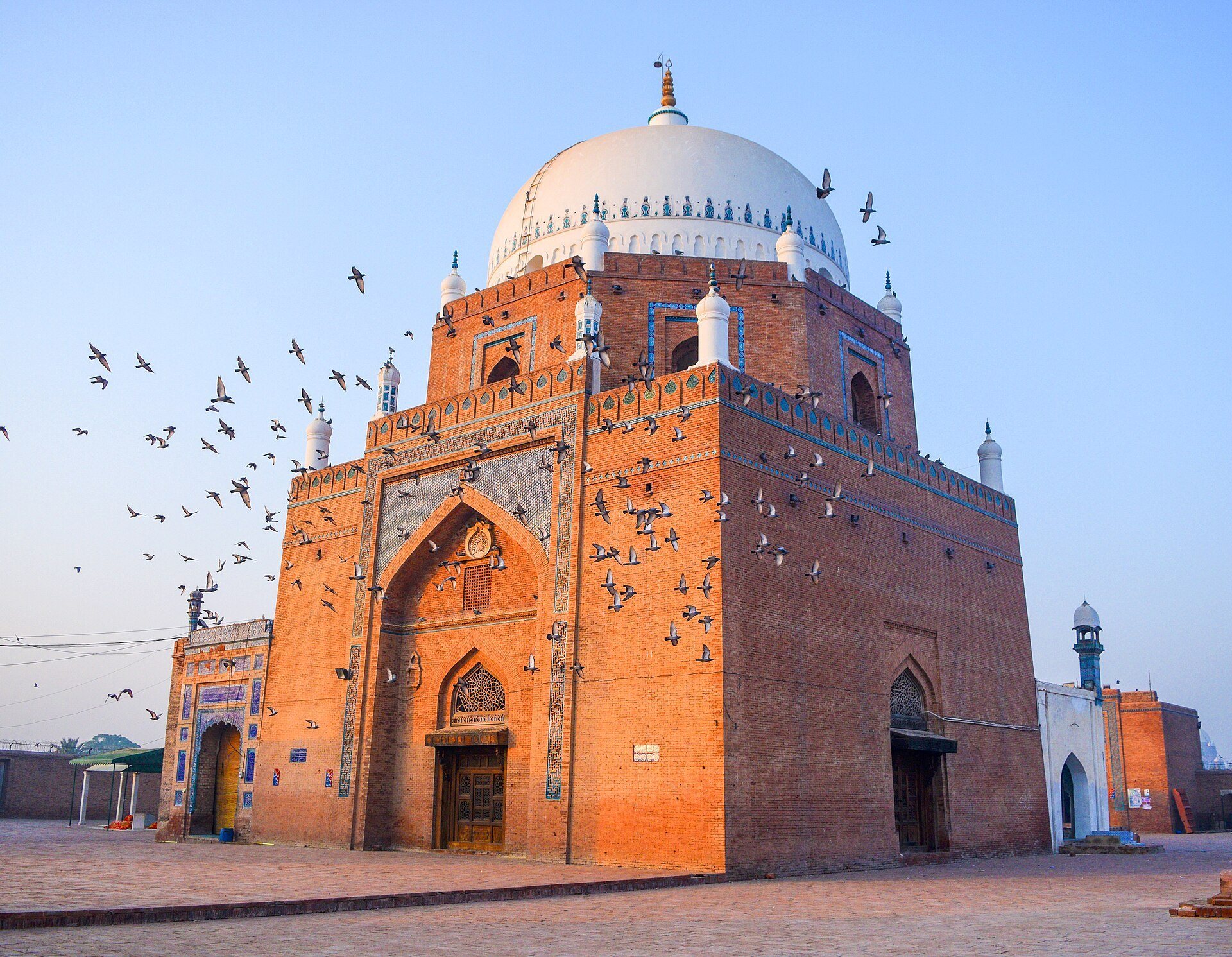
The funerary and ritual complex is centered on a two-tiered brick mausoleum, with a square lower section, an octagonal upper tier, and a white hemispherical dome. A large courtyard surrounds it, while secondary graves, a verandah, an inner sanctum, and an associated mosque extend the physical setting of the shrine beside the ruins of the ancient Prahladpuri Temple. The complex stands immediately north of Multan’s old walled city.
Mausoleum and courtyard
Mausoleum
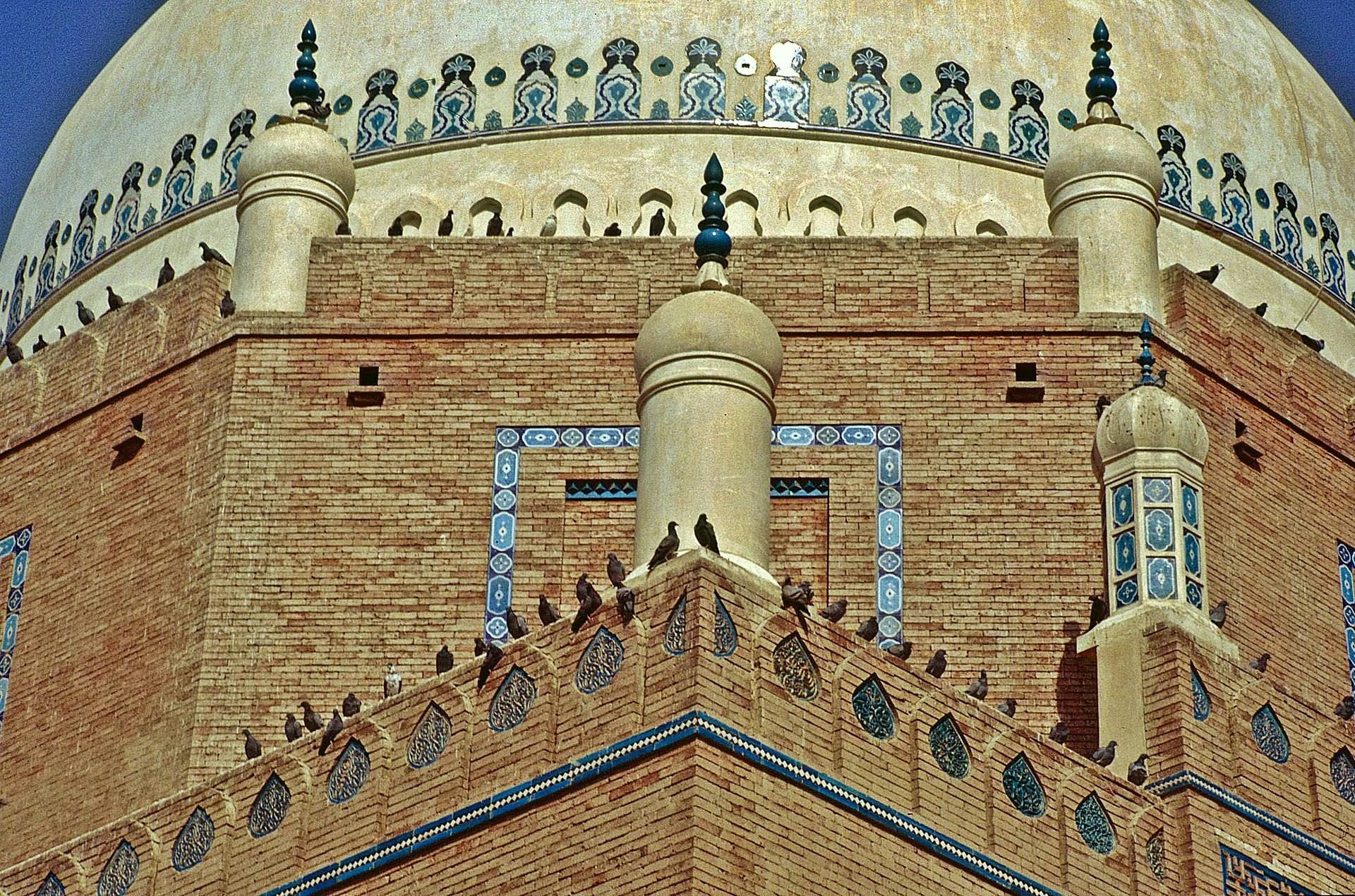
The mausoleum’s square base measures approximately 51 feet 9 inches, or 15.77 metres, on each side. An octagonal tier rises above the square section to roughly half its height and supports the white hemispherical dome. Brick forms the principal building material. Glazed blue tiles decorate the structure, placing it among the early buildings to use a treatment that later became characteristic of Multan and southern Punjab. Their use reflects the influence of Central Asian immigrant architects active in the Punjab during the 13th century.
Courtyard and graves
The shrine is enclosed by a vast courtyard covering several hundred square metres. Nawab Ali Mohammad Khan Khakwani, the Durrani governor of Multan, built its enclosing walls in the 18th century. Hundreds of secondary graves belonging to Bahauddin Zakariya’s descendants and devotees surround the mausoleum.
Later additions and associated buildings
Verandah and inner sanctum
A spacious brick verandah with a painted wooden ceiling was added in 1952. Large wooden doors connect the verandah with the shrine’s inner sanctum, the central sacred chamber containing the tomb.
Associated mosque
A small mosque forms part of the complex beside the ruins of the ancient Prahladpuri Temple. Together with the courtyard, graves, verandah, mausoleum, and inner sanctum, it contributes to the shrine’s combined funerary and ritual character.