Schloss Lebenberg, Kitzbühel: A Medieval Hilltop Castle and Hotel


Site at a Glance
- Rating
- 4.6
- Popularity
- Medium
- Country
- Austria
- Primary era
- Modern
- External website
- Open
- Eras represented
- Medieval, Early Modern, Modern
- Civilizations
- Holy Roman Empire
- Site type
- Domestic
- Remains
- Castle
On this page7 sections
History
Schloss Lebenberg, Kitzbühel, is a medieval stone castle in Austria, built on the spur of Lebenberg above the town. Although its exact foundation date remains disputed, a stone fortress stood here by the thirteenth century, when the surrounding territory belonged to the Diocese of Bamberg, a Catholic ecclesiastical jurisdiction whose authority extended beyond Bamberg itself. Knights of the von Oxenberg family served as castellans, officials responsible for administering and defending the castle for its owner or territorial lord.
From Pfaffenberg to Lebenberg
The hill was originally known as Pfaffenberg. By the fifteenth century it had taken the name Lebenberg, which was later applied to the fortifications built there. In 1446, the Reichertsheim family of Wagrain acquired the castle and commissioned a stone residential tower halfway up the hill. The complex appears under the name Lebenberg from 1500 onward.
During the Renaissance, the castle changed hands several times through sales and the extinction of noble families rather than through military conquest. The Vinsterwalder family owned it from 1531 to 1545, followed by the Jänisch family until 1551. Matthäus Lang von Wellenburg and his descendants held it until 1559, while the Ungnad family remained associated with the property until 1601. Owners commonly added “von Lebenberg” to their surnames or adopted the castle’s name.
The Lamberg ownership
In 1693, Cardinal Johann Philipp von Lamberg acquired the neighboring lordships of Lebenberg, Münichau, and Kapsbrunn. A cardinal is a senior dignitary of the Catholic Church. This acquisition greatly expanded the family’s territorial holdings and income, and Schloss Lebenberg remained in the possession of the von Lamberg family until the 1930s.
From castle residence to hotel
Between 1885 and 1888, Count Hugo Anton Emil von Lamberg established one of Kitzbühel’s first guesthouses in the castle. He initially leased apartments to English visitors attracted by winter sports. The castle and its guesthouse subsequently began to appear in Austrian travel guides, adding a new role to the site’s long history as a fortified residence.
The Counts von Schlick owned Schloss Lebenberg from 1930 to 1961. They carried out a large, phased reconstruction, first operating the property as a convalescent and holiday home. From 1950, they rebuilt it entirely for use as a hotel. The resort business stopped during the Second World War, although military operations did not damage the castle.
Schloss Lebenberg now operates as a hotel and belongs to the Harisch Hotels group. In 2006, the hotel gave its name to Lebenberg Kitzbühel, a Catholic non-dueling secondary-school student association, meaning a student fraternity that does not practice academic fencing or dueling. The castle remains privately owned and has been restored.
Remains
Castle layout and exterior
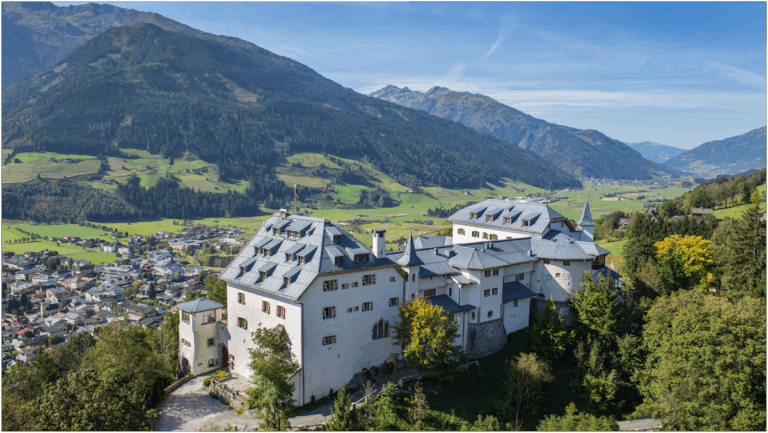
Schloss Lebenberg occupies an approximately 80-metre-high spur of Lebenberg about one kilometre from central Kitzbühel. The hilltop complex is arranged around a three-storey rectangular main building, whose ends are flanked by two four-storey square towers. A circular stair tower projects from the centre of the main building. Plastered and painted white, the buildings are covered by high roofs.
Repeated reconstructions have substantially changed the castle’s appearance, and almost none of the small medieval castle’s original walls survives. The stone residential and defensive tower erected halfway up the hill by the Reichertsheim family in 1446 forms part of the site’s surviving architectural history. Above the main entrance, the von Oxenberg family’s coat of arms is carved with the date 1433.
Historic interiors and later surroundings
Most rooms in the historic castle are now used as hotel rooms. Their interiors have been rebuilt repeatedly over the past 150 years, leaving little of the earlier halls and rooms. Several early-seventeenth-century Renaissance doors with carved fittings survive, together with a beam ceiling in a first-floor room.
The historic castle stands immediately beside a much larger modern ski-hotel complex that also bears the name Lebenberg. This later building forms a separate part of the present architectural setting, while the restored historic complex continues to serve as a hotel.