Sankore Madrasah: A Mosque and Centre of Learning in Timbuktu
Site at a Glance
- Rating
- 4.4
- Popularity
- Very Low
- Country
- Mali
- Primary era
- Early Modern
- Eras represented
- Medieval, Early Modern
- Civilizations
- Mali Empire, Songhai Empire
- Site type
- Religious
- Remains
- Madrasa
On this page14 sections
History
Sankore Madrasah is a mosque and Islamic centre of learning in Timbuktu, Mali, built in the Sudano-Sahelian tradition of earthen construction and timber elements. Founded in the fourteenth or early fifteenth century, it became one of Timbuktu’s three medieval mosques and scholarly centres, alongside Djinguereber Mosque and Sidi Yahya Mosque.
Foundation and the Rise of Timbuktu
The mosque was established with financial support from a Tuareg woman of the Aghlal tribe. It stood in the Sankore quarter, which was historically inhabited mainly by Berbers and Arabs. The name Sankore has been interpreted in Songhai as “white masters” or “white nobles,” referring to light-skinned Sanhaja Berbers. Other interpretations understand it as “neighborhood of the nobles” or “neighborhood of the lords.”
Timbuktu grew as a commercial centre during the fourteenth century, when Walata declined as the region’s main trans-Saharan trading hub. About a century later, the Aqit clan of the Massufa migrated to the city and strengthened its scholarly culture, particularly through the study of Islamic law. Sankore received repeated patronage and renovation under the Mali and Songhai empires as Timbuktu expanded its religious and intellectual influence.
Songhai Patronage and Scholarly Expansion
Sankore flourished especially under the Askia dynasty, the ruling house of the Songhai Empire from 1493 to 1591. During this period, it served as Timbuktu’s principal centre of teaching. Its golden age came in the sixteenth century under Askia Muhammad, when scholars from as far away as Egypt and Syria were drawn to Timbuktu. Songhai rulers presented respected scholars with gifts during Ramadan, while scholars maintained wider connections through pilgrimage to Mecca and teaching in other centres.
The mosque’s scholars accumulated books from across the Muslim world, making Sankore both a place of worship and a centre of study. The name “University of Sankore” is useful as a description of its scholarly importance, but the institution operated through a community of independent scholars and their private students rather than through the centralized administration associated with a modern university. Teachers, known as sheikhs or ulama, taught their own students in the mosque or in their homes.
Students often remained with one teacher for as long as ten years in an apprenticeship-like relationship, while others studied with several teachers at different madrasas. Tuition was paid with money or through barter. In the sixteenth century, Timbuktu contained approximately 150 to 180 Quranic schools and an estimated 4,000 to 9,000 pupils. Around 200 to 300 students from wealthy families continued to advanced study and became ulama, including jurists, historians, and theologians.
Curriculum and Intellectual Life
Instruction centred on the Quran, and scholarly arguments were expected to have Quranic support. Students studied Arabic grammar, the Quran, hadith, jurisprudence, spiritual purification, mathematics, astronomy, history, geography, physics, chemistry, trade, and business ethics. Education followed four levels. The primary stage required Arabic literacy and complete memorization of the Quran. The secondary stage combined grammar, sciences, Islamic learning, and introductory commercial ethics. Advanced study involved specialist teachers, research, and philosophical or religious debate, while the highest level prepared scholars to serve as judges or professors. Students traditionally received a turban after completing each level.
Senior scholars advised regional rulers on legal and religious questions, assigned research problems to advanced students, and issued fatwas, formal legal or religious opinions, after considering the results of scholarly discussion. Book production and trade formed another part of Sankore’s intellectual life. Local students copied manuscripts to support themselves, and works produced in Timbuktu circulated into North Africa. Some scholars maintained private libraries containing more than 1,600 manuscripts.
Ahmad Baba and the Moroccan Conquest
Ahmad Baba al-Timbukti, the final chancellor of Sankore Madrasah, wrote more than forty works. Among them was a biographical dictionary of Maliki scholars that became influential throughout the Maghreb. He was among the early citizens of Timbuktu to protest the Moroccan conquest and was later imprisoned and exiled.
In 1591, the invasion of Ahmad al-Mansur of Morocco brought about the fall of the Songhai Empire after the Battle of Tondibi and began a long decline in the region. In 1594, Moroccan troops arrested and deported many Sankore scholars, including Ahmad Baba, while confiscating their manuscript collections. Ahmad Baba’s personal library of approximately 1,600 books was lost in the process.
Modern Preservation
Sankore scholars continued to connect Timbuktu with the wider Muslim world through pilgrimage, study, and teaching. They travelled to Mecca, exchanged knowledge with scholars elsewhere, studied with leading scholars in Cairo, and taught in Kano, Katsina, and Walata. Mohammed Bagayogo received an honorary doctorate in Cairo during his pilgrimage.
Modern urbanization and new construction have placed pressure on the madrasa’s integrity. Flooding and inadequate maintenance have damaged the building, leading to government-funded restoration and the creation of protection committees. The Old Town Management and Conservation Committee has worked with the World Heritage Center on a long-term plan that includes a 500-foot protective buffer and a sustainable urban-development framework. Sankore forms part of the UNESCO World Heritage Site of Timbuktu.
Remains
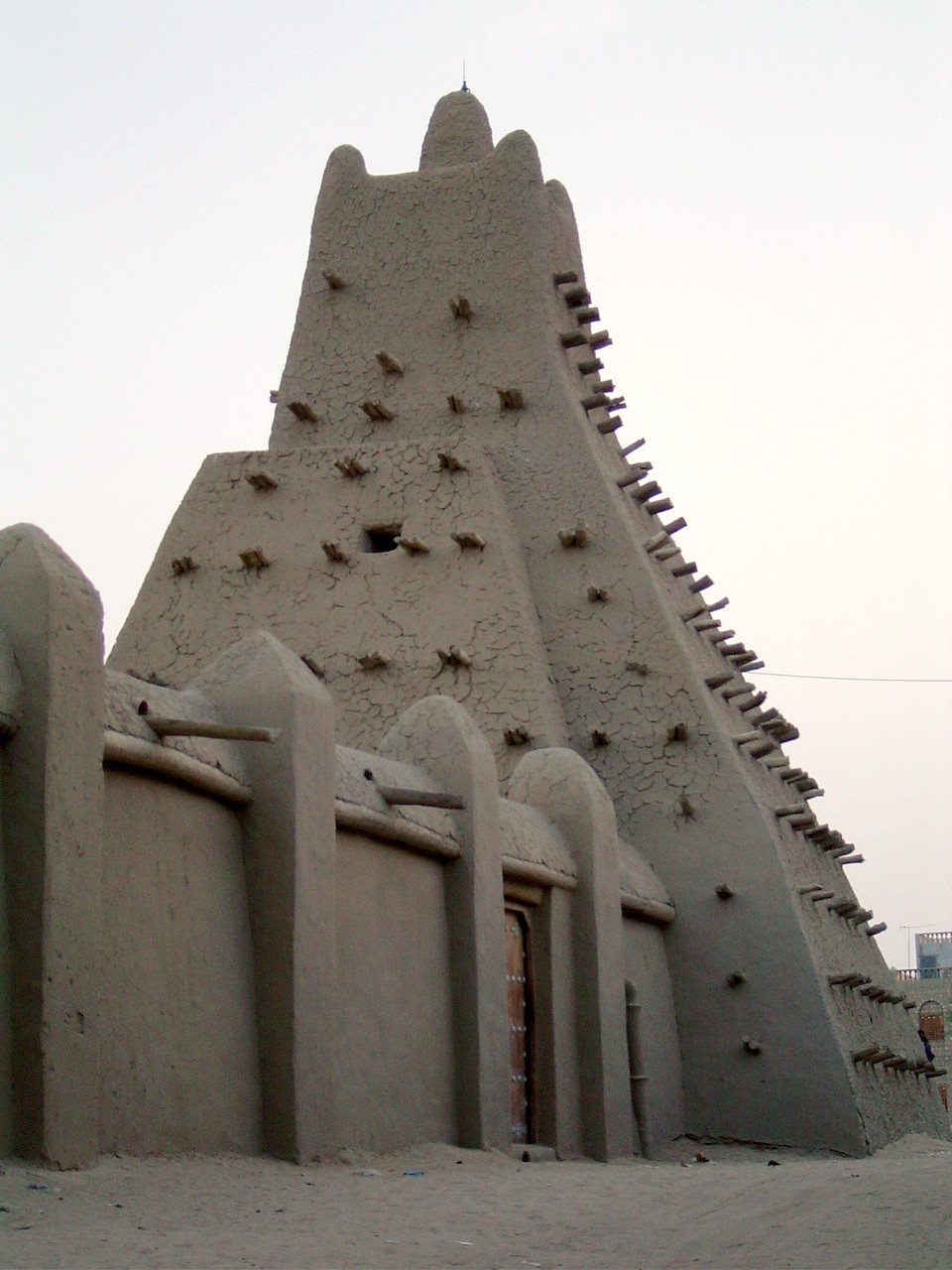
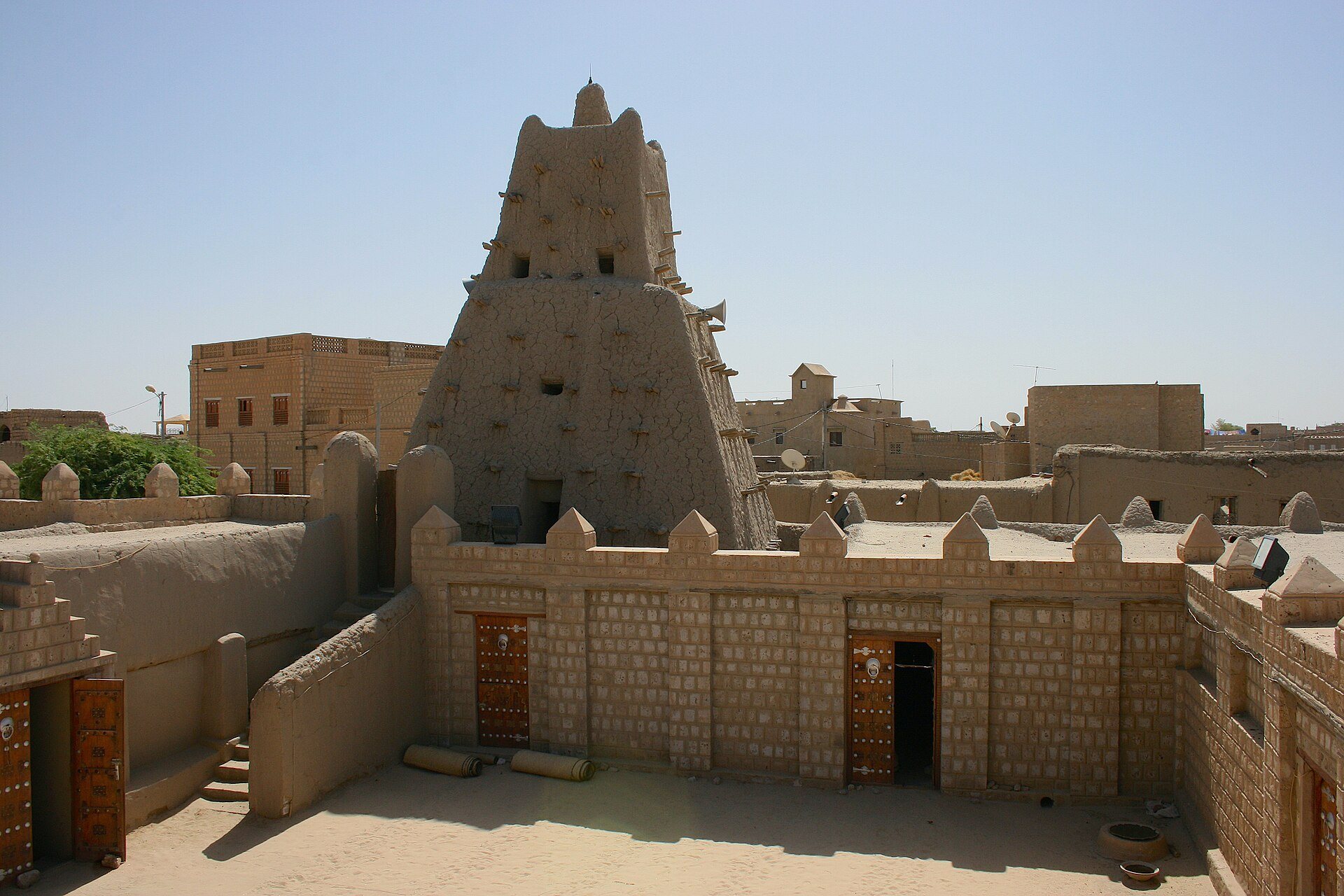
Sankore survives as a square mosque and madrasa built in the Sudano-Sahelian architectural style. Its principal materials are mudbrick, clay, and wooden beams. The complex combines a sanctuary with an open courtyard that served as a teaching space, linking religious use with the scholarly activities that made Sankore one of Timbuktu’s major centres of learning.
Sanctuary and Courtyard
Sanctuary
The sanctuary was demolished and rebuilt between 1578 and 1582 under Imam Al-Aqib ibn Mahmud ibn Umar, Timbuktu’s chief qadi, or judge who applies Islamic law. The rebuilt sanctuary was given dimensions matching the Kaaba in Mecca. This late-sixteenth-century reconstruction formed part of the repeated renovation of Sankore under the Mali and Songhai empires.
Teaching Courtyard
The associated courtyard was reconstructed in the late sixteenth century to the same dimensions as the rebuilt sanctuary. It was constructed entirely from clay and wooden beams and provided space for classes. The courtyard therefore remains closely connected to the madrasa’s educational function, where scholars taught students alongside their religious duties.
Architectural Tradition and Condition
Sudano-Sahelian Construction
Sankore’s form belongs to Saharan mosque traditions and to traditional African architectural and religious practices. Its earthen walls and timber elements reflect the Sudano-Sahelian building tradition. The mosque is smaller and less elaborate than earlier Malian monuments such as the Great Mosque of Djenné. The claim that its form was principally derived from the Andalusian architect al-Sahili is treated as a historical myth rather than the basis for understanding the building’s architecture.
Manuscript Collections
The mosque’s scholarly remains also include the intellectual legacy of the manuscript collections associated with its teachers. Private libraries could contain more than 1,600 manuscripts, while local students copied texts for their livelihood and works produced in Timbuktu travelled to North Africa. These activities help explain the relationship between the surviving mosque, its teaching spaces, and the wider scholarly community that developed around it.
Conservation Challenges
Flooding has damaged the building, and insufficient maintenance has caused further deterioration. The traditional fabric remains vulnerable to physical damage and to urban expansion around the madrasa. Restoration and protection efforts seek to preserve the earthen and timber construction within a broader framework for conserving Timbuktu’s historic town.