San Felipe Castle: A Spanish Harbor Fortress in Venezuela
Site at a Glance
- Rating
- 4.4
- Popularity
- Very Low
- Country
- Venezuela
- Primary era
- Early Modern
- Eras represented
- Early Modern
- Civilizations
- Spanish
- Site type
- Military
- Remains
- Fort
On this page10 sections
History
San Felipe Castle is an eighteenth-century Spanish military fortress in Venezuela, located at Puerto Cabello in Carabobo. Proposed in 1729 and built between 1732 and 1741, it was designed as a star fort, a fortress with projecting angular defenses that allowed overlapping fields of fire. Commissioned by Spain and named for Philip V, the first Bourbon king of Spain, it defended the harbor, the town, and the commercial traffic that passed through Puerto Cabello.
Construction and colonial defense
Lope Carrillo de Andrade Sotomayor y Pimentel, governor of the Province of Venezuela, proposed the fortress. Military engineers Juan de Gayangos Lascari and Juan Amador Courten directed its construction. San Felipe formed part of the coastal defenses of New Granada and completed Puerto Cabello’s defensive system together with Fort Solano, built on the heights above the town in 1766.
Puerto Cabello was one of the principal ports of the Guipuzcoan Company of Caracas, a Spanish-chartered company that held a monopoly over much of the commerce between Venezuela and Spain. The castle therefore protected both a strategic harbor and an important colonial trade route. Its construction took place during persistent rivalry among Spain, France, Britain, and the Dutch Republic over Caribbean commerce, while piracy and repeated attacks threatened Spanish possessions.
Attacks in the eighteenth century
In 1741, the British fleet commanded by Edward Vernon attempted to attack several Spanish positions in the Caribbean, including Puerto Cabello, but the effort failed. During the War of Jenkins’ Ear, an eighteenth-century conflict between Britain and Spain fought largely over trade, smuggling, and maritime power in the Caribbean, Charles Knowles’s squadron attacked Puerto Cabello from 4 April to 13 May 1743.
The 1743 assault included bombardment, troop landings, exchanges of prisoners, and permission for British forces to obtain water at the mouth of the Borburata River. About 900 bombs were fired, with approximately 40 striking the castle. Its walls, barracks, and batteries suffered comparatively limited damage despite the intensity of the attack. Around 30 defenders were killed and 60 wounded, including the castle’s constable.
On the night of 24 to 25 October 1799, boats from the British frigate HMS Surprise attacked the Santa Cecilia, formerly HMS Hermione, after mutineers had delivered the vessel to the Spanish. The castle’s guns did not prevent the British from recapturing the ship. Spanish losses reached 119 dead, while the British suffered no fatalities and about twelve wounded, including Captain Edward Hamilton.
Prisoners and the independence struggle
After Francisco de Miranda’s expedition failed in 1806, royalist forces brought the schooners Bee and Backus to Puerto Cabello. Fifty-eight prisoners were confined in San Felipe Castle. On 21 July, ten of them, most of them Americans, were hanged and dismembered on the castle esplanade. The remaining prisoners stayed in confinement for more than ten years. The executed men have been regarded as the first non-Hispanic martyrs of Spanish American independence.
During Venezuela’s independence war, Francisco Fernández Vinoni revolted in the castle on 30 June 1812 by arming royalist prisoners. Simón Bolívar, the Venezuelan military and political leader known as “El Libertador,” or “The Liberator,” was then commanding Puerto Cabello. The royal flag was raised, and the town was bombarded. The episode contributed to the collapse of Venezuela’s First Republic.
Francisco de Miranda was imprisoned in the castle after the capitulation of 1812 and was later transferred through Puerto Rico to Cádiz. Vicente Salias was executed there on 17 September 1814. Tradition identifies Salias as the author of the lyrics of Venezuela’s national anthem.
The last Spanish stronghold
After the Battle of Carabobo in 1821, the retreating royalist Valencey battalion took refuge in San Felipe Castle. The fortress became the last Spanish stronghold in Venezuelan territory. In 1822, Field Marshal Francisco Tomás Morales assumed supreme command of Puerto Cabello’s fortifications, with Brigadier Sebastián de la Calzada as his second in command.
Morales capitulated to republican forces at Maracaibo on 3 August 1823. Calzada then became the fortress’s final commander and surrendered to José Antonio Páez on 10 November. Páez received assistance from Colonel Fernando Figueredo, who had previously been imprisoned in the fortress and knew its spaces and access routes. Figueredo’s troops approached by swimming at night with swords and knives and captured the castle quickly. Its surrender ended the last Spanish stronghold in Venezuela.
Rebellions and foreign intervention
During the Revolution of the Reforms, rebels led by Blas Bruzual and Pedro Carujo captured Puerto Cabello on 17 December 1835 and placed the port under siege conditions. Government forces captured both leaders on 24 December. After government troops regained control of Maracaibo on 1 January 1836, Castle Libertador surrendered on 1 March, bringing the armed conflict to an end.
During the Federal War, a Spanish squadron commanded by Admiral Casto Méndez Núñez entered Puerto Cabello’s roadstead despite the insurgent blockade and protected foreign lives and property. In 1869, General Venancio Pulgar was imprisoned in the castle after his failed attempt to separate Zulia from Venezuela. He eventually subverted the garrison, which had been the last stronghold opposing the newly established government of Antonio Guzmán Blanco.
In 1902, during the government of Cipriano Castro, San Felipe Castle, Fort Solano, and Puerto Cabello were attacked by the British battleship HMS Charybdis and the German cruiser Vineta because Venezuela had unpaid debts to European powers.
Political prison and modern military use
Under the governments of Cipriano Castro and Juan Vicente Gómez, the castle became a prison for political dissidents. Its prisoners included José Manuel Hernández, José Rafael Pocaterra, Ramón Cecilio Farreras, José Rafael Gabaldón, Biófilo Panclasta, Jóvito Villalba, Pío Tamayo, Juan Pablo Peñaloza, Rómulo Betancourt, Alejandro Colina, Andrés Eloy Blanco, and Nicolás Figueredo Boggio.
Andrés Eloy Blanco wrote the poetic work Barco de piedra during his imprisonment, referring to the fortress’s elongated form and its surrounding sea. Nicolás Figueredo Boggio’s confinement continued a family connection with the castle. His grandfather, Colonel Fernando Figueredo, had been imprisoned there by royalists in 1812 before helping Páez capture the fortress in 1823.
On 2 and 3 June 1962, Puerto Cabello was the scene of the Porteñazo uprising, an armed revolt involving naval-base forces, civilians, and guerrillas against troops loyal to President Rómulo Betancourt. Fighting in the city caused more than 400 deaths and 700 injuries. The last rebel stronghold, Fort Solano, fell three days later after the insurgent leaders had been captured.
San Felipe Castle is now occupied by the Venezuelan Navy within the Agustín Armario naval base. Its military setting restricts public access.
Remains
Fortress and harbor defenses
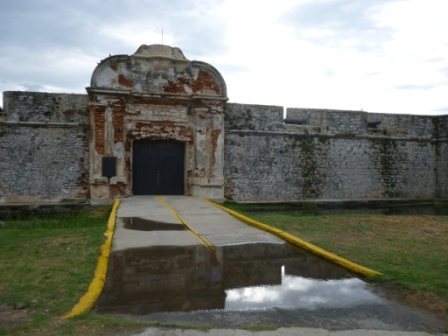
San Felipe Castle is an elongated star fort commanding the entrance to Puerto Cabello’s harbor. Its walls were built from coral stone, and its hull-like shape, surrounded by the sea, gave rise to Andrés Eloy Blanco’s description of it as a “stone ship.” The surviving fortress includes defensive walls, barracks, batteries, and an esplanade, features that supported its changing roles as a harbor-defense installation, military stronghold, naval base, and prison.
The castle’s defensive arrangement formed part of a wider landscape with Fort Solano, constructed in 1766 on the heights above Puerto Cabello. Together, the two fortifications protected the town and harbor. British bombardment in 1743 struck the walls, barracks, and batteries, but the damage to these elements remained comparatively limited in relation to the scale of the attack.
Present military setting
The fortress stands within the Agustín Armario naval base and remains associated with Venezuela’s naval forces. This present military setting shapes the condition in which the castle is encountered and limits public access to its coral-stone defenses, internal buildings, batteries, and esplanade.